
Cancer Res Treat. 2026;58(2):563-572.
Discrepancy between Genetically Predicted and Observed Alcohol Intake and Its Impact on Gastric Cancer Susceptibility.
제1저자 이가은, 신철민 · 교신저자 원성호, 김나영
소속 (10)
- Interdisciplinary Program of Bioinformatics, Seoul National University, Seoul, Korea.
- Department of Internal Medicine, Seoul National University Bundang Hospital, Seongnam, Korea.
- Institute of Health and Environment, Seoul National University, Seoul, Korea.
- Department of Public Health Sciences, Seoul National University, Seoul, Korea.
- Department of Mathematical Data Science, Hanyang University (ERICA), Ansan, Korea.
- Precision Medicine Center, Seoul National University Bundang Hospital, Seongnam, Korea.
- Center for Gastric Cancer, National Cancer Center Hospital, National Cancer Center, Goyang, Korea.
- Department of Epidemiology and Health Promotion, Institute for Health Promotion, Graduate School of Public Health, Yonsei University, Seoul, Korea.
- Department of Internal Medicine and Liver Research Institute, Seoul National University College of Medicine, Seoul, Korea.
- RexSoft Inc., Seoul, Korea.
Abstract
PURPOSE We aimed to investigate how genetic predisposition to drinking and gastric cancer (GC) modifies the association between alcohol consumption and GC risk in the Korean population.
MATERIALS AND METHODS Polygenic risk scores for GC (PRS-GC) and alcohol consumption (PRS-Alcohol) were formulated using genome-wide association results from BioBank Japan. Validation was performed using Korean cohorts (SNUBH-GENIE cohort), incorporating 8,846 controls and 531 patients with GC. Subsequently, these PRSs were applied to an independent Korean cohort of 67,771 participants, including 313 patients with GC during the follow-up for 14 years (KoGES cohort).
RESULTS In KoGES cohort, the influence of alcohol consumption on GC risk was significantly altered by the PRS-GC and exhibited a synergistic interaction effect. PRS-Alcohol itself shows a negative correlation with GC risk. However, when actual alcohol consumption significantly exceeded genetically predicted levels, the risk of alcohol-related GC was notably increased (adjusted hazard ratio, 1.32; 95% confidence interval, 1.01 to 1.72). Heavy drinkers in the high-PRS-GC/low-PRS-Alcohol group had a 2.16 times higher risk of GC than non-to-light drinkers, which was prominent in males.
CONCLUSION Korean drinkers with higher PRS-GC who consume alcohol more than genetically predicted levels are susceptible to GC. PRS-GC and PRS-Alcohol may be beneficial for assessing the impact of alcohol consumption on GC risk in Koreans.
Keywords
Alcohol drinkingGenetic risk scoreLauren classificationSexStomach neoplasms
Figures

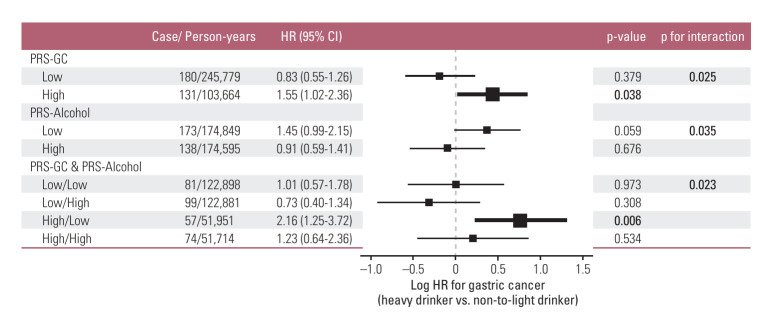

그림 출처: PubMed Central 공개 논문 (PMC13093037)
Conflict of interest statement
Conflict of Interest . Conflict of interest relevant to this article was not reported.
그 밖의 정보
- 출판 형태
- Journal Article
- 저널
- Cancer research and treatment · eISSN 2005-9256
- 전자 출판
- 2025-05-30
- MeSH
- Humans · Stomach Neoplasms* / epidemiology / genetics / etiology · Male · Alcohol Drinking* / adverse effects / epidemiology · Female · Genetic Predisposition to Disease* · Middle Aged · Genome-Wide Association Study · Republic of Korea / epidemiology · Aged · Risk Factors · Adult · Case-Control Studies · Polymorphism, Single Nucleotide
- 연구비
- Seoul National University Bundang Hospital 13-2019-001 · Seoul National University Bundang Hospital 02-2020-041 · Seoul National University Bundang Hospital 02-2023-0012 · National Research Foundation of Korea RS-2024-00337453 · National Research Foundation of Korea RS-2024-00346850 · Ministry of Science and ICT
- 참고문헌
- 35편