
Front Cardiovasc Med. 2021;8:647491.
Associations of Brachial-Ankle Pulse Wave Velocity With Left Ventricular Geometry and Diastolic Function in Untreated Hypertensive Patients.
제1저자 곽순구 · 교신저자 김학령
소속 (2)
- Division of Cardiology, Department of Internal Medicine, Boramae Medical Center, Seoul National University College of Medicine, Seoul, South Korea.
- Seoul National University College of Medicine, Seoul, South Korea.
Abstract
Background: Although brachial-ankle pulse wave velocity (baPWV) is simple and convenient, its usefulness as an initial screening test for hypertensive patients is not well-known. This study aimed to investigate the association of baPWV with left ventricular (LV) geometry and diastolic function in treatment-naive hypertensive patients. Methods: A total of 202 untreated hypertensive patients (mean age, 62 years; males, 51.5%) without documented cardiovascular diseases were prospectively enrolled. Both baPWV and transthoracic echocardiography were performed on the same day before antihypertensive treatment. Results: In multiple linear regression analysis after adjustment for potential confounders, baPWV had significant correlations with structural measurements of LV including relative wall thickness (β = 0.219, P = 0.021) and LV mass index (β = 0.286, P = 0.002), and four diastolic parameters including septal e' velocity (β = -0.199, P = 0.018), E/e' (β = 0.373, P < 0.001), left atrial volume index (β = 0.334, P < 0.001), and maximal velocity of tricuspid regurgitation (β = 0.401, P < 0.001). The baPWV was significantly increased in patients with LV hypertrophy, abnormal LV remodeling, or diastolic dysfunction, compared to those without (P = 0.008, P = 0.035, and P < 0.001, respectively). In the receiver operating characteristic curve analysis, the discriminant ability of baPWV in predicting LV hypertrophy and diastolic dysfunction had an area under the curve of 0.646 (95% confidence interval 0.544-0.703, P = 0.004) and 0.734 (95% confidence interval 0.648-0.800, P < 0.001), respectively. Conclusion: baPWV was associated with parameters of LV remodeling and diastolic function in untreated hypertensive patients. The baPWV could be a useful screening tool for the early detection of adverse cardiac features among untreated hypertensive patients.
Copyright © 2021 Kwak, Kim, In, Lim, Seo, Kim, Zo and Kim.
Keywords
arterial stiffnessdiastolic functionhypertensionleft ventricular remodelingpulse wave velocity
Figures

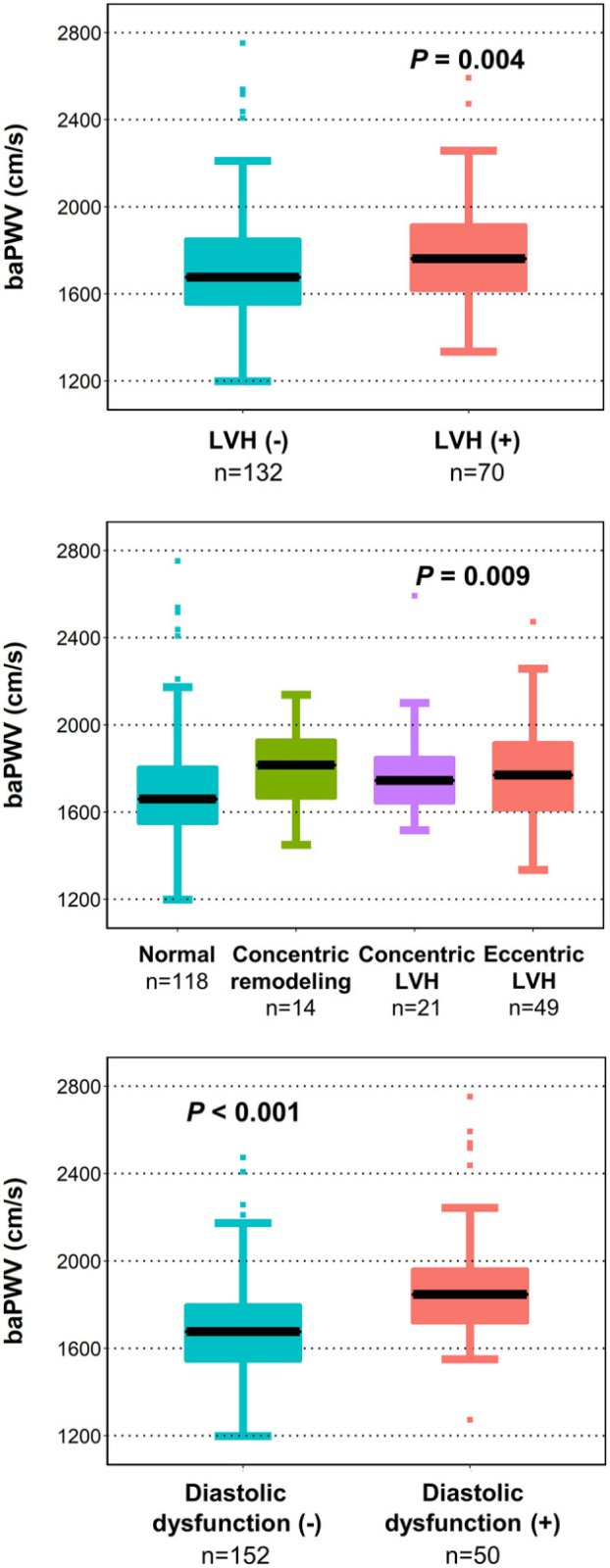
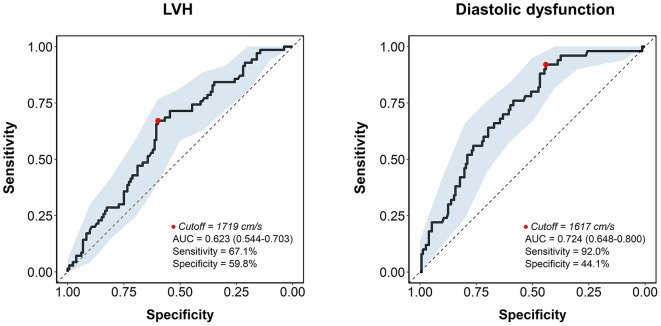
그림 출처: PubMed Central 공개 논문 (PMC8143267)
Conflict of interest statement
The authors declare that the research was conducted in the absence of any commercial or financial relationships that could be construed as a potential conflict of interest.
그 밖의 정보
- 출판 형태
- Journal Article
- 저널
- Frontiers in cardiovascular medicine · ISSN 2297-055X
- 전자 출판
- 2021-05-10
- 참고문헌
- 44편