SCI 발표논문

SCI 발표논문

← SCI 발표논문 목록

Gastric Cancer. 2022;25(3):573-585.

rs2671655 single nucleotide polymorphism modulates the risk for gastric cancer in Helicobacter pylori-infected individuals: a genome-wide association study in the Korean population.

, , , , , , , , ,

제1저자 신철민,박경택 · 교신저자 김나영

소속 (8)
  1. Department of Internal Medicine, Seoul National University Bundang Hospital,, 173-82, Gumi-ro, Bundang-gu, Seongnam, Gyeonggi-do, 13620, South Korea.
  2. Interdisciplinary Program of Bioinformatics, Seoul National University, Seoul, Korea.
  3. Department of Internal Medicine, Seoul National University Bundang Hospital,, 173-82, Gumi-ro, Bundang-gu, Seongnam, Gyeonggi-do, 13620, South Korea. nayoungkim49@empal.com.
  4. Department of Internal Medicine and Liver Research Institute, Seoul National University College of Medicine, Seoul, South Korea. nayoungkim49@empal.com.
  5. Department of Public Health Sciences, Seoul National University, Seoul, South Korea.
  6. Department of Pathology, Seoul National University Bundang Hospital, Seongnam, South Korea.
  7. Department of Internal Medicine and Liver Research Institute, Seoul National University College of Medicine, Seoul, South Korea.
  8. Department of Internal Medicine and Healthcare Research Institute, Healthcare System Gangnam Center, Seoul National University Hospital, Seoul, Korea.

Abstract

OBJECTIVE To identify genetic variations which is associated with gastric cancer (GC) risk according to Helicobacter pylori infection.

METHODS This study incorporated 527 GC patients and 441 controls from a cohort at Seoul National University Bundang Hospital. The associations between GC risk and single nucleotide polymorphisms were calculated, stratified by H. pylori status, adjusting for age, sex, and smoking. mRNA expression from non-cancerous gastric mucosae was evaluated using reverse transcription quantitative polymerase chain reaction.

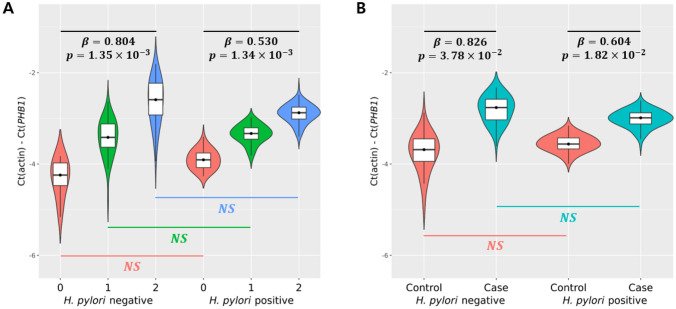
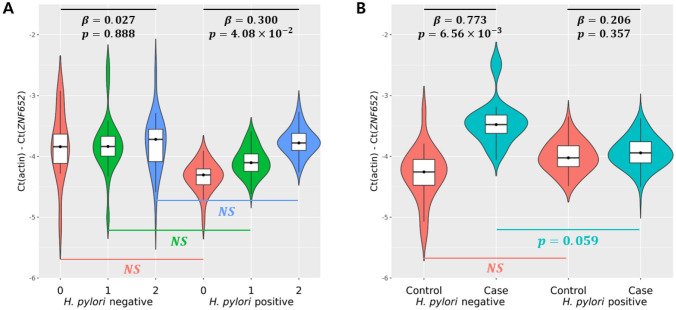
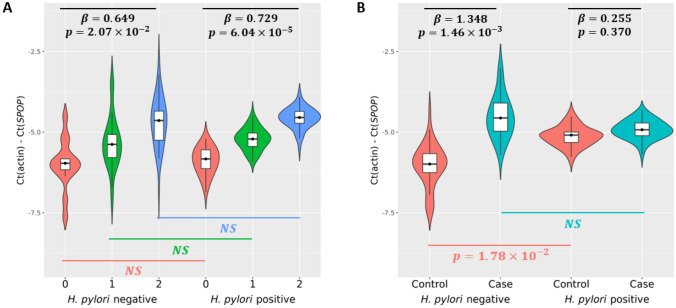
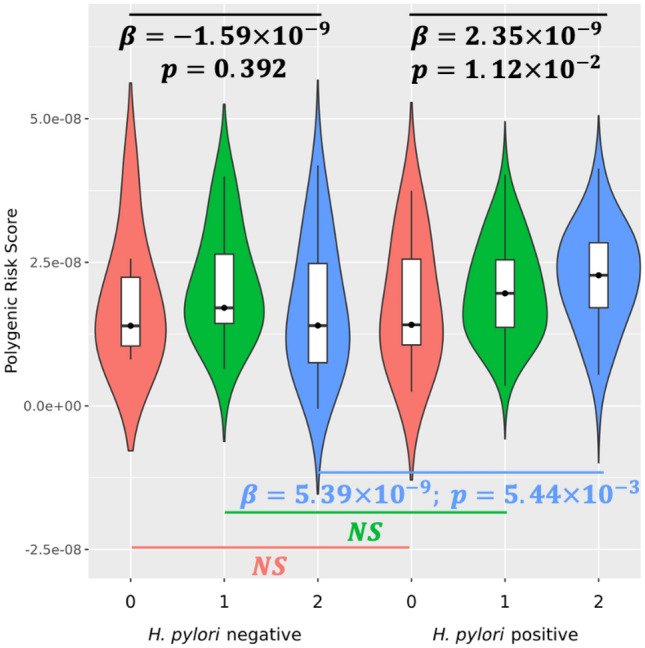
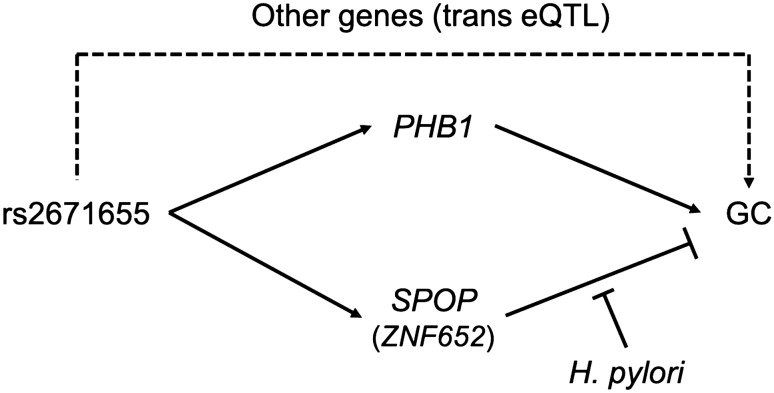
RESULTS In the entire cohort, genome-wide association study showed no significant variants reached the genome-wide significance level. In the H. pylori-positive group, rs2671655 (chr17:47,468,020;hg19, GH17J049387 enhancer region) was identified at a genome-wide significance level, which was more pronounced in diffuse type GC. There was no significant variant in the H. pylori-negative group, indicating the effect modification of rs2671655 by H. pylori. Among the target genes of GH17J049387 enhancer (PHB1, ZNF652 and SPOP), PHB1 mRNA was expressed more in cases than in controls, who were not affected by H. pylori. By contrast, an increase in ZNF652 and SPOP in GC was observed only in the H. pylori-negative group (P < 0.05). Mediation analysis showed that PHB1 (P = 0.0238) and SPOP (P = 0.0328) mediated the effect of rs2671655 on GC risk. The polygenic risk score was associated with the number of rs2671655 risk alleles only in the H. pylori-positive group (P = 0.0112).

CONCLUSION After H. pylori infection, rs2671655 may increase GC risk, especially in diffuse-type GC, by regulating the expression of several genes that consequently modify susceptibility to GC.

© 2022. The Author(s) under exclusive licence to The International Gastric Cancer Association and The Japanese Gastric Cancer Association.

Keywords

Gastric cancerGene–environmental interactionGenome-wide association studyHelicobacter

Figures
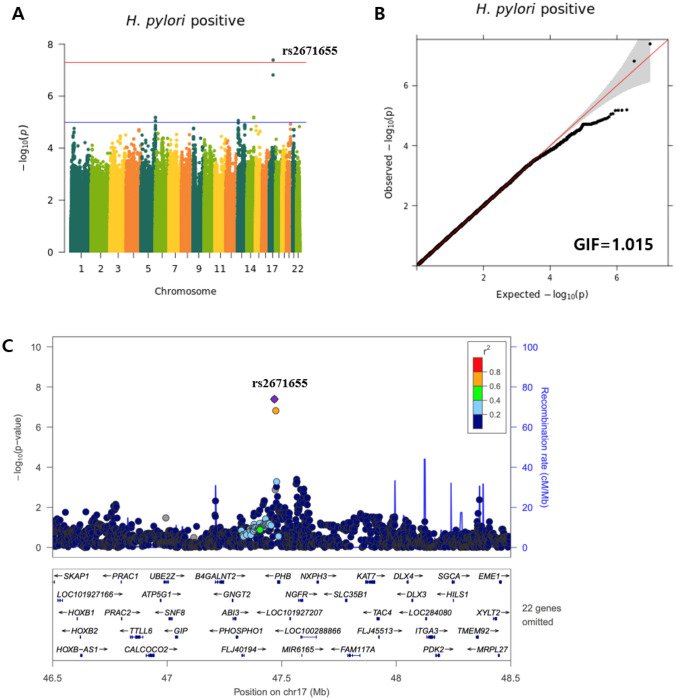
Fig. 1
Fig. 1 GWAS results of H. pylori-positive subjects in SNUBH cohort (n =761). A Manhattan plot. Red and blue lines indicate significance level of \documentclass[12pt]{minimal} \usepackage{amsmath} \usepackage{wasysym} \usepackage{amsfonts} \usepackage{amssymb} \usepackage{amsbsy} \usepackage{mathrsfs} \usepackage{upgreek} \setlength{\oddsidemargin}{-69pt} \begin{document}$$5 \times 10^{ - 8}$$\end{document}5×10⁻⁸ and \documentclass[12pt]{minimal} \usepackage{amsmath} \usepackage{wasysym} \usepackage{amsfonts} \usepackage{amssymb} \usepackage{amsbsy} \usepackage{mathrsfs} \usepackage{upgreek} \setlength{\oddsidemargin}{-69pt} \begin{document}$$1 \times 10^{ - 5}$$\end{document}1×10⁻⁵, respectively. B Quantile–quantile plot. Gray colored region shows 95% pointwise confidence interval. C Regional plot. Purple square represents rs2671655 and other colored circles do variants and their degree of correlation \documentclass[12pt]{minimal} \usepackage{amsmath} \usepackage{wasysym} \usepackage{amsfonts} \usepackage{amssymb} \usepackage{amsbsy} \usepackage{mathrsfs} \usepackage{upgreek} \setlength{\oddsidemargin}{-69pt} \begin{document}$$\left( {r^{2} } \right)$$\end{document}r2 with rs2671655, respectively. P Pvalue, GIF genomic inflation factor, Chr chromosome
Fig. 2
Fig. 2 RT-qPCR analysis results of PHB1. Comparison of PHB1 expression in H. pylori positive and negative groups depending on (A) the number of T allele of rs2671655 and (B) phenotypes. Y-axis indicates estimated values of cycle threshold of actin minus that of PHB1 adjusting effects of sex, age, smoking status and top 4 PC scores. Black lines represent association results among H. pylori-positive or -negative groups and colored lines represent those between H. pylori-positive and -negative subgroups of the same color, respectively. Ct cycle threshold, \documentclass[12pt]{minimal} \usepackage{amsmath} \usepackage{wasysym} \usepackage{amsfonts} \usepackage{amssymb} \usepackage{amsbsy} \usepackage{mathrsfs} \usepackage{upgreek} \setlength{\oddsidemargin}{-69pt} \begin{document}$$\beta$$\end{document}β estimated difference among groups, P P value, NS not significant
Fig. 3
Fig. 3 RT-qPCR analysis results of ZNF652. Comparison of ZNF652 expression in H. pylori positive and negative groups depending on (A) the number of T allele of rs2671655 and (B) phenotypes. Y-axis indicates estimated values of cycle threshold of actin minus that of ZNF652 adjusting effects of sex, age, smoking status and top 4 PC scores. Black lines represent association results among H. pylori positive or negative groups and colored lines represent those between H. pylori-positive and -negative subgroups of the same color, respectively. Ct cycle threshold, \documentclass[12pt]{minimal} \usepackage{amsmath} \usepackage{wasysym} \usepackage{amsfonts} \usepackage{amssymb} \usepackage{amsbsy} \usepackage{mathrsfs} \usepackage{upgreek} \setlength{\oddsidemargin}{-69pt} \begin{document}$$\beta$$\end{document}β estimated difference among groups, P P value, NS not significant
Fig. 4
Fig. 4 RT-qPCR analysis results of SPOP. Comparison of SPOP expression in H. pylori positive and negative groups depending on (A) the number of T allele of rs2671655 and (B) phenotypes. Y-axis indicates estimated values of cycle threshold of actin minus that of ZNF652 adjusting effects of sex, age, smoking status and top 4 PC scores. Black lines represent association results among H. pylori-positive or negative groups and colored lines represent those between H. pylori-positive and -negative subgroups of the same color, respectively. Ct cycle threshold, \documentclass[12pt]{minimal} \usepackage{amsmath} \usepackage{wasysym} \usepackage{amsfonts} \usepackage{amssymb} \usepackage{amsbsy} \usepackage{mathrsfs} \usepackage{upgreek} \setlength{\oddsidemargin}{-69pt} \begin{document}$$\beta$$\end{document}β estimated difference among groups, P P value, NS not significant
Fig. 5
Fig. 5 Polygenic risk score (PRS) comparison. PRS estimates were compared in the two groups and between H. pylori-positive and -negative groups depending on the number of T alleles of rs2671655, respectively. Black lines represent association results in H. pylori-positive or -negative subgroups, respectively, and colored lines represent between H. pylori-positive and -negative groups where participants have same number of risk alleles of rs2671655, respectively. \documentclass[12pt]{minimal} \usepackage{amsmath} \usepackage{wasysym} \usepackage{amsfonts} \usepackage{amssymb} \usepackage{amsbsy} \usepackage{mathrsfs} \usepackage{upgreek} \setlength{\oddsidemargin}{-69pt} \begin{document}$$\beta$$\end{document}β estimated association, P P value, NS not significant
Fig. 6
Fig. 6 Hypothetical pathway

그림 출처: PubMed Central 공개 논문 (PMC8943788)

Conflict of interest statement

The authors have no conflicts of interest to declare.

그 밖의 정보
출판 형태
Journal Article
저널
Gastric cancer : official journal of the International Gastric Cancer Association and the Japanese Gastric Cancer Association · eISSN 1436-3305
전자 출판
2022-03-24
MeSH
Genome-Wide Association Study · Helicobacter Infections* / complications / genetics · Helicobacter pylori* / genetics · Humans · Nuclear Proteins / genetics · Polymorphism, Single Nucleotide · RNA, Messenger / genetics · Repressor Proteins / genetics · Republic of Korea · Stomach Neoplasms* / epidemiology
Substances
Nuclear Proteins · RNA, Messenger · Repressor Proteins
참고문헌
51편