Department of Internal Medicine, Seoul National University College of Medicine, Seoul, Republic of Korea.
Laboratory of Infection & Immunity, Seoul National University Hospital Biomedical Research Institute, Seoul, Republic of Korea.
Abstract
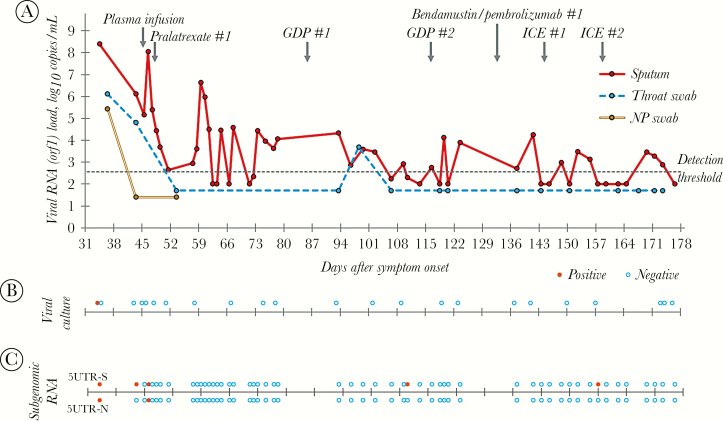
During the 2015 Korea Middle East Respiratory Syndrome coronavirus (MERS-CoV) outbreak, a lymphoma patient developed MERS pneumonia. His pneumonia improved by 45 days after illness onset, but the polymerase chain reaction tests remained (+) for 6 months. However, replication-competent virus was detected by 60 days after illness onset.
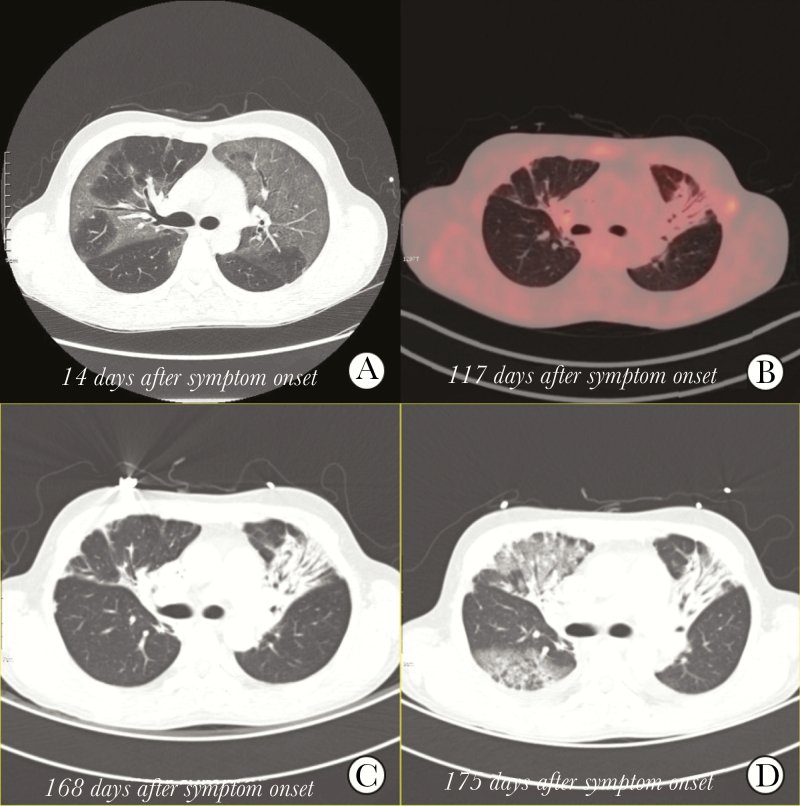
Figure 1.Chest radiographs of the patients. A computed tomography scan of the chest at 14 days after symptom onset. A, revealed pneumonia in both lung fields. Positron emission tomography-computed tomography at 117 days after symptom onset. B, showed only scar lesions with no 18F-fluorodeoxyglucose activity in the lung parenchyma. A computed tomography scan of the chest at 168 days after symptom onset. C, Showed only scar lesions, but a computed tomography scan of the chest at 175 days after symptom onset. D, Showed newly developed ground-glass opacities in right lung filed.Figure 2.Changes in MERS-CoV concentrations in respiratory samples over time. A, Results of real-time reverse-transcriptase polymerase chain reactions; MERS-CoV RNA was detected in the sputum samples until 173 days after symptom onset. B, Results of viral culture; MERS-CoV was isolated from one sputum sample obtained at 34 days after symptom onset. C, Results of subgenomic mRNA assay; subgenomic mRNA was detected in the sputum collected at 34 days after symptom onset and 46 days after symptom onset. orf1, open reading frame 1; GDP, Gemcitabine/Cisplatin/Dexamethasone; ICE, Ifosfamide/carboplatin/etoposide.