SCI 발표논문

SCI 발표논문

← SCI 발표논문 목록

J Am Heart Assoc. 2018;7(5):JAHA.117.007567.

Effect of β-Blockers Beyond 3 Years After Acute Myocardial Infarction.

, , , , , , ,

제1저자 박진주 · 교신저자 윤창환

소속 (2)
  1. Cardiovascular Center, Seoul National University Bundang Hospital, Seongnam, Korea.
  2. Cardiovascular Center, Seoul National University Bundang Hospital, Seongnam, Korea kunson2@snu.ac.kr.

Abstract

BACKGROUND The optimal duration of β-blocker therapy in patients with acute myocardial infarction (AMI) is unknown. We aimed to evaluate the late effect of β-blockers in patients with AMI.

METHODS AND RESULTS We enrolled all consecutive patients who presented with AMI at Seoul National University Bundang Hospital, between June 3, 2003 and February 24, 2015. The primary end point was 5-year all-cause mortality, depending on the use of β-blockers at discharge, 1 year after AMI, and 3 years after AMI. Of 2592 patients, the prescription rates of β-blockers were 72%, 69%, 63%, and 60% at discharge and 1, 3, and 5 years after AMI, respectively. The patients who were receiving β-blocker therapy had more favorable clinical characteristics, such as younger age (62 versus 65 years; P<0.001). They received reperfusion therapy more often (92% versus 80%; P<0.001) than those without β-blocker prescription. In the univariate analysis, the patients with β-blocker prescription had lower 5-year mortality at all time points. In the Cox model after adjustment for significant covariates, β-blocker prescription at discharge was associated with a 29% reduced mortality risk (hazard ratio, 0.71; 95% confidence interval, 0.55-0.90; P=0.006); however, β-blocker prescriptions at 1 and 3 years after AMI were not associated with reduced mortality.

CONCLUSIONS The beneficial effect of β-blocker therapy after AMI may be limited until 1 year after AMI. Whether late β-blocker therapy beyond 1 year after AMI offers clinical benefits should be confirmed in further clinical trials.

© 2018 The Authors. Published on behalf of the American Heart Association, Inc., by Wiley.

Keywords

acute myocardial infarctionmortalitysecondary preventionβ‐blocker

Figures

Figure 1
Figure 1 Flow chart of the study population. AMI indicates acute myocardial infarction; and SNUBH, Seoul National University Bundang Hospital.
Figure 2
Figure 2 β‐Blockers (BBs) and blood pressure of the study patients. A, Prescription rates of BBs were 72%, 69%, 63%, and 60% at discharge and 1, 3, and 5 years after acute myocardial infarction, respectively. B, At discharge, the most commonly prescribed agents were carvedilol (70%), followed by bisoprolol (28%) and nebivolol (1%). C, BB prescription status changed during follow‐up and, thus, it was significantly different in the 3 populations analyzed in this study. Of the patients, 20% and 11% changed their BB statuses from discharge to 1 year and from 1 to 3 years, respectively. D, The difference in systolic blood pressure between the patients with and those without BBs at discharge and during follow‐up was not significant in the 3 populations.
Figure 3
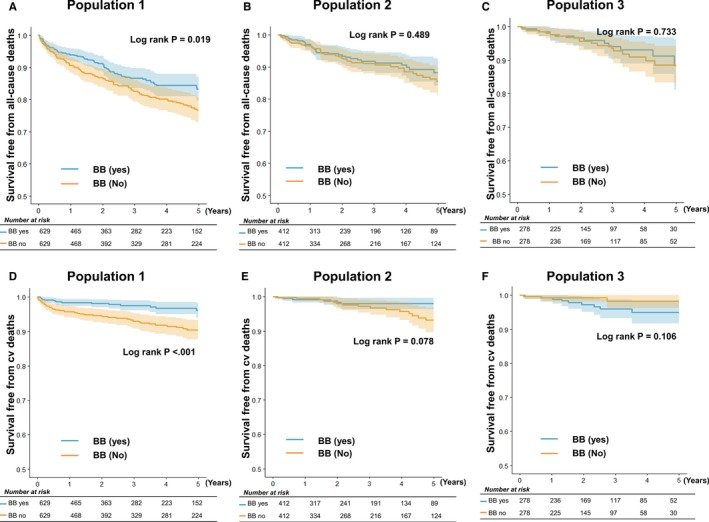
Figure 3 Five‐year all‐cause and cardiovascular (cv) mortality. In the Kaplan‐Meier survival analysis, the patients with a β‐blocker (BB) prescription in population 1 (at discharge) (A), population 2 (1 year after discharge) (B), and population 3 (3 years after discharge) (C) had lower all‐cause mortality rates than their counterparts without BB use. Similarly, patients with a BB prescription had lower cv mortality in population 1 (D), population 2 (E), and population 3 (F).
Figure 4
Figure 4 Exploratory subgroup analyses. A, In population 1, no significant interaction was observed between β‐blocker and mortality across all subgroups. B, In population 2, among the patients <65 years and those who were receiving renin‐angiotensin system (RAS) inhibitors, β‐blocker therapy seemed to demonstrate a protective effect. C, In population 3, β‐blocker therapy showed a protective effect only in the patients <65 years. CABG indicates coronary artery bypass graft; CI, confidence interval; Cr, creatinine; EF, ejection fraction; HR, hazard ratio; NSTEMI, non‐STEMI;PCI, percutaneous coronary intervention; and STEMI,ST‐segment–elevation myocardial infarction.
Figure 5
Figure 5 Five‐year all‐cause and cardiovascular (cv) mortality in propensity score–matched cohort. A, In the Kaplan‐Meier survival analysis, the patients with a β‐blocker (BB) prescription in population 1 had lower mortality rate than their counterparts without BB use. However, the 5‐year mortality did not differ between patients with or without BB prescription in population 2 (B) and population 3 (C). For 5‐year cv mortality, the patients with a BB prescription in population 1 had lower mortality rate than their counterparts without BB use (D); however, there was no difference between patients with or without BB prescription in populations 2 (E) and 3 (F).
Figure 6
Figure 6 One‐year mortality. A through C, 1‐year all‐cause mortality. D through F, 1‐year cardiovascular (cv) mortality. G through I, 1‐year all‐cause mortality in propensity‐matched cohort. J through L, 1‐year cv mortality in propensity‐matched cohort. BB indicates β‐blocker.

그림 출처: PubMed Central 공개 논문 (PMC5866322)

그 밖의 정보
출판 형태
Journal Article, Research Support, Non-U.S. Gov't
저널
Journal of the American Heart Association · eISSN 2047-9980
전자 출판
2018-03-03
MeSH
Adrenergic beta-Antagonists / administration & dosage / adverse effects · Aged · Drug Administration Schedule · Female · Humans · Male · Middle Aged · Myocardial Infarction / diagnosis / drug therapy / mortality / physiopathology · Registries · Risk Assessment · Risk Factors · Seoul · Time Factors · Treatment Outcome
Substances
Adrenergic beta-Antagonists
참고문헌
33편