
Gut Liver. 2013;7(2):175-81.
High Recurrence Rate of Idiopathic Peptic Ulcers in Long-Term Follow-up.
제1저자 윤혁 · 교신저자 김상균
소속 (1)
- Department of Internal Medicine and Liver Research Institute, Seoul National University College of Medicine, Seoul, Korea.
Abstract
BACKGROUND/AIMS Our aim was to compare the long-term clinical outcomes of idiopathic peptic ulcer disease (IPUD) with those of Helicobacter pylori-positive and nonsteroidal anti-inflammatory drug (NSAID)-induced peptic ulcer disease (PUD).
METHODS Patients with endoscopically diagnosed PUD were retrospectively reviewed. According to their H. pylori-infection status and history of NSAIDs use, patients were categorized into three groups: H. pylori-positive PUD, NSAID-induced PUD, and IPUD. Clinical outcomes were analyzed, and the recurrence rate of PUD was compared among the three groups.
RESULTS A total of 238 patients were enrolled. Those with IPUD, NSAID-induced PUD, and H. pylori-positive PUD comprised of 56, 60, and 122 patients, respectively. The 5-year cumulative incidences of recurrent ulcers were 24.3% (95% confidence interval [CI], 11.6% to 37.0%) in IPUD, 10.9% (95% CI, 2.6% to 19.2%) in NSAID-induced PUD, and 3.8% (95% CI, 0.1% to 7.5%) in H. pylori-positive PUD (IPUD vs NSAID-induced PUD/H. pylori-positive PUD, p=0.43/p<0.001 by log-rank test). In the Cox-proportional hazards model, only IPUD remained as an independent risk factor associated with recurrent ulcers (hazard ratio, 5.97; 95% CI, 1.94 to 18.34; p=0.002).
CONCLUSIONS IPUD exhibited a higher recurrence rate than H. pylori-positive and NSAID-induced PUD in long-term follow-up and was an independent risk factor for ulcer recurrence.
Keywords
Helicobacter pyloriIdiopathic peptic ulcerNonsteroidal anti-inflammatory drugRecurrence
Figures

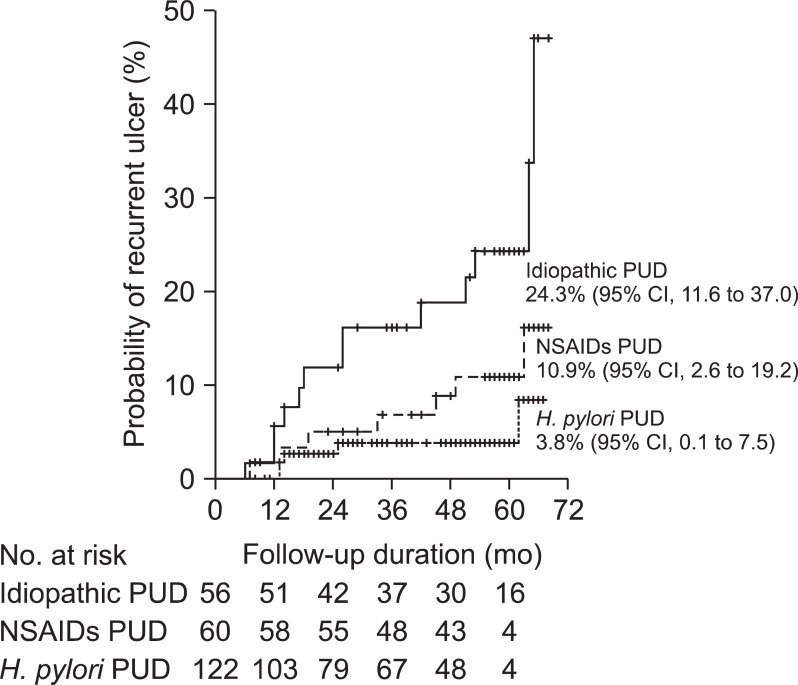

그림 출처: PubMed Central 공개 논문 (PMC3607771)
Conflict of interest statement
No potential conflict of interest relevant to this article was reported.
그 밖의 정보
- 출판 형태
- Journal Article
- 저널
- Gut and liver · ISSN 1976-2283
- 전자 출판
- 2013-03-14
- 참고문헌
- 29편