
Medicine (Baltimore). 2017;96(19):e6666.
Circulating TNF receptors predict cardiovascular disease in patients with chronic kidney disease.
제1저자 배은진 · 교신저자 이정표
소속 (1)
- Department of Internal Medicine, Gyeongsang National University Changwon Hospital, Changwon Department of Internal Medicine, National Medical Center Department of Internal Medicine, Seoul National University College of Medicine Department of Internal Medicine, Seoul National University Boramae Medical Center, Seoul Department of Internal Medicine, Dongguk University Medical Center, Gyeongju Department of Internal Medicine, Dong-A University, Busan Department of Dental Hygiene, College of Health Science, Eulji University, Seongnam Department of Internal Medicine, Yonsei University College of Medicine, Seoul Department of Internal Medicine, Dongguk University Medical Center, Goyang Kidney Research Institute, Seoul National University, Seoul, Republic of Korea.
Abstract
Cardiovascular disease (CVD) is the main public health problem in patients with chronic kidney disease (CKD); however, there is no established biomarker for predicting CVD morbidity and mortality in CKD. The aim of this study was to evaluate the role of circulating tumor necrosis factor receptors (cTNFRs) in predicting CVD risk in CKD patients.We prospectively recruited 984 patients with CKD from 11 centers between 2006 and 2012. The levels of cTNFR1 and cTNFR2 were determined by performing an enzyme-linked immunosorbent assay. During the mean follow-up period of 4 years, 36 patients experienced a CVD event. The median serum concentrations of cTNFR1 and cTNFR2 were 2703.4 (225.6-13,057.7) and 5661.0 (634.9-30,599.6) pg/mL, respectively, and the cTNFR1 level was closely correlated with the cTNFR2 level (r = 0.86, P < .0001). The urinary protein-to-creatinine ratio (UPCR) and estimated glomerular filtration rate (eGFR) were significantly correlated with the cTNFR2 level (r = 0.21 for UPCR, r = -0.67 for eGFR; P < .001 for all). Similar correlations were observed for serum cTNFR1 (r = 0.21 for UPCR, r = -0.75 for eGFR; P < .001 for all). In the Cox proportional hazard analyses, cTNFR1 (hazard ratio [HR] 2.506, 95% confidence interval [CI] 1.186-5.295, P = .016) and cTNFR2 (HR 4.156, 95% CI 1.913-9.030, P < .001) predicted CVD risk even after adjustment for clinical covariates, such as UPCR, eGFR, and high-sensitivity C-reactive protein. cTNFR1 and 2 are associated with CVD and other risk factors in CKD, independently of eGFR and UPCR. Furthermore, cTNFRs could be relevant predictors of CVD in CKD patients.
Figures

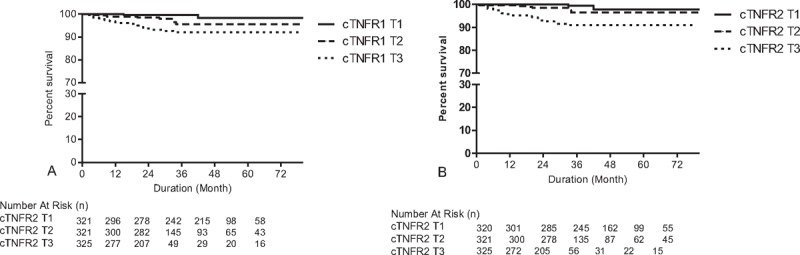
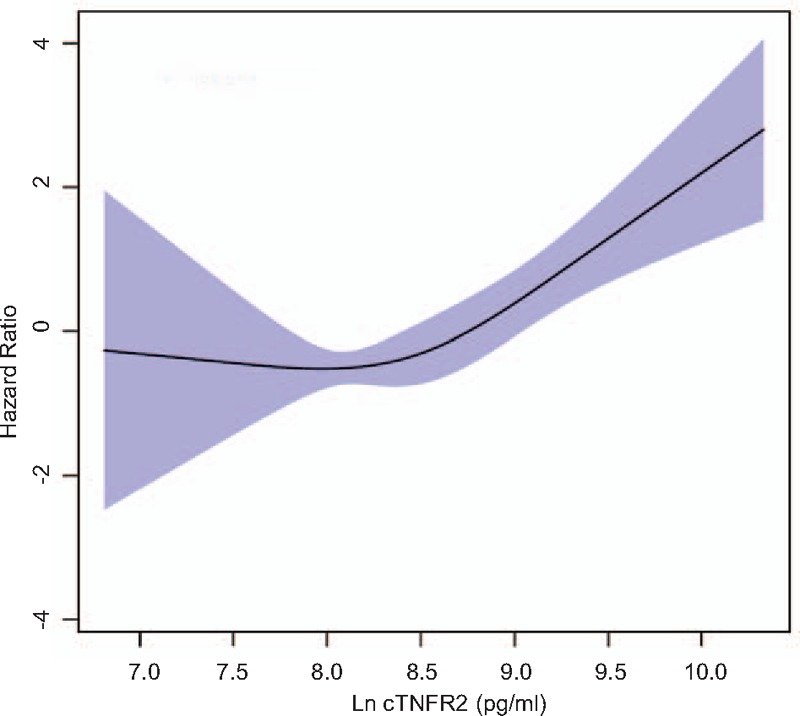

그림 출처: PubMed Central 공개 논문 (PMC5428576)
Conflict of interest statement
The authors have no conflicts of interest to disclose.
그 밖의 정보
- 출판 형태
- Journal Article, Multicenter Study, Observational Study
- 저널
- Medicine · eISSN 1536-5964
- MeSH
- Adult · Aged · Blood Chemical Analysis · Cardiovascular Diseases / blood / complications / mortality / urine · Creatinine / urine · Eccrine Porocarcinoma · Enzyme-Linked Immunosorbent Assay · Female · Follow-Up Studies · Glomerular Filtration Rate · Humans · Male · Middle Aged · Proportional Hazards Models · Prospective Studies · Receptors, Tumor Necrosis Factor, Type I / blood · Receptors, Tumor Necrosis Factor, Type II / blood · Renal Insufficiency, Chronic / blood / complications / mortality / urine · Risk Factors
- Substances
- Receptors, Tumor Necrosis Factor, Type I · Receptors, Tumor Necrosis Factor, Type II · Creatinine
- 참고문헌
- 55편