
Sci Rep. 2017;7(1):7542.
Association between Frailty and Hypertension Prevalence, Treatment, and Control in the Elderly Korean Population.
제1저자 강민구 · 교신저자 김광일
소속 (2)
- Department of Internal Medicine, Seoul National University College of Medicine, Seoul National University Bundang Hospital, Seongnam, South Korea.
- Department of Internal Medicine, Seoul National University College of Medicine, Seoul National University Bundang Hospital, Seongnam, South Korea. kikim907@snu.ac.kr.
Abstract
Frailty is a common geriatric syndrome characterized by increased risk of disability, hospitalization, and mortality. Hypertension (HTN) is one of the most common chronic medical conditions in the elderly. However, there have been few studies regarding the association between frailty and HTN prevalence, treatment, and control rates. We analyzed data of 4,352 older adults (age ≥ 65 years) from the fifth Korea National Health and Nutrition Examination Survey. We constructed a frailty index based on 42 items and classified participants as robust, pre-frail, or frail. Of the subjects, 2,697 (62.0%) had HTN and 926 (21.3%) had pre-HTN. Regarding frailty status, 721 (16.6%), 1,707 (39.2%), and 1,924 (44.2%) individuals were classified as robust, pre-frail and frail, respectively. HTN prevalence was higher in frail elderly (67.8%) than pre-frail (60.8%) or robust elderly (49.2%) (P < 0.001). Among hypertensive patients, frail elderly were more likely to be treated than pre-frail or robust elderly (P < 0.001), but the proportion of patients whose blood pressure was under control ( < 150/90 mmHg) was lower in frail elderly (P = 0.005). Considering the adverse cardiovascular outcomes associated with frailty, more attention should be paid to the blood pressure control of the frail elderly.
Figures
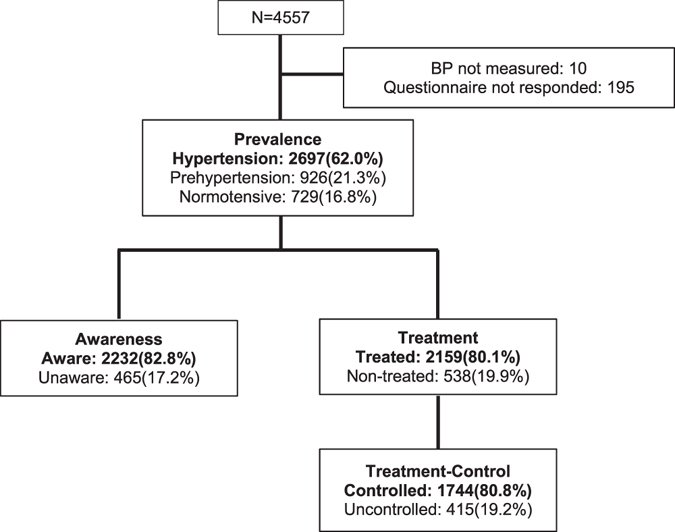
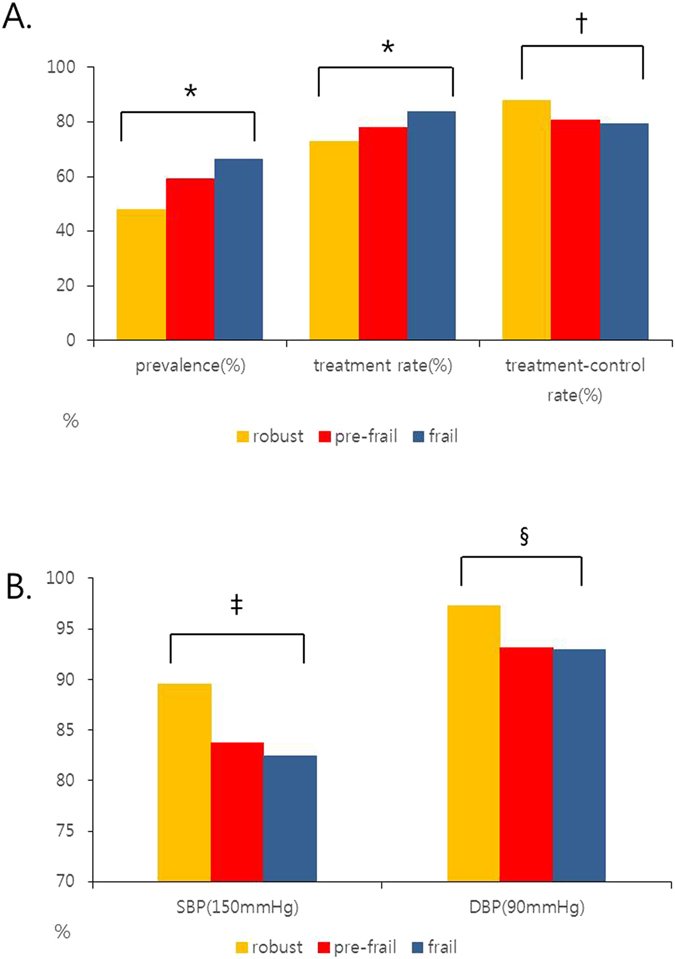
그림 출처: PubMed Central 공개 논문 (PMC5548733)
Conflict of interest statement
The authors declare that they have no competing interests.
그 밖의 정보
- 출판 형태
- Journal Article
- 저널
- Scientific reports · eISSN 2045-2322
- 전자 출판
- 2017-08-08
- MeSH
- Activities of Daily Living · Aged · Aged, 80 and over · Frail Elderly · Geriatric Assessment / statistics & numerical data · Health Services for the Aged / statistics & numerical data · Hospitalization / statistics & numerical data · Humans · Hypertension / epidemiology / prevention & control / therapy · Nutrition Surveys / statistics & numerical data · Prevalence · Republic of Korea / epidemiology
- 참고문헌
- 28편