
Sci Rep. 2017;7(1):6324.
Proteinuria Detected by Urine Dipstick Test as a Risk Factor for Atrial Fibrillation: A Nationwide Population-Based Study.
제1저자 임우현 · 교신저자 최의근
소속 (5)
- Division of Cardiology, Department of Internal medicine, Seoul National University Boramae Medical Center, Seoul, Republic of Korea.
- Division of Cardiology, Department of Internal medicine, Seoul National University Hospital, Seoul, Republic of Korea. choiek417@snu.ac.kr.
- Department of Biostatistics, College of Medicine, The Catholic University of Korea, Seoul, Republic of Korea.
- Division of Cardiology, Department of Internal medicine, Seoul National University Hospital, Seoul, Republic of Korea.
- Department of Cardiology, Cardiovascular Center, Seoul National University Bundang Hospital, Seongnam, Republic of Korea.
Abstract
Proteinuria is one of the well-known risk factors for cardiovascular disease. However the impact of proteinuria on the incidence of atrial fibrillation (AF) is unclear. In this study, we investigated the association between proteinuria detected using urine dipstick test and the risk of AF. A total of 18,201,275 individuals were analyzed, who had no prior AF and had received biennial health checkups provided by the National Health Insurance Service between 2005 and 2008 in Korea. Incidences of AF were ascertained through the end of 2015. During a mean follow-up of 9.6 years, a total of 324,764 (1.8%) developed AF (1.86 per 1,000 person-years). In Cox regression models, proteinuria was associated with an increased risk of AF: adjusted HR and 95% CI of AF occurrence were 1.13 (1.10-1.16), 1.34 (1.31-1.38), 1.53 (1.48-1.58), 1.82 (1.71-1.94), and 1.86 (1.61-2.16) in individuals with trace, 1+, 2+, 3+, and 4+ proteinuria, respectively, compared with those without proteinuria. The result was consistent even after additional adjustment for estimated glomerular filtration rate. In addition, the risk of AF further increased or decreased according to the follow-up dipstick test results. Thus, proteinuria measured with a dipstick test might be considered a potent risk factor for AF development.
Figures
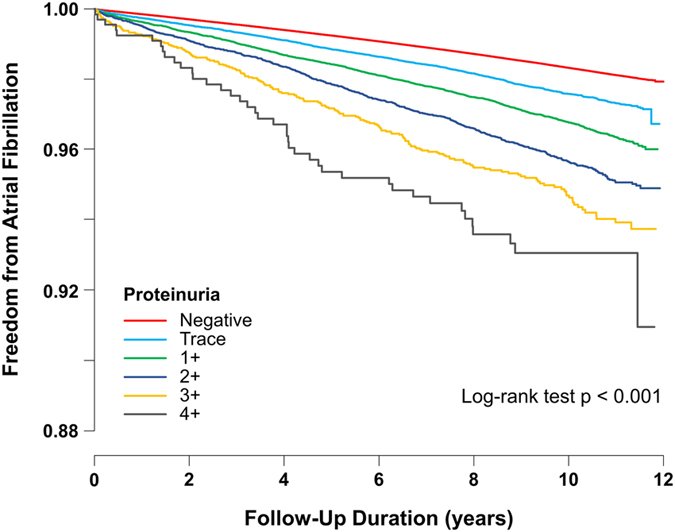
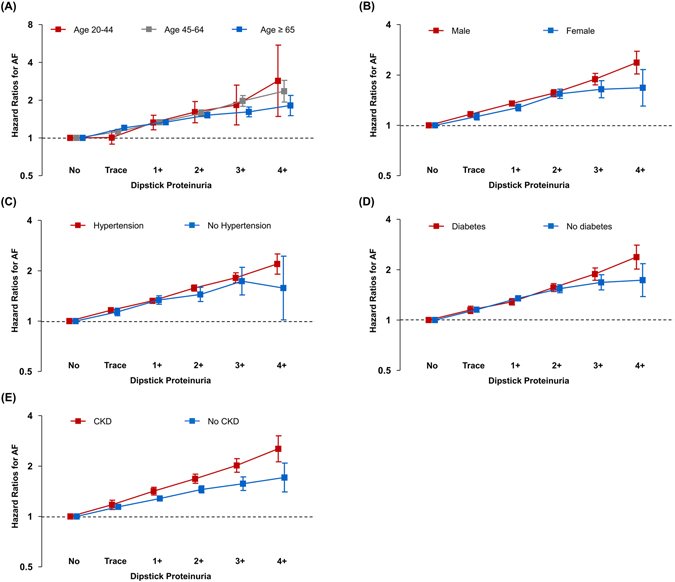
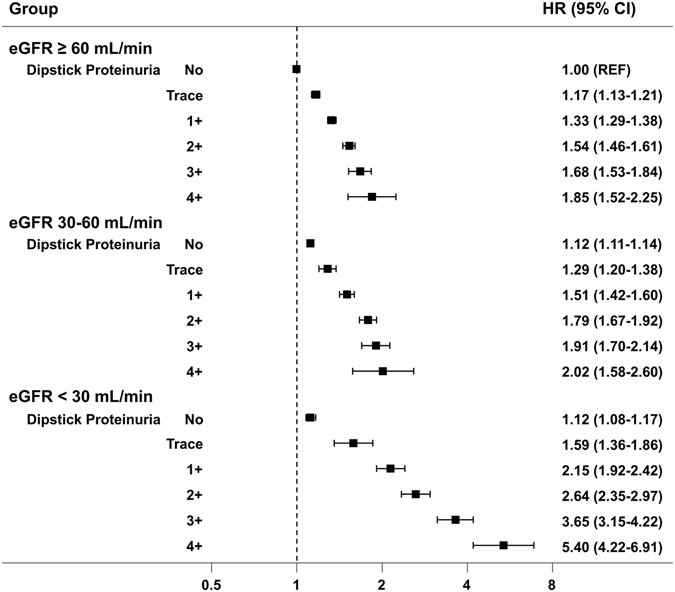
그림 출처: PubMed Central 공개 논문 (PMC5524798)
Conflict of interest statement
The authors declare that they have no competing interests.
그 밖의 정보
- 출판 형태
- Journal Article, Research Support, Non-U.S. Gov't
- 저널
- Scientific reports · eISSN 2045-2322
- 전자 출판
- 2017-07-24
- MeSH
- Adult · Aged · Atrial Fibrillation / epidemiology / etiology · Female · Glomerular Filtration Rate · Humans · Incidence · Male · Middle Aged · National Health Programs · Proportional Hazards Models · Proteinuria / complications / diagnosis / physiopathology · Regression Analysis · Republic of Korea · Risk Factors
- 참고문헌
- 42편