
Medicine (Baltimore). 2017;96(13):e6486.
Point prevalence and epidemiological characteristics of chronic cough in the general adult population: The Korean National Health and Nutrition Examination Survey 2010-2012.
제1저자 강민규 · 교신저자 송우정
소속 (1)
- Division of Allergy and Clinical Immunology, Department of Internal Medicine, Chungbuk National University Hospital, Cheongju Division of Allergy and Clinical Immunology, Department of Internal Medicine, Seoul National University College of Medicine Department of Preventive Medicine, College of Medicine, Korea University, Seoul Department of Internal Medicine, Pusan National University College of Medicine, Busan Department of Internal Medicine, Ewha Womans University School of Medicine, Seoul Division of Allergy and Clinical Immunology, Department of Internal Medicine, Seoul National University Bundang Hospital, Seongnam Department of Internal Medicine, Hanyang University College of Medicine Division of Allergy, Department of Medicine, Samsung Medical Center, Sungkyunkwan University School of Medicine, Seoul, Korea Centre for Cardiovascular and Metabolic Research, Hull York Medical School, Castle Hill Hospital, University of Hull, Cottingham, East Yorkshire, United Kingdom Institute of Allergy and Clinical Immunology, Seoul National University Medical Research Center, Seoul, Korea.
Abstract
Cough is frequently self-limiting, but may persist longer in certain individuals. Most of previous studies on the epidemiology of chronic cough have only measured period prevalence, and thus have afforded limited information on the burden and natural course. We aimed to investigate the epidemiology of chronic cough by using a point prevalence measure in a large-scale general population.We analyzed cross-sectional data collected from 18,071 adults who participated in the Korean National Health and Nutrition Examination Survey 2010-2012. Presence and duration of current cough was ascertained by structured questionnaires, and cough was classified into acute (<3 weeks), subacute (3-8 weeks), or chronic cough (≥8 weeks). Demographic and clinical parameters were examined in relation to chronic cough.The point prevalences of acute, subacute, and chronic cough were 2.5 ± 0.2%, 0.8 ± 0.1% and 2.6 ± 0.2%, respectively. The proportion of current cough showed a steep decrease after 1 week of duration. However, 2 peaks in the prevalence of current cough were revealed; cough durations of less than 1 week and longer than 1 year were most common (31.1% and 27.7% of current cough, respectively). Subacute and chronic cough were more prevalent in the elderly (≥65 years); the positive associations with older age were independent of other confounders, including current smoking and comorbidities.This is the first report on the epidemiology of cough using a point prevalence measure in a nationally representative population sample. Our findings indicate a high burden of chronic cough among adults with current cough in the community. The dual-peak of cough duration suggested that the pathophysiology of acute and chronic cough may differ. The preponderance of elderly people in the prevalence of chronic cough warrants further investigation. In addition, more sophistication and validation of tools to define chronic cough will help our understanding of the epidemiology.
Figures
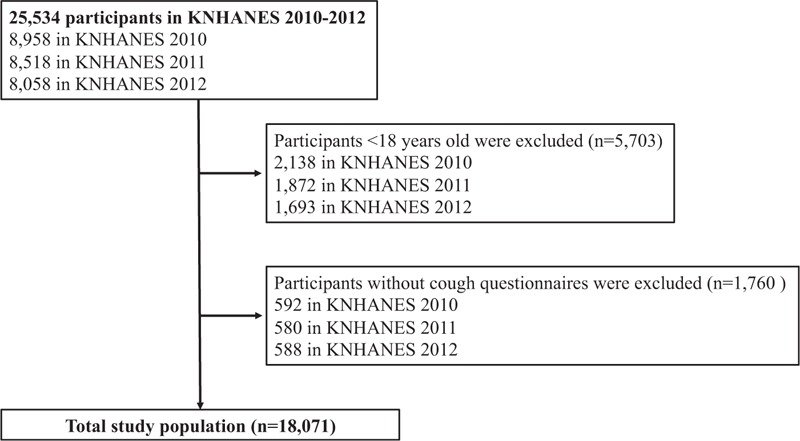
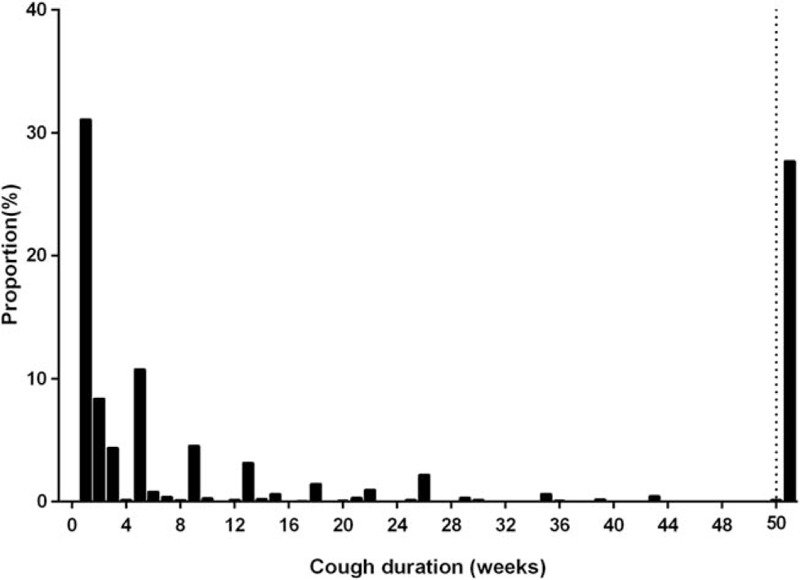
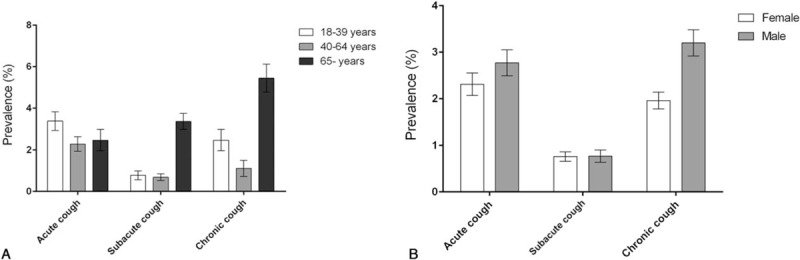
그림 출처: PubMed Central 공개 논문 (PMC5380274)
Conflict of interest statement
The authors have no funding and conflicts of interest to disclose.
그 밖의 정보
- 출판 형태
- Journal Article, Observational Study
- 저널
- Medicine · eISSN 1536-5964
- MeSH
- Adult · Chronic Disease · Cough / epidemiology · Female · Humans · Male · Middle Aged · Nutrition Surveys · Prevalence · Republic of Korea / epidemiology · Sex Factors · Socioeconomic Factors
- 참고문헌
- 39편