SCI 발표논문

SCI 발표논문

← SCI 발표논문 목록

PLoS One. 2012;7(4):e35007.

Effect of a dipeptidyl peptidase-IV inhibitor, des-fluoro-sitagliptin, on neointimal formation after balloon injury in rats.

, , , , , , , , , ,

제1저자 임수 · 교신저자 박경수

소속 (1)
  1. Department of Internal Medicine, Seoul National University Bundang Hospital, Seongnam, Korea.

Abstract

BACKGROUND Recently, it has been suggested that enhancement of incretin effect improves cardiac function. We investigated the effect of a DPP-IV inhibitor, des-fluoro-sitagliptin, in reducing occurrence of restenosis in carotid artery in response to balloon injury and the related mechanisms.

METHODS AND FINDINGS Otsuka Long-Evans Tokushima Fatty rats were grouped into four: control (normal saline) and sitagliptin 100, 250 and 500 mg/kg per day (n = 10 per group). Sitagliptin or normal saline were given orally from 1 week before to 2 weeks after carotid injury. After 3 weeks of treatment, sitagliptin treatment caused a significant and dose-dependent reduction in intima-media ratio (IMR) in obese diabetic rats. This effect was accompanied by improved glucose homeostasis, decreased circulating levels of high-sensitivity C-reactive protein (hsCRP) and increased adiponectin level. Moreover, decreased IMR was correlated significantly with reduced hsCRP, tumor necrosis factor-α and monocyte chemoattractant protein-1 levels and plasminogen activator inhibitor-1 activity. In vitro evidence with vascular smooth muscle cells (VSMCs) demonstrated that proliferation and migration were decreased significantly after sitagliptin treatment. In addition, sitagliptin increased caspase-3 activity and decreased monocyte adhesion and NFκB activation in VSMCs.

CONCLUSIONS Sitagliptin has protective properties against restenosis after carotid injury and therapeutic implications for treating macrovascular complications of diabetes.

Figures

Figure 1
Figure 1 Plasma active GLP-1 (A) and glucagon (B) levels after 3 week treatment of sitagliptin. Plasma active GLP-1 levels increased and glucagon levels decreased significantly in a dose-dependent manner (*p <0.05 compared with control and †p <0.05 compared with 100 mg/kg of sitagliptin treatment). In vivo inhibition of neointimal formation after 3 weeks of treatment with sitagliptin. C. H&E stained sections of the four groups (control and sitagliptin groups: 100, 250 and 500 mg/kg). D. Intima-media ratios (IMRs) in the three groups (n = 10 in each group). Treatment with sitagliptin produced a lower IMR than controls in a dose-dependent manner (the lower IMR with the higher dose of sitagliptin, p < 0.05 between control and 250 mg/kg or 500 mg/kg of sitagliptin groups).
Figure 2
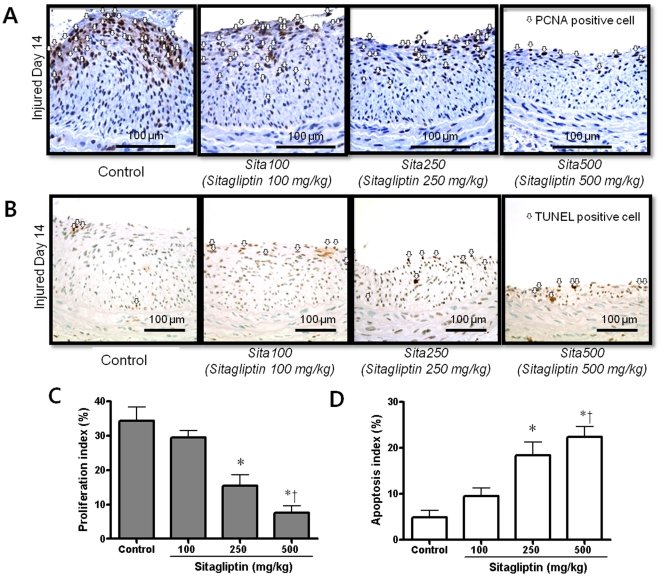
Figure 2 Effects of sitagliptin treatment or normal saline as a control on proliferation and apoptosis of vascular smooth muscle cells. A. Cell proliferation measured by immunostaining for proliferating cell nuclear antigen (PCNA) was markedly lower in the sitagliptin-treated groups than in the controls (open arrow). B. TUNEL staining of the three groups (open arrow). C. The proliferation index was significantly lower in the sitagliptin-treated groups than in the control group. There was a dose-dependent pattern in the level of proliferation between sitagliptin-treated groups (*p < 0.05 vs. control and †p < 0.05 vs. sitagliptin 100 mg/kg). D. Apoptosis index (%) at 2 weeks after balloon injury. Apoptosis was significantly higher in the sitagliptin -treated groups than in the control group, and there was a dose-dependent pattern in the level of apoptosis between sitagliptin-treated groups (*p < 0.05 vs. control and †p < 0.05 vs. sitagliptin 100 mg/kg).
Figure 3
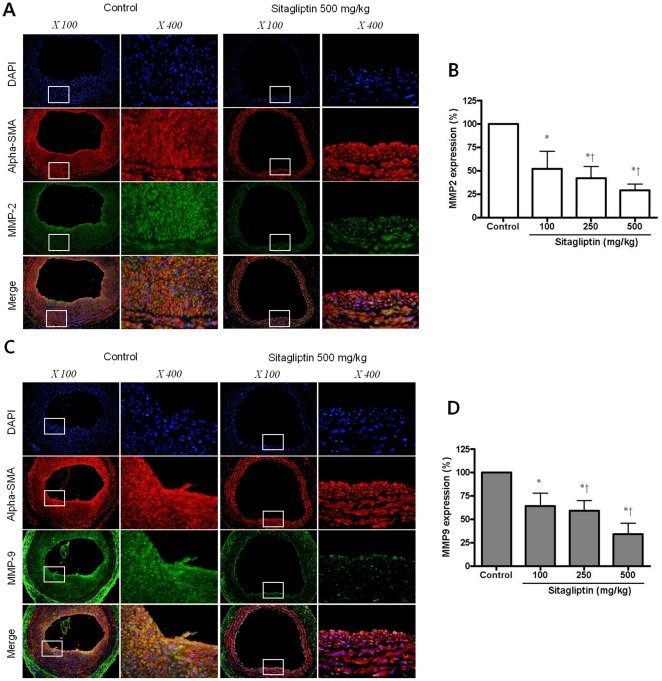
Figure 3 Immunofluorescent double staining for MMP2 (A) and MMP9 (C) expressing cells in tissue sections of injured arteries. Double-staining was done with the anti-αSMA antibody (red) and anti-MMP2 or MMP9 antibody (green). Nucleus of cells was stained by DAPI (blue). MMP2 and MMP9 expressions were reduced by sitagliptin treatment (500 mg/kg) compared to control. Two scaled photos were displayed (×100 and ×400). Effect of sitagliptin on MMP2 (B) and MMP9 (D) expression in tissue sections of injured arteries (*p < 0.01 compared with control and †p < 0.01 compared with 100 mg/kg of sitagliptin treatment).
Figure 4
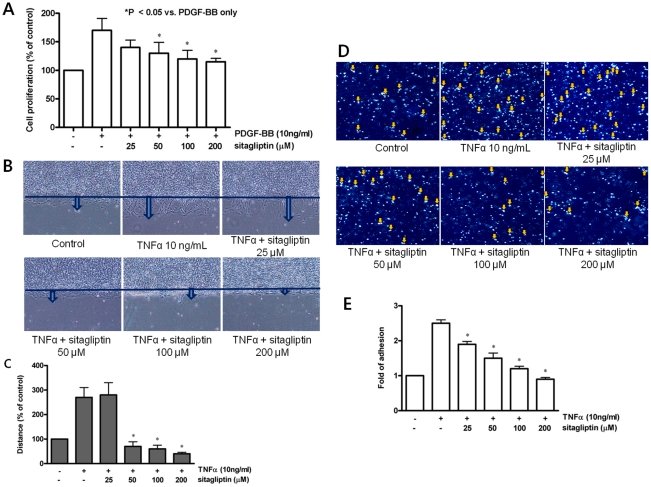
Figure 4 Effects of sitagliptin on proliferation and migration of rat aortic smooth muscle cells (RAoSMC). A. In MTT viability assays, cell proliferation was significantly decreased by sitagliptin treatment (*p < 0.05 compared with PDGF-BB only). B. TNFα-directed migration with sitagliptin treatment. C. Dose-dependent inhibiting pattern of TNFα-directed migration from 50 to 200 µg/mL (*p < 0.05 compared with TNFα treatment). D. Effects of sitagliptin on TNFα-stimulated monocyte adhesion using U937 cells. Open arrows indicate adhered monocytes. E. Dose-dependent inhibiting pattern of TNFα-stimulated monocyte adhesion (*p < 0.05 compared with TNFα treatment).
Figure 5
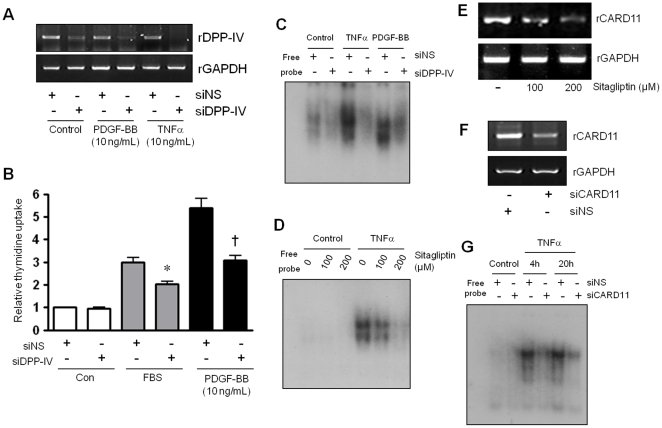
Figure 5 Mechanistic experiment with small interfering RNA (siRNA) against DPP-IV and CARD11. A. DPP-IV expression in VSMCs. The DPP-IV expression was knockdowned by siDPP-IV while it was not changed by treatment of PDGF-BB or TNFα. B. FBS- or PDGF-BB-induced cell proliferation was significantly attenuated by siDPP-IV transfection. C. Attenuation of TNFα- or PDGF-BB-induced NFκB activation by siDPP-IV transfection was also confirmed in EMSA assay. D. TNFα-induced NFκB activation was attenuated by sitagliptin treatment dose-dependently. E. Expression of CARD11 was decreased dose-dependently by sitagliptin treatment in VSMCs. F. CARD11 was expressed in VSMCs and its expression was knockdowned by siCARD11. G. TNFα-induced NFκB activation was decreased by siCARD11 transfection in EMSA assay.

그림 출처: PubMed Central 공개 논문 (PMC3320861)

Comment · 정정

  • Erratum in PLoS One. 2012;7(5): doi/10.1371/annotation/f0a21e28-7f3c-4b76-870e-128dd89d0e29

Conflict of interest statement

Competing Interests:This work was partly supported by the investigator initiated studies programs of Merck. The sitagliptin used in this study is a Merck product. There are no patents, products in development or other marketed products to declare. This does not alter the authors' adherence to all the PLoS ONE policies on sharing data and materials.

그 밖의 정보
출판 형태
Journal Article, Research Support, Non-U.S. Gov't
저널
PloS one · eISSN 1932-6203
전자 출판
2012-04-06
MeSH
Adiponectin / blood · Administration, Oral · Animals · Blood Glucose / analysis · C-Reactive Protein / analysis · Carotid Arteries / drug effects / enzymology / pathology · Carotid Artery Injuries / drug therapy / enzymology · Chemokine CCL2 / blood · Coronary Restenosis / prevention & control · Dipeptidyl-Peptidase IV Inhibitors / administration & dosage / therapeutic use · Dose-Response Relationship, Drug · Male · Muscle, Smooth, Vascular / cytology / drug effects · Myocytes, Smooth Muscle / cytology / drug effects · Plasminogen Activator Inhibitor 1 / blood · Pyrazines / administration & dosage / therapeutic use · Rats · Rats, Inbred OLETF · Sitagliptin Phosphate · Triazoles / administration & dosage / therapeutic use · Tumor Necrosis Factor-alpha / blood · Tunica Intima / drug effects / injuries
Substances
Adiponectin · Blood Glucose · Ccl2 protein, rat · Chemokine CCL2 · Dipeptidyl-Peptidase IV Inhibitors · Plasminogen Activator Inhibitor 1 · Pyrazines · Triazoles · Tumor Necrosis Factor-alpha · C-Reactive Protein · Sitagliptin Phosphate
참고문헌
45편