
PLoS One. 2012;7(8):e42352.
Effects of chemosignals from sad tears and postprandial plasma on appetite and food intake in humans.
제1저자 오태정 · 교신저자 조영민
소속 (1)
- Department of Internal Medicine, Seoul National University College of Medicine, Seoul, Republic of Korea.
Abstract
Chemosignals from human body fluids may modulate biological functions in humans. The objective of this study was to examine whether chemosignals from human sad tears and postprandial plasma modulate appetite. We obtained fasting and postprandial plasma from male participants and sad tears and saline, which was trickled below the eyelids, from female volunteers. These samples were then randomly distributed to male participants to sniff with a band-aid containing 100 µl of each fluid on four consecutive days in a double-blind fashion. We checked appetite by a visual analogue scale (VAS) and food intake by measuring the consumption of a test meal. In addition, the serum levels of total testosterone and LH were measured. Twenty men (mean age 26.3±4.6 years) were enrolled in this study. They could not discriminate between the smell of fasting and postprandial plasma and the smell of sad tears and trickled saline. Appetite and the amount of food intake were not different between the groups. Although the VAS ratings of appetite correlated with the food intake upon sniffing fasting plasma, postprandial plasma, and trickled saline, there was no such correlation upon sniffing sad tears. In addition, the decrease in serum testosterone levels from the baseline was greater with sad tears than with the trickled saline (-28.6±3.3% vs. -14.0±5.2%; P = 0.019). These data suggest that chemosignals from human sad tears and postprandial plasma do not appear to reduce appetite and food intake. However, further studies are necessary to examine whether sad tears may alter the appetite-eating behavior relation.
Figures

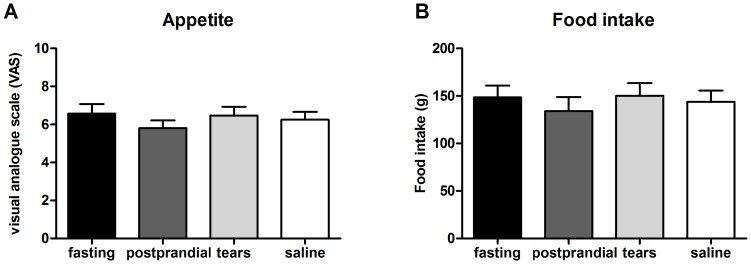


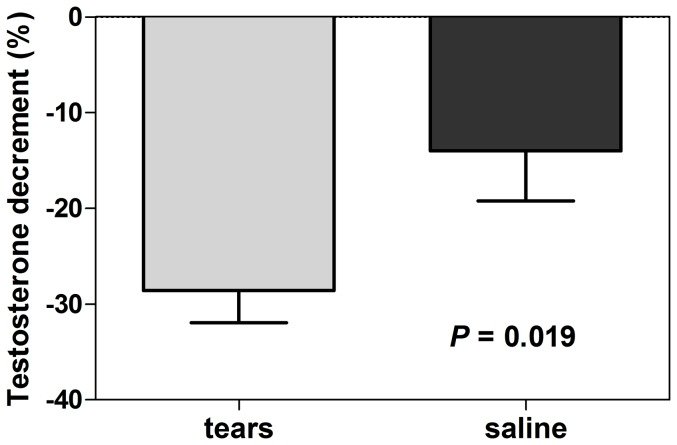
그림 출처: PubMed Central 공개 논문 (PMC3411620)
Conflict of interest statement
Competing Interests:The authors have declared that no competing interests exist.
그 밖의 정보
- 출판 형태
- Clinical Trial, Journal Article, Research Support, Non-U.S. Gov't
- 저널
- PloS one · eISSN 1932-6203
- 전자 출판
- 2012-08-01
- MeSH
- Adolescent · Adult · Appetite* · Double-Blind Method · Eating* · Emotions* · Female · Humans · Plasma* · Postprandial Period* · Tears*
- 참고문헌
- 33편