
Rheumatology (Oxford). 2023;62(9):3014-3024.
Lung function trajectory of rheumatoid arthritis-associated interstitial lung disease.
제1저자 장성혜 · 교신저자 이은영
소속 (11)
- Division of Rheumatology, Department of Internal Medicine, Soonchunhyang University College of Medicine, Cheonan, Republic of Korea.
- Division of Rheumatology, Department of Internal Medicine, Soonchunhyang University Hospital, Cheonan, Republic of Korea.
- Department of Medical Statistics, Clinical Research Center, Asan Institute for Life Sciences, Asan Medical Center, Seoul, Republic of Korea.
- Division of Rheumatology, Department of Internal Medicine, Seoul National University Bundang Hospital, Seongnam, Republic of Korea.
- Department of Radiology, SMG-SNU Boramae Medical Center, Seoul, Republic of Korea.
- Department of Radiology, Soonchunhyang University College of Medicine, Cheonan, Republic of Korea.
- Graduate School of Medical Science and Engineering, Korea Advanced Institute of Science and Technology, Daejeon, Republic of Korea.
- Division of Rheumatology, Department of Internal Medicine, Catholic University of Daegu School of Medicine, Daegu, Republic of Korea.
- Division of Rheumatology, Department of Internal Medicine, Kyung Hee University Hospital, Seoul, Republic of Korea.
- Division of Rheumatology, Department of Internal Medicine, Yonsei University College of Medicine, Seoul, Republic of Korea.
- Division of Rheumatology, Department of Internal Medicine, Seoul National University College of Medicine, Seoul, Republic of Korea.
Abstract
OBJECTIVES To explore the course of lung function and RA disease activity and predictive factors for deteriorating lung function in patients with RA-interstitial lung disease (ILD).
METHODS The Korean Rheumatoid Arthritis-Interstitial Lung Disease cohort is a multicentre, prospective observational cohort. Patients with RA-ILD were enrolled and followed up annually for 3 years for RA disease activity and ILD status assessment. Group-based modelling was used to cluster a similar predicted percentage of forced vital capacity (FVC%) patterns into trajectories.
RESULTS This study included 140 patients who underwent at least two pulmonary function tests. Four distinctive trajectories for predicted FVC% were 'improving' [n = 11 (7.9%)], 'stable' [n = 68 (38.4%)], 'slowly declining' [n = 54 (48.6%)] and 'rapidly declining' [n = 7 (5.0%)]. Most (77.7%) patients maintained or improved to low RA disease activity. The lung function trajectory was not comparable to the RA disease activity trajectory. Age ≥70 years [relative risk (RR) 10.8 (95% CI 1.30, 89.71)] and early RA diagnosed within the preceding 2 years [RR 10.1 (95% CI 1.22, 84.2)] were associated with increased risk for rapidly declining predicted FVC%. The risk for deterioration or mortality increased in patients with a simultaneous diagnosis of RA and ILD within 24 weeks [RR 9.18 (95% CI 2.05, 41.0)] and the extent of lung involvement [RR 3.28 (95% CI 1.12, 9.60)].
CONCLUSION Most patients with RA-ILD experienced stable or slowly declining lung function. In 5% of patients, predicted FVC% deteriorated rapidly, especially in older adults with early RA. The lung function trajectory was not comparable to the RA disease activity trajectory.
© The Author(s) 2023. Published by Oxford University Press on behalf of the British Society for Rheumatology.
Keywords
RAinterstitial lung diseaselung function trajectoryprospective cohort study
Figures
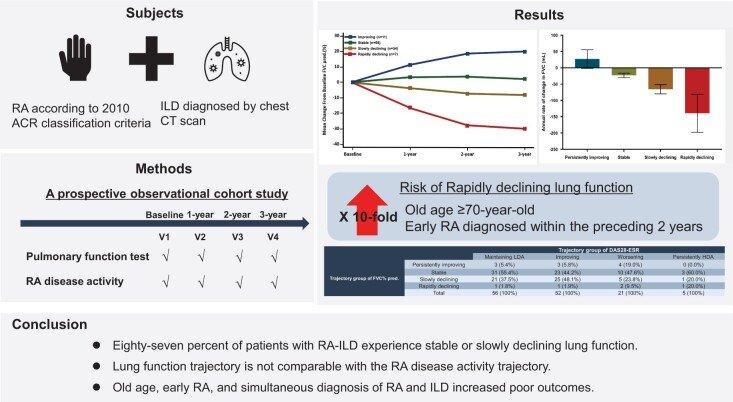
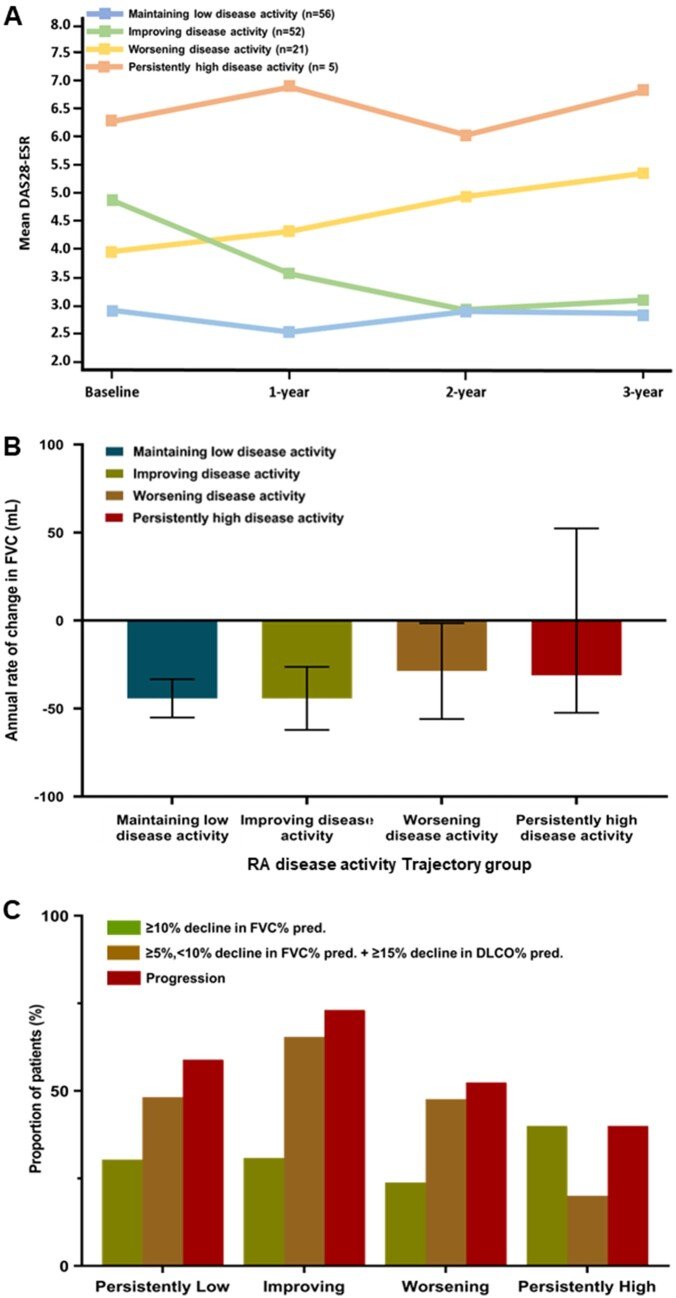
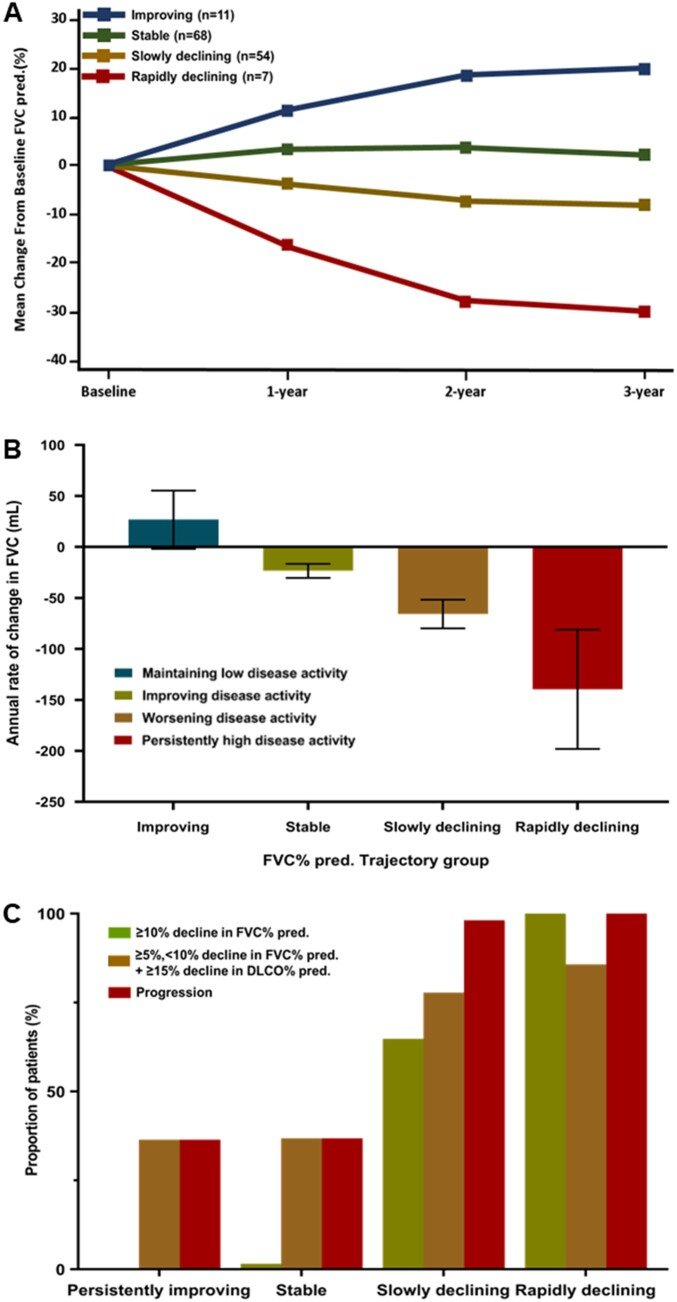
그림 출처: PubMed Central 공개 논문 (PMC10473227)
그 밖의 정보
- 출판 형태
- Observational Study, Journal Article, Research Support, Non-U.S. Gov't
- 저널
- Rheumatology (Oxford, England) · eISSN 1462-0332
- MeSH
- Humans · Aged · Retrospective Studies · Arthritis, Rheumatoid* / complications · Lung Diseases, Interstitial* · Vital Capacity · Lung
- 참고문헌
- 44편