
J Gastroenterol. 2025;60(7):854-865.
Impact of early aggressive treatment on long-term biochemical marker patterns in inflammatory bowel disease.
제1저자 전유경 · 교신저자 안소연, 윤혁
소속 (5)
- Department of Internal Medicine, Seoul National University Bundang Hospital, Seongnam, South Korea.
- Department of Internal Medicine and Liver Research Institute, Seoul National University College of Medicine, Seoul, South Korea.
- Division of Statistics, Medical Research Collaborating Center, Seoul National University Bundang Hospital, Seongnam, South Korea. ahnsoyeon@gmail.com.
- Department of Internal Medicine, Seoul National University Bundang Hospital, Seongnam, South Korea. 99801114@snu.ac.kr.
- Department of Internal Medicine and Liver Research Institute, Seoul National University College of Medicine, Seoul, South Korea. 99801114@snu.ac.kr.
Abstract
BACKGROUNDS The disease course of inflammatory bowel disease (IBD) is highly variable; early and precise identification of patients with poor outcomes is crucial. We aimed to classify the long-term disease course of IBD using biochemical markers and evaluate the clinical factors associated with different disease courses.
METHODS A latent class mixed model was employed to identify distinct trajectories of C-reactive protein (CRP) and fecal calprotectin (FCP) levels in 256 and 635 patients with Crohn's disease (CD) and ulcerative colitis (UC), respectively, from a tertiary hospital cohort. Multinomial logistic regression was used to evaluate the relationships between various trajectories and clinical variables.
RESULTS Three trajectories were identified for CD and UC: class 1, early and sustained biochemical remission; class 2, delayed remission; and class 3, prolonged difficulty in achieving remission for > 5 years. For patients with CD, early immunomodulator initiation was associated with a high likelihood of belonging to class 1 in the CRP trajectory analysis, whereas early advanced therapy increased the probability of belonging to class 1 in the FCP trajectory analysis. CRP trajectory analysis showed no significant associations in patients with UC. Younger age at diagnosis and early immunomodulator initiation were associated with higher odds of being in class 2 or 3, whereas current smoking was associated with a high likelihood of being in class 1 in the FCP trajectory analysis.
CONCLUSIONS Early aggressive medical treatment for CD may lead to long-term biochemical remission, whereas no similar association was observed in UC.
© 2025. The Author(s).
Keywords
Crohn’s DiseaseInflammatory Bowel DiseasesLatent Class Analysis
Figures
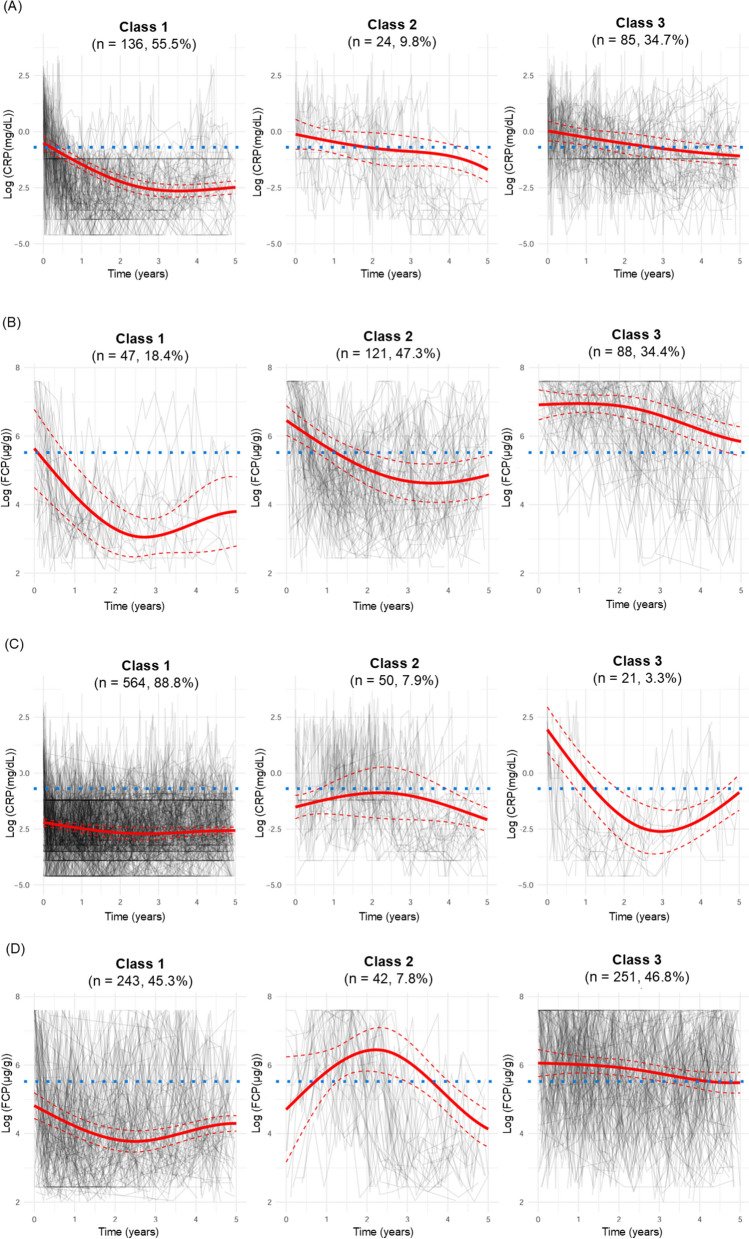
그림 출처: PubMed Central 공개 논문 (PMC12176982)
Conflict of interest statement
Declarations. Conflict of interests: None.
그 밖의 정보
- 출판 형태
- Journal Article, Research Support, Non-U.S. Gov't
- 저널
- Journal of gastroenterology · eISSN 1435-5922
- 전자 출판
- 2025-05-02
- MeSH
- Humans · Male · Female · C-Reactive Protein* / analysis / metabolism · Leukocyte L1 Antigen Complex* / analysis / metabolism · Biomarkers / analysis / metabolism · Adult · Colitis, Ulcerative* / drug therapy · Middle Aged · Crohn Disease* / drug therapy · Feces / chemistry · Remission Induction · Immunologic Factors* / therapeutic use / administration & dosage · Disease Progression · Young Adult · Time Factors · Logistic Models · Age Factors · Cohort Studies
- Substances
- C-Reactive Protein · Leukocyte L1 Antigen Complex · Biomarkers · Immunologic Factors
- 연구비
- Seoul National University Bundang Hospital 02-2023-0024
- 참고문헌
- 42편