
Circ Rep. 2024;6(8):333-340.
One-Month Dual Antiplatelet Therapy in High Bleeding Risk Asian Patients Undergoing Percutaneous Coronary Intervention - Onyx ONE Clear 2-Year Results.
제1저자 강지훈 · 교신저자 김효수
소속 (15)
- Seoul National University Hospital Seoul Republic of Korea.
- Hospital Serdang Kajang Malaysia.
- Keimyung University Dongsan Medical Center Daegu Republic of Korea.
- Queen Mary Hospital Hong Kong China.
- Bundang Cha Medical Center Seongnam-si Republic of Korea.
- Seoul National University Bundang Hospital Seongnam-si Republic of Korea.
- Piedmont Heart Institute Atlanta, GA USA.
- The Cardiovascular Research Foundation New York, NY USA.
- School of Medicine at Mount Sinai New York, NY USA.
- Montefiore Medical Center New York, NY USA.
- McGill University Health Center Montreal, Quebec Canada.
- Medtronic Santa Rosa, CA USA.
- Medtronic Seoul Republic of Korea.
- Inselspital, University of Bern Bern Switzerland.
- The Zena and Michael A. Wiener Cardiovascular Institute, Icahn School of Medicine at Mount Sinai New York, NY USA.
Abstract
BACKGROUND One-month dual antiplatelet therapy (DAPT) in high bleeding risk (HBR) patients undergoing percutaneous coronary intervention (PCI) with the Resolute OnyxTM zotarolimus-eluting stents (ZES) is safe and effective. Asian patients have a unique ischemia/bleeding risk profile. Here, we compare the outcomes between Asian and non-Asian patients after PCI and 1-month DAPT.
METHODS AND RESULTS Onyx ONE Clear was a prospective, multicenter study enrolling HBR patients undergoing PCI with the Resolute Onyx ZES (ClinicalTrials.gov identifier NCT03647475). Event-free patients after 1-month DAPT transitioned to single antiplatelet therapy. Clinical outcomes between 1 month and 2 years were compared between patients from Asian and non-Asian countries after 1 : 1 propensity score matching accounting for baseline differences. Patients from Asian countries represented 18% (n=273) of the study group (n=1,507). Non-Asian patients had greater clinical complexity; however, these differences were minimal after matching. There were no significant differences in ischemic outcomes between matched cohorts from 1 month to 2 years, including the primary composite endpoint of cardiac death or myocardial infarction (12% vs. 12%; P>0.99). However, there were significantly fewer Bleeding Academic Research Consortium types 3-5 bleeding events in the Asian vs. non-Asian cohort (4% vs. 9%; P=0.007), despite similar bleeding risk profiles after matching.
CONCLUSIONS After propensity score matching, HBR patients from Asian countries undergoing PCI treated with 1-month DAPT had similar ischemic outcomes but fewer bleeding events between 1 month and 2 years compared with patients from non-Asian countries.
Copyright © 2024, THE JAPANESE CIRCULATION SOCIETY.
Keywords
Asian patientsDrug-eluting stentsHigh bleeding riskPercutaneous coronary intervention
Figures

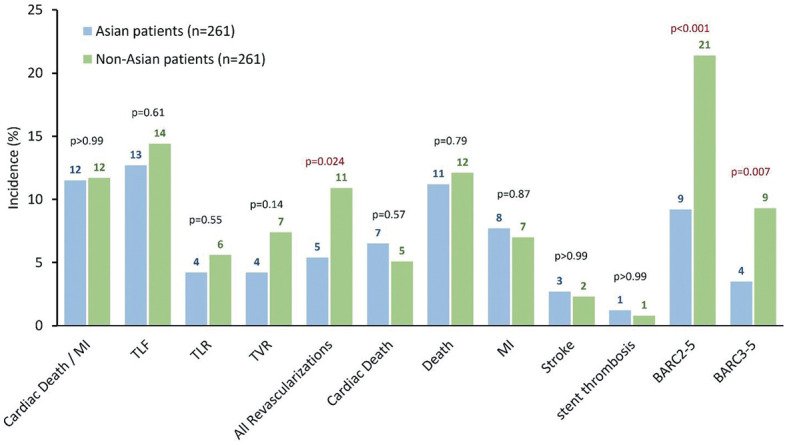
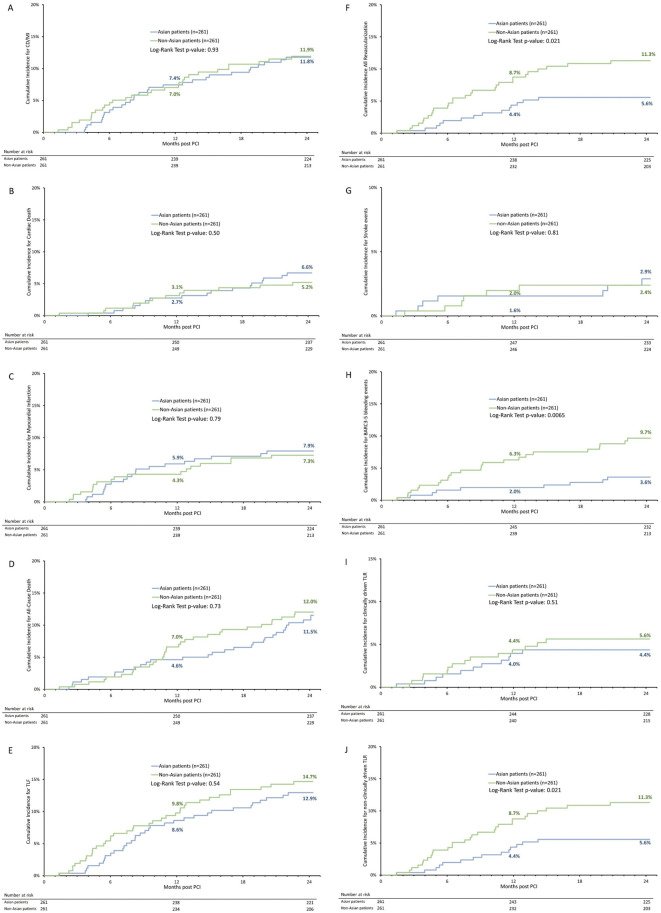
그림 출처: PubMed Central 공개 논문 (PMC11309775)
Conflict of interest statement
S.-H.H. receives research grants through Keimyung University Dongsan Hospital and from Terumo and Biotronik. He also receives consultation fees from Viatris. C.C.T. is on the Medtronic Advisory Board. D.E.K. reports institutional research/grant support from Biotronik, Boston Scientific, Cardiovascular Systems, Inc., Orbus Neich, Teleflex, Medtronic and Ablative Solutions, and personal consulting honoraria from Cardiovascular Systems, Inc., Medtronic, and Abbott Vascular. A.J.K. reports institutional funding to Columbia University and/or the Cardiovascular Research Foundation from Medtronic, Boston Scientific, Abbott Vascular, Amgen, CSI, Siemens, Philips, ReCorMedical, Neurotronic, Biotronik. In addition to research grants, institutional funding includes fees paid to Columbia University and/or the Cardiovascular Research Foundation for consulting and/or speaking engagements in which A.J.K. controlled the content. He has also received consulting fees from IMDS, travel expenses/meals from Medtronic, Boston Scientific, Abbott Vascular, Abiomed, CSI, Siemens, Philips, ReCorMedical, Chiesi, OpSens, Zoll, and Regeneron. A.L. reports being a consultant and/or on the advisory board of Medtronic, Abbott Vascular, and Boston Scientific. T.-H.L. and S.-J.Y. are employees of Medtronic. S.W. reports research, travel or educational grants to the institution without personal remuneration from Abbott, Abiomed, Amgen, Astra Zeneca, Bayer, Braun, Biotronik, Boehringer Ingelheim, Boston Scientific, Bristol Myers Squibb, Cardinal Health, CardioValve, Cordis Medical, Corflow Therapeutics, CSL Behring, Daiichi Sankyo, Edwards Lifesciences, Farapulse Inc. Fumedica, Guerbet, Idorsia, Inari Medical, InfraRedx, Janssen-Cilag, Johnson & Johnson, Medalliance, Medicure, Medtronic, Merck Sharp & Dohm, Miracor Medical, Novartis, Novo Nordisk, Organon, OrPha Suisse, Pharming Tech. Pfizer, Polares, Regeneron, Sanofi-Aventis, Servier, Sinomed, Terumo, Vifor, V-Wave. S.W. served as advisory board member and/or member of the steering/executive group of trials funded by Abbott, Abiomed, Amgen, Astra Zeneca, Bayer, Boston Scientific, Biotronik, Bristol Myers Squibb, Edwards Lifesciences, MedAlliance, Medtronic, Novartis, Polares, Recardio, Sinomed, Terumo, and V-Wave with payments to the institution but no personal payments. He is also member of the steering/executive committee group of several investigator-initiated trials that receive funding by industry without impact on his personal remuneration. G.W.S. has received speaker honoraria from Medtronic, Pulnovo, Infraredx, Abiomed, Amgen, Boehringer Ingelheim, has served as a consultant to Abbott, Daiichi Sankyo, Ablative Solutions, CorFlow, Apollo Therapeutics, Cardiomech, Gore, Robocath, Miracor, Vectorious, Abiomed, Valfix, TherOx, HeartFlow, Neovasc, Ancora, Elucid Bio, Occlutech, Impulse Dynamics, Adona Medical, Millennia Biopharma, Oxitope, Cardiac Success, and HighLife, and has equity/options from Ancora, Cagent, Applied Therapeutics, Biostar family of funds, SpectraWave, Orchestra Biomed, Aria, Cardiac Success, Valfix, Xenter. G.W.S.’s employer, Mount Sinai Hospital, receives research grants from Abbott, Abiomed, Bioventrix, Cardiovascular Systems Inc, Phillips, Biosense-Webster, Shockwave, Vascular Dynamics, Pulnovo and V-wave. Family disclosure: G.W.S.’s daughter is an employee at IQVIA. H.-S.K. received research grants through Seoul National University Hospital from Abbott, Medtronic, Biotronik, B Braun, and Daiichi Sankyo. He received fees for lecture and consultation from Edwards Lifesciences, Medtronic, Novartis, Pfizer, Sankyo, AmGen, Astrazeneca, and Beringer Ingelheim. All other authors have no conflicts of interest to disclose.
그 밖의 정보
- 출판 형태
- Journal Article
- 저널
- Circulation reports · eISSN 2434-0790
- 전자 출판
- 2024-07-06
- 데이터
- ClinicalTrials.gov: NCT03647475
- 참고문헌
- 23편