
JHEP Rep. 2024;6(7):101089.
Lack of association between early on-treatment HBeAg seroclearance and development of hepatocellular carcinoma or decompensated cirrhosis.
제1저자 신현재, 최원묵, 김승업 · 교신저자 이정훈
소속 (4)
- Department of Internal Medicine and Liver Research Institute, Seoul National University College of Medicine, Seoul, Republic of Korea.
- Department of Gastroenterology, Liver Center, Asan Medical Center, University of Ulsan College of Medicine, Seoul, Republic of Korea.
- Department of Internal Medicine, Yonsei University College of Medicine, Seoul, Korea; Yonsei Liver Center, Severance Hospital, Seoul, Republic of Korea.
- INSERM Unit 1052 - Cancer Research Center of Lyon, Hospices Civils de Lyon, Lyon University, Lyon, France.
Abstract
BACKGROUND & AIMS The association between hepatitis B envelope antigen (HBeAg) seroclearance during long-term nucleos(t)ide analogue (NA) treatment and the risk of hepatocellular carcinoma (HCC) in patients with chronic hepatitis B (CHB) remains unclear. Here, we aimed to investigate the association of HBeAg seroclearance during potent NA treatment with the development of HCC and decompensated cirrhosis.
METHODS Using a multicenter historical cohort including 2,392 non-cirrhotic adult patients with HBeAg-positive CHB who initiated NA treatment with tenofovir or entecavir, the risk of HCC and decompensated cirrhosis was compared between patients who achieved HBeAg seroclearance within 36 months of NA treatment (the HBeAg-loss group) and those who did not (the HBeAg-maintained group), using inverse probability of treatment weighting.
RESULTS Over a median of 6.6 years of NA treatment, 1,077 patients achieved HBeAg seroclearance (HBeAg loss rate = 6.0 per 100 person-years), 64 patients developed HCC (HCC incidence rate = 0.39 per 100 person-years), and 46 patients developed decompensated cirrhosis (decompensation incidence rate = 0.28 per 100 person-years). The HBeAg-loss and HBeAg-maintained groups had a similar risk of developing HCC (hazard ratio 0.89; 95% CI 0.47-1.68; p = 0.72) and decompensated cirrhosis (hazard ratio 0.98; 95% CI 0.48-1.81; p = 0.91). Compared with delayed HBeAg seroclearance beyond 10 years of NA treatment, the risk of HCC was comparable in those who achieved earlier HBeAg seroclearance at any time point within 10 years, regardless of baseline age and fibrotic burden.
CONCLUSIONS Early HBeAg seroclearance during NA treatment was not associated with a reduced risk of development of HCC or decompensated cirrhosis in non-cirrhotic HBeAg-positive patients with CHB.
IMPACT AND IMPLICATIONS The association between hepatitis B envelope antigen (HBeAg) seroclearance during long-term nucleos(t)ide analogue treatment and the risk of hepatocellular carcinoma in patients with chronic hepatitis B remains unclear. Our findings indicate that early on-treatment HBeAg seroclearance within 3 years was not associated with the development of hepatocellular carcinoma or decompensated cirrhosis. Achieving HBeAg seroclearance may not be an appropriate surrogate endpoint for preventing the development of liver-related outcomes in non-cirrhotic patients with HBeAg-positive chronic hepatitis B treated with nucleos(t)ide analogues.
© 2024 The Author(s).
Keywords
EntecavirLiver cancerNucleos(t)ide analogueTenofovirTime-varying effects
Figures
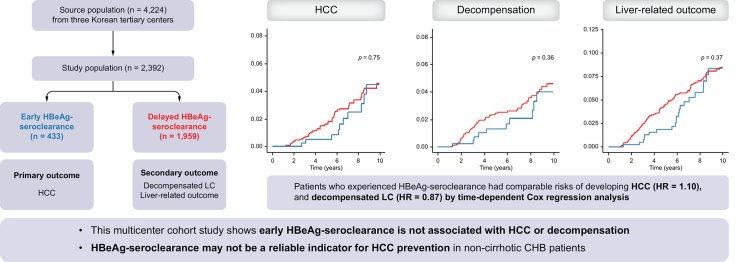
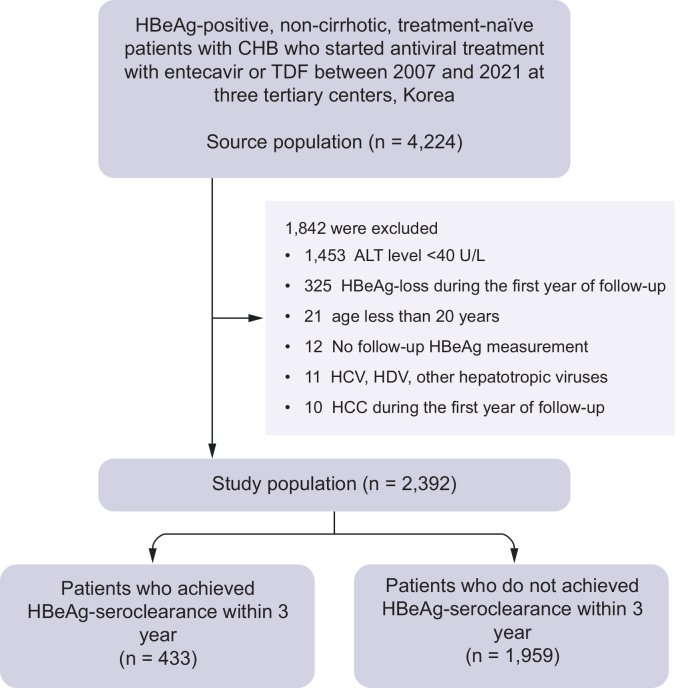
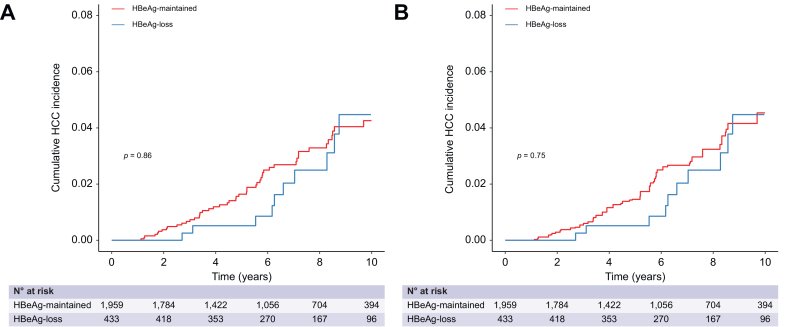
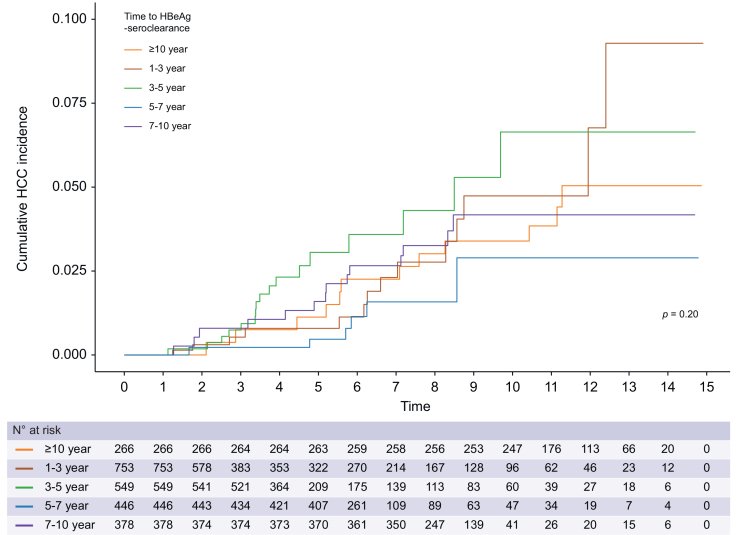
그림 출처: PubMed Central 공개 논문 (PMC11225842)
그 밖의 정보
- 출판 형태
- Journal Article
- 저널
- JHEP reports : innovation in hepatology · eISSN 2589-5559
- 전자 출판
- 2024-04-08
- 참고문헌
- 50편