
Medicine (Baltimore). 2016;95(21):e3671.
Pretransplant Hepatitis B Viral Infection Increases Risk of Death After Kidney Transplantation: A Multicenter Cohort Study in Korea.
제1저자 이정환 · 교신저자 이정표
소속 (1)
- From the Internal Medicine (JL), Hallym University Hangang Sacred Heart Hospital, Seoul; Internal Medicine (JHC, CDK), Kyungpook National University Hospital, Daegu; Department of Internal Medicine (JSL), Ulsan University Hospital, University of Ulsan College of Medicine, Ulsan; Internal Medicine (DWA, CSL, JPY), Seoul National University Boramae Medical Center; Internal Medicine (CA, YSK), Seoul National University Hospital; Surgery (IMJ), Seoul National University Boramae Medical Center; Surgery (DJH, YHK), Ulsan University Seoul Asan Medical Center, Seoul, Korea.
Abstract
Clinical outcomes in kidney transplant recipients (KTRs) with hepatitis B virus (HBV) have not been thoroughly evaluated. Here, we investigated recent posttransplant clinical outcomes of KTRs with HBV and compared them with KTRs with hepatitis C virus (HCV) and seronegative KTRs.Of 3855 KTRs from April 1999 to December 2011, we enrolled 3482 KTRs who had viral hepatitis serology data; the patients were followed up for 89.1 ± 54.1 months. The numbers of recipients with HBV and HCV were 160 (4.6%) and 55 (1.6%), respectively. We analyzed the clinical outcomes, including overall mortality and graft failure, among patients who had undergone kidney transplantation.Patients with HBV showed poorer survival (P = 0.019; adjusted hazard ratio [HR] = 2.370; 95% confidence interval [CI]: 1.155-4.865) than KTRs without HBV. However, the graft survival of patients with chronic hepatitis B did not differ from that of patients without HBV. Hepatic complications were the primary causes of mortality of KTRs with HBV. Mortality significantly correlated with a higher grade of inflammation (P = 0.002) and with the use of lamivudine or adefovir antiviral treatment (P = 0.016). HBV-positive KTRs treated with the new-generation antiviral agent entecavir showed improved patient survival compared with KTRs receiving lamivudine (log-rank P = 0.050). HCV did not affect patient survival; however, it increased the incidence of graft failure (P = 0.010; adjusted HR = 2.899; 95% CI: 1.289-6.519). KTRs with HCV had an increased incidence of acute rejection (log-rank P = 0.005, crude HR = 2.144; 95% CI: 1.341-3.426; P = 0.001).KTRs with chronic hepatitis B may exhibit poor survival due to post-transplantation hepatic complications. Pretransplant histological liver evaluations and adequate antiviral management with potent nucleoside/nucleotide analogues are needed to improve the survival of KTRs with chronic hepatitis B even when liver function is within the normal range.
Figures
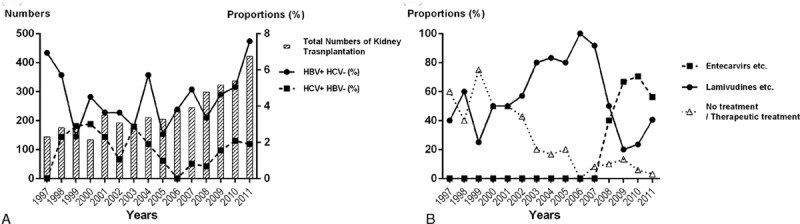
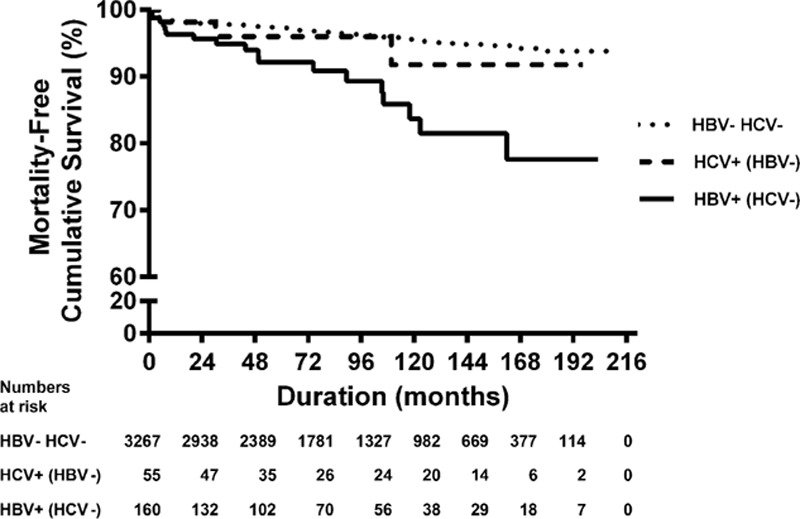
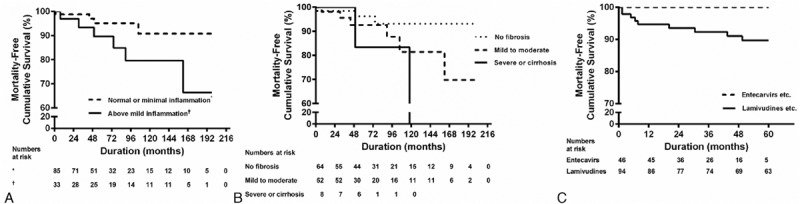
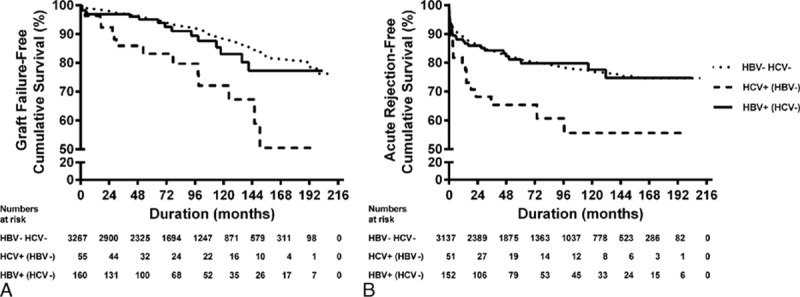
그림 출처: PubMed Central 공개 논문 (PMC4902351)
Conflict of interest statement
The authors have no conflicts of interest to disclose.
그 밖의 정보
- 출판 형태
- Journal Article, Multicenter Study, Observational Study
- 저널
- Medicine · eISSN 1536-5964
- MeSH
- Adult · Antiviral Agents / therapeutic use · Biopsy · Cohort Studies · Female · Graft Survival · Hepatitis B / complications / drug therapy · Hepatitis C / complications / drug therapy · Humans · Kidney Transplantation / mortality / statistics & numerical data · Male · Middle Aged · Proportional Hazards Models · Renal Insufficiency / complications / surgery · Republic of Korea / epidemiology · Tertiary Care Centers
- Substances
- Antiviral Agents
- 참고문헌
- 43편