
JHEP Rep. 2024;6(4):101033.
Adverse pregnancy outcomes as a risk factor for new-onset metabolic dysfunction-associated steatotic liver disease in postpartum women: A nationwide study.
제1저자 정영미, 이승미 · 교신저자 박중신, 조금준 김원
소속 (7)
- Department of Obstetrics and Gynecology, Korea University College of Medicine, Seoul, Korea.
- Department of Obstetrics and Gynecology, Seoul National University College of Medicine, Seoul, Korea.
- Department of Obstetrics and Gynecology, Seoul National University Hospital, Seoul, Korea.
- Innovative Medical Technology Research Institute, Seoul National University Hospital, Seoul, Korea.
- Institute of Reproductive Medicine and Population, Medical Research Center, Seoul National University, Seoul, Korea.
- Department of Internal Medicine, Seoul National University College of Medicine, Seoul, Korea.
- Division of Gastroenterology and Hepatology, Department of Internal Medicine, Seoul Metropolitan Government Boramae Medical Center, Seoul, Korea.
Abstract
BACKGROUND & AIMS Adverse pregnancy outcomes (APOs) can worsen cardiometabolic risk factors in women, raising their likelihood of developing cardiometabolic diseases at a young age after their initial pregnancy. Nevertheless, there are limited data on the risk of newly developing metabolic dysfunction-associated steatotic liver disease (MASLD) in women who have had APOs. This study aimed to evaluate the risk of new-onset MASLD after experiencing APOs.
METHODS Singleton pregnant women who underwent national health screenings 1 year before pregnancy and 1 year after delivery were included in this study. APOs were defined as the presence of at least one of the followings: hypertensive disorders of pregnancy (HDP), gestational diabetes mellitus (GDM), preterm birth, low birth weight, and placental abruption. The primary outcome was new-onset MASLD based on the presence of APOs.
RESULTS Among 80,037 study participants, 9,320 (11.6%) experienced APOs during pregnancy. Women who experienced APOs had an increased risk of developing new-onset MASLD after delivery even after adjustments for various covariates (adjusted odds ratio [OR] 1.58, 95% CI 1.45-1.72). In particular, women who experienced either HDP or GDM showed a significantly increased risk of developing new-onset MASLD (adjusted OR 2.20, 95% CI 1.81-2.67, for HDP and adjusted OR 1.83, 95% CI 1.65-2.03, for GDM). Moreover, there was a tendency toward an increased risk of new-onset MASLD according to the number of APOs (p <0.001 for trend of odds).
CONCLUSIONS APOs were associated with the risk of new-onset MASLD after delivery. Specifically, only HDP or GDM were identified as risk factors for new-onset MASLD.
IMPACT AND IMPLICATIONS This nationwide cohort study confirms that postpartum women with a history of adverse pregnancy outcomes (APOs) are at an increased risk of developing metabolic dysfunction-associated steatotic liver disease (MASLD). These findings may bring us one step closer to understanding the exact mechanisms underlying such an important association between prior APOs and cardiovascular disease (CVD) risk among postpartum women. This bidirectional association between APOs and MASLD highlights the importance of considering pregnancy history in assessing CVD risk in women. It suggests a need for closer monitoring and lifestyle interventions for women with a history of APOs to reduce the risk of MASLD and subsequent CVD complications.
© 2024 The Author(s).
Keywords
Adverse pregnancy outcomesCardiovascular diseaseGestational diabetes mellitusHypertensive disorders of pregnancyMetabolic dysfunction-associated steatotic liver disease
Figures
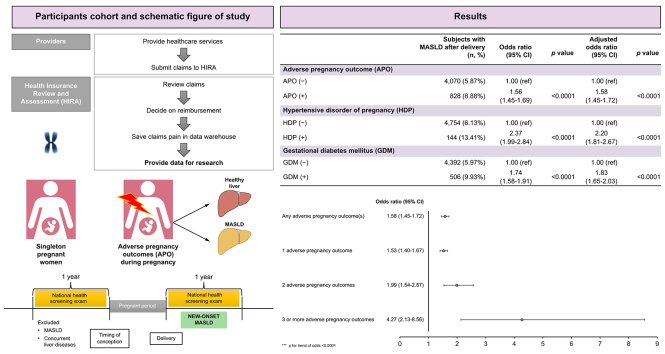
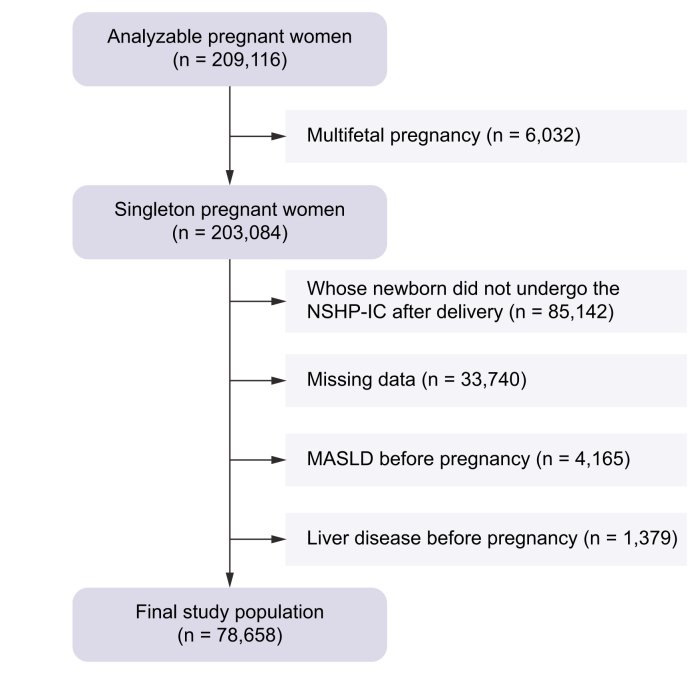
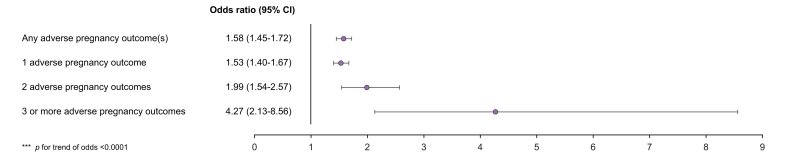
그림 출처: PubMed Central 공개 논문 (PMC10960121)
Conflict of interest statement
The authors have no conflicts of interest to disclose. Please refer to the accompanying ICMJE disclosure forms for further details.
그 밖의 정보
- 출판 형태
- Journal Article
- 저널
- JHEP reports : innovation in hepatology · eISSN 2589-5559
- 전자 출판
- 2024-02-23
- 참고문헌
- 43편