
ERJ Open Res. 2020;6(3):00109-2020.
Clinical course of asymptomatic small enhancing brain nodules in patients with nonsmall cell lung cancer: do we have to follow them up?
제1저자 이현우 · 교신저자 최선미
소속 (3)
- Division of Pulmonary and Critical Care Medicine, Dept of Internal Medicine, Seoul Metropolitan Government-Seoul National University Boramae Medical Center, Seoul, South Korea.
- Division of Pulmonary and Critical Medicine, Dept of Internal Medicine, Seoul National University College of Medicine, Seoul National University Hospital, Seoul, South Korea.
- Dept of Radiology, Seoul National University Hospital, Seoul, South Korea.
Abstract
AIMS Brain magnetic resonance imaging (MRI) is recommended during the initial work-up for nonsmall cell lung cancer (NSCLC). Although small enhancing brain nodules not radiologically confirmed as metastatic lesions have often been detected, their clinical course has not been well studied.
METHODS This nested case-control study included NSCLC patients who had small enhancing brain nodules detected by serial brain MRIs from January 2014 through December 2018 at a tertiary university hospital. Small enhancing brain nodules were defined as round enhancing nodules of ≤10 mm diameter without oedema in thin-section (1 mm) contrast MRIs. The incidence, natural course and risk factors of growing nodules were evaluated.
RESULTS A total of 171 small enhancing brain nodules in 123 patients were observed over an average of 22.1 months. The incidence of nodule growth was 49.1% with mean growth rate of 11 mm·year-1. We found that 25.0% of the growing nodules contributed to clinical upstaging compared to the initial stage. Cerebral events were more common in growing nodules; therefore, local therapy was performed more often. However, there was no difference in the cerebral event-related mortality. Nodule growth was more frequent in younger individuals, multiple nodules, advanced disease, poorly differentiated carcinoma, rim enhancement and larger initial size. In multivariable analysis, predictors of growth were N stage ≥1, existence of epidermal growth factor receptor mutation and larger initial size.
CONCLUSION Considering the clinical course of small enhancing brain nodules, more intensive evaluation is required for early detection and pre-emptive intervention when accompanied by risk factors.
Copyright ©ERS 2020.
Figures
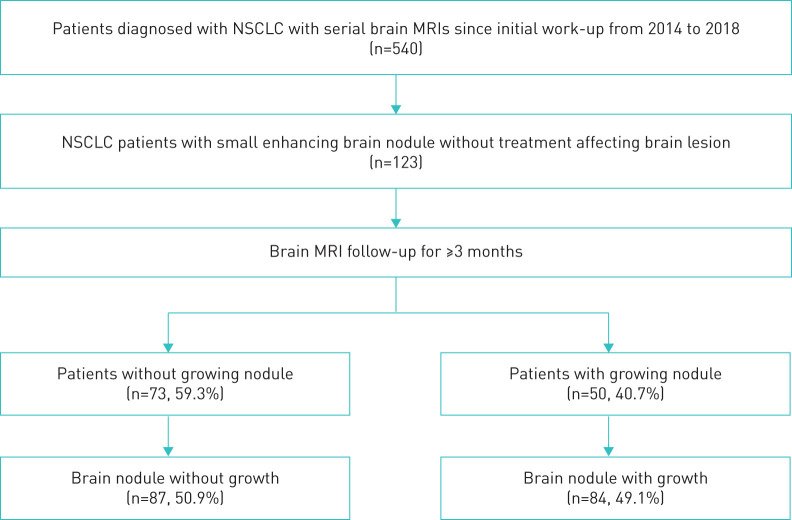
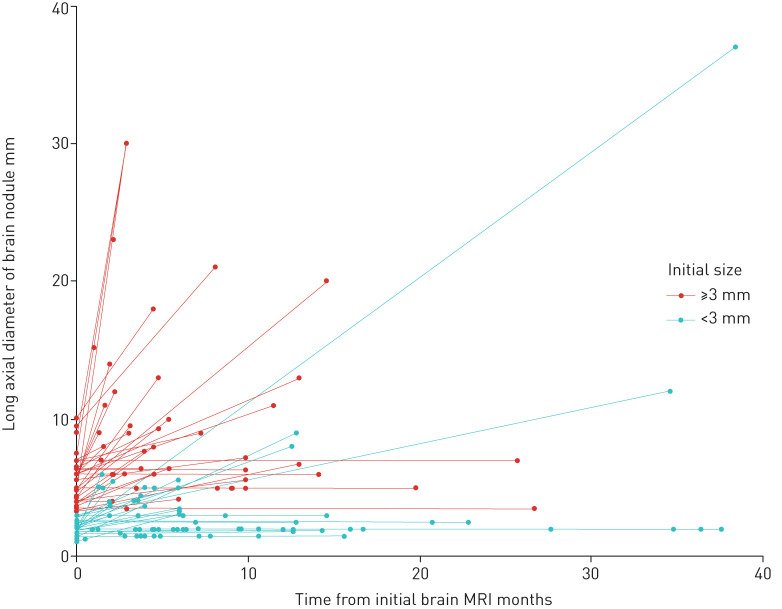
그림 출처: PubMed Central 공개 논문 (PMC7487354)
Conflict of interest statement
Conflict of interest: H.W. Lee has nothing to disclose. Conflict of interest: J. Cho has nothing to disclose. Conflict of interest: N. Kwak has nothing to disclose. Conflict of interest: I. Hwang has nothing to disclose. Conflict of interest: Y.S. Park has nothing to disclose. Conflict of interest: C-H. Lee has nothing to disclose. Conflict of interest: S-M. Lee has nothing to disclose. Conflict of interest: C-G. Yoo has nothing to disclose. Conflict of interest: Y.W. Kim has nothing to disclose. Conflict of interest: S.M. Choi has nothing to disclose.
그 밖의 정보
- 출판 형태
- Journal Article
- 저널
- ERJ open research · ISSN 2312-0541
- 전자 출판
- 2020-09-14
- 참고문헌
- 24편