
Antimicrob Resist Infect Control. 2017;6:103.
Implementation of central line-associated bloodstream infection prevention bundles in a surgical intensive care unit using peer tutoring.
제1저자 박상원 · 교신저자 박상원
소속 (3)
- Infection Control Office, Boramae Medical Center, Seoul, Republic of Korea.
- Department of Internal Medicine, Boramae Medical Center, Seoul National University College of Medicine, 20 Boramae-ro 5-Gil, Dongjak-gu, Seoul, 07061 Republic of Korea.
- Intensive Care Units, Boramae Medical Center, Seoul, Republic of Korea.
Abstract
BACKGROUND Central line-associated bloodstream infections (CLABSIs) can be prevented through well-coordinated, multifaceted programs. However, implementation of CLABSI prevention programs requires individualized strategies for different institutional situations, and the best strategy in resource-limited settings is uncertain. Peer tutoring may be an efficient and effective method that is applicable in such settings.
METHODS A prospective intervention was performed to reduce CLABSIs in a surgical intensive care unit (SICU) at a tertiary hospital. The core interventions consisted of implementation of insertion and maintenance bundles for CLABSI prevention. The overall interventions were guided and coordinated by active educational programs using peer tutoring. The CLABSI rates were compared for 9 months pre-intervention, 6 months during the intervention and 9 months post-intervention. The CLABSI rate was further observed for three years after the intervention.
RESULTS The rate of CLABSIs per 1000 catheter-days decreased from 6.9 infections in the pre-intervention period to 2.4 and 1.8 in the intervention (6 m; P = 0.102) and post-intervention (9 m; P = 0.036) periods, respectively. A regression model showed a significantly decreasing trend in the infection rate from the pre-intervention period (P < 0.001), with incidence-rate ratios of 0.348 (95% confidence interval [CI], 0.98-1.23) in the intervention period and 0.257 (95% CI, 0.07-0.91) in the post-intervention period. However, after the 9-month post-intervention period, the yearly CLABSI rates reverted to 3.0-5.4 infections per 1000 catheter-days over 3 years.
CONCLUSIONS Implementation of CLABSI prevention bundles using peer tutoring in a resource-limited setting was useful and effectively reduced CLABSIs. However, maintaining the reduced CLABSI rate will require further strategies.
Keywords
Central line-associated bloodstream infectionEducationIntensive care unitInterventionLearning by teachingPeer tutoring
Figures
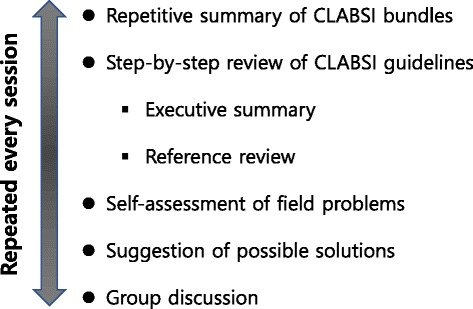
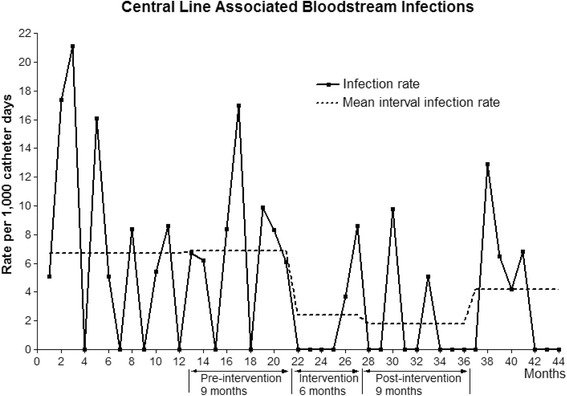
그림 출처: PubMed Central 공개 논문 (PMC5625794)
Conflict of interest statement
ETHICS APPROVAL AND CONSENT TO PARTICIPATE: This study was approved by the Institutional Review Board at Boramae Medical Center (06–2012-105). Collection of informed consent was waived because this study was conducted as part of an institutional policy to improve internal infection control and was retrospective in nature. All personal identifiers were anonymized for confidentiality before data processing. This research was in compliance with the Helsinki Declaration. CONSENT FOR PUBLICATION: Not applicable. COMPETING INTERESTS: The authors declare that they have no competing interests. PUBLISHER’S NOTE: Springer Nature remains neutral with regard to jurisdictional claims in published maps and institutional affiliations.
그 밖의 정보
- 출판 형태
- Journal Article
- 저널
- Antimicrobial resistance and infection control · eISSN 2047-2994
- 전자 출판
- 2017-10-02
- 참고문헌
- 24편