
J Am Heart Assoc. 2017;6(11):JAHA.117.007170.
Cardiovascular Effects of Long-Term Exposure to Air Pollution: A Population-Based Study With 900 845 Person-Years of Follow-up.
제1저자 김현지 · 교신저자 강시혁
소속 (5)
- Department of Internal Medicine, Seoul National University College of Medicine, Seoul National University Bundang Hospital, Seongnam-Si, Korea.
- Department of Emergency Medicine, Seoul National University Bundang Hospital, Seongnam-Si, Korea.
- Department of Internal Medicine, Seoul National University College of Medicine, Seoul National University Bundang Hospital, Seongnam-Si, Korea eandp303@snu.ac.kr.
- Department of Internal Medicine, Chung-Ang University College of Medicine, Seoul, Korea.
- Department of Environmental Health and Institute of Health and Environment, Graduate School of Public Health, Seoul National University, Seoul, Korea.
Abstract
BACKGROUND Studies have shown that long-term exposure to air pollution such as fine particulate matter (≤2.5 μm in aerodynamic diameter [PM2.5]) increases the risk of all-cause and cardiovascular mortality. To date, however, there are limited data on the impact of air pollution on specific cardiovascular diseases. This study aimed to evaluate cardiovascular effects of long-term exposure to air pollution among residents of Seoul, Korea.
METHODS AND RESULTS Healthy participants with no previous history of cardiovascular disease were evaluated between 2007 and 2013. Exposure to air pollutants was estimated by linking the location of outdoor monitors to the ZIP code of each participant's residence. Crude and adjusted analyses were performed using Cox regression models to evaluate the risk for composite cardiovascular events including cardiovascular mortality, acute myocardial infarction, congestive heart failure, and stroke. A total of 136 094 participants were followed for a median of 7.0 years (900 845 person-years). The risk of major cardiovascular events increased with higher mean concentrations of PM2.5 in a linear relationship, with a hazard ratio of 1.36 (95% confidence interval, 1.29-1.43) per 1 μg/m3 PM2.5. Other pollutants including PM2.5-10 of CO, SO2, and NO2, but not O3, were significantly associated with increased risk of cardiovascular events. The burden from air pollution was comparable to that from hypertension and diabetes mellitus.
CONCLUSIONS This large-scale population-based study demonstrated that long-term exposure to air pollution including PM2.5 increases the risk of major cardiovascular disease and mortality. Air pollution should be considered an important modifiable environmental cardiovascular risk factor.
© 2017 The Authors. Published on behalf of the American Heart Association, Inc., by Wiley.
Keywords
air pollutioncardiovascular disease risk factorsepidemiologyparticulate matter
Figures

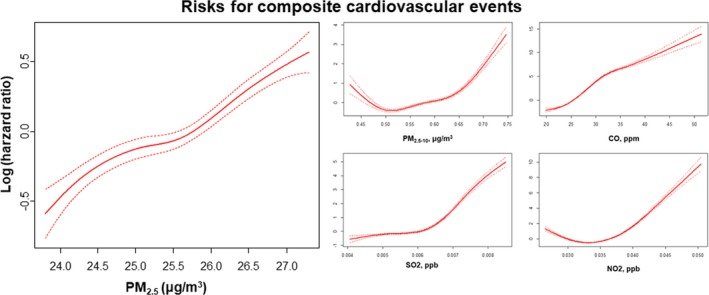


그림 출처: PubMed Central 공개 논문 (PMC5721790)
그 밖의 정보
- 출판 형태
- Journal Article, Multicenter Study
- 저널
- Journal of the American Heart Association · eISSN 2047-9980
- 전자 출판
- 2017-11-08
- MeSH
- Adult · Aged · Air Pollution / adverse effects · Cardiovascular Diseases / epidemiology / etiology · Female · Follow-Up Studies · Healthy Volunteers · Humans · Male · Middle Aged · Morbidity / trends · Population Surveillance* · Prognosis · Proportional Hazards Models · Republic of Korea / epidemiology · Risk Factors · Survival Rate / trends · Time Factors
- 참고문헌
- 34편