
Cancer Res Treat. 2026;58(2):656-663.
Prognostic Landscape of TP53 Mutations in Hematologic Malignancies.
제1저자 장서윤 · 교신저자 신동엽
소속 (5)
- Department of Internal Medicine, Seoul National University Hospital, Seoul, Korea.
- Department of Laboratory Medicine, Seoul National University Hospital, Seoul, Korea.
- Cancer Research Institute, Seoul National University College of Medicine, Seoul, Korea.
- Department of Internal Medicine, Seoul Metropolitan Government Seoul National University Boramae Medical Center, Seoul, Korea.
- Center for Medical Innovation, Biomedical Research Institute, Seoul National University Hospital, Seoul, Korea.
Abstract
PURPOSE While TP53 mutations are well known to be associated with adverse prognosis in hematological diseases, their functional impact remains incompletely understood. This study examines the spectrum of TP53 mutations across various hematologic malignancies and evaluates their functional impact.
MATERIALS AND METHODS Using targeted sequencing panels, we analyzed TP53 mutations in the bone marrow aspiration samples of a retrospective cohort of 856 patients diagnosed with hematologic malignancies. To assess the impact of TP53 mutations, we applied the evolutionary action (EAp53) score and the relative fitness score (RFS), previously proposed functional scoring methods. The effects of variant allele frequency (VAF), disruptive mutations, EAp53 score, and RFS on overall survival (OS) were evaluated.
RESULTS TP53 mutations were associated with inferior OS compared with wildtype TP53 (median OS 10.0 months versus not estimable; hazard ratio (HR) 4.6; p<0.001). In the acute myeloid leukemia, multiple myeloma, and myelodysplastic syndrome subgroups, TP53 mutations had a significant adverse impact on OS. (HRs 3.8, 4.2, 6.0, respectively; p<0.001, p=0.005, p<0.001, respectively). Patients with VAF >50% had significantly poorer OS compared to those with VAF ≤50% (median OS 7.5 months versus 22.8 months; HR 2.2, p=0.016). Moreover, patients in the high-risk RFS group (RFS >0.22) had significantly worse OS compared to those in the low-risk RFS group (RFS ≤0.22) (median OS 5.6 months versus 16.3 months; HR 2.2, p=0.041). However, no significant survival difference was observed between the EAp53 high-risk (>75) and low-risk (≤75) groups, or between patients with disruptive and non-disruptive mutations.
CONCLUSION Our findings highlight VAF and RFS as valuable tools for stratifying TP53-mutant patients into high-risk and low-risk groups.
Keywords
DNAGenesHematologic neoplasmsSequence analysisp53
Figures

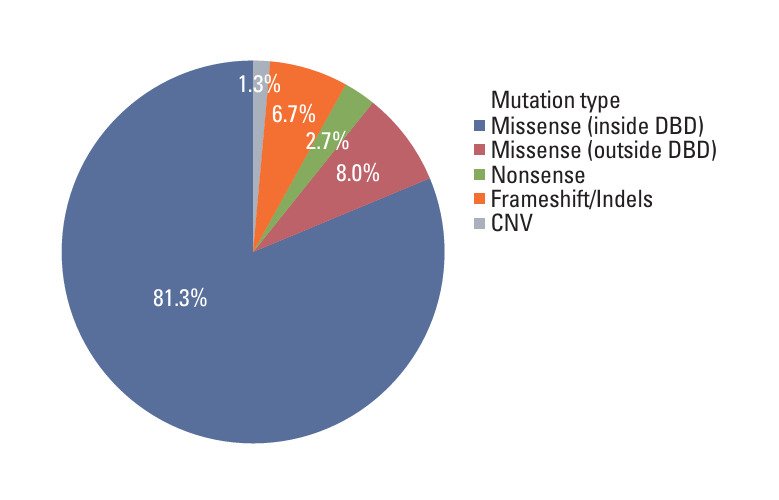
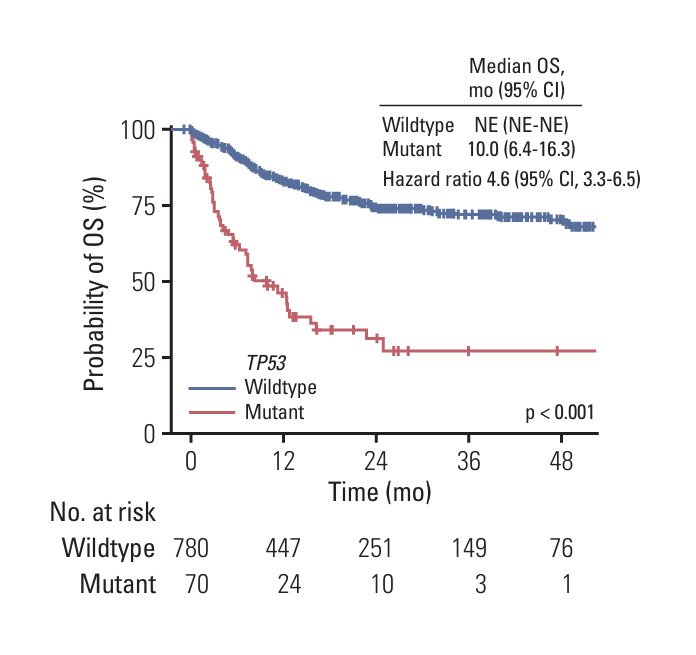
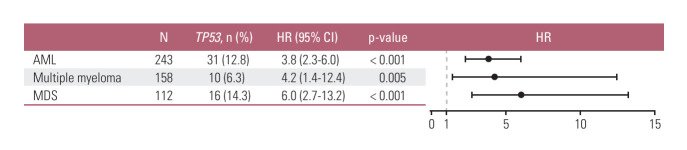


그림 출처: PubMed Central 공개 논문 (PMC13093014)
Conflict of interest statement
Conflicts of Interest . Conflict of interest relevant to this article was not reported.
그 밖의 정보
- 출판 형태
- Journal Article
- 저널
- Cancer research and treatment · eISSN 2005-9256
- 전자 출판
- 2025-05-27
- MeSH
- Humans · Tumor Suppressor Protein p53* / genetics · Hematologic Neoplasms* / genetics / mortality / pathology · Mutation* · Prognosis · Male · Female · Middle Aged · Aged · Retrospective Studies · Adult · Aged, 80 and over · Gene Frequency · Young Adult · Biomarkers, Tumor* / genetics
- Substances
- Tumor Suppressor Protein p53 · TP53 protein, human · Biomarkers, Tumor
- 참고문헌
- 30편