
Cancer Res Treat. 2026;58(1):252-263.
Survival Rates of Patients with Gastric Cancer According to Age and Sex: A Large-Scale Study Using Data from 14,739 Patients.
제1저자 최용훈 · 교신저자 김나영
소속 (10)
- Department of Internal Medicine, Seoul National University Bundang Hospital, Seongnam, Korea.
- Research Center for Sex- and Gender-Specific Medicine, Seoul National University Bundang Hospital, Seongnam, Korea.
- Department of Internal Medicine and Liver Research Institute, Seoul National University College of Medicine, Seoul, Korea.
- Department of Internal Medicine, Daegu Catholic University School of Medicine, Daegu, Korea.
- Department of Pathology, Seoul National University Bundang Hospital, Seongnam, Korea.
- Department of Pathology, Seoul National University College of Medicine, Seoul, Korea.
- Department of Surgery, Seoul National University Bundang Hospital, Seongnam, Korea.
- Department of Surgery, Seoul National University College of Medicine, Seoul, Korea.
- Department of Radiology, Seoul National University Bundang Hospital, Seongnam, Korea.
- Department of Radiology, Seoul National University College of Medicine, Seoul, Korea.
Abstract
PURPOSE The male predominance in the incidence of gastric cancer (GC) is established; however, sex differences in the prognosis of GC remain controversial. As such, this study analyzed the prognosis of patients with GC based on age and sex.
MATERIALS AND METHODS Data from 14,739 patients diagnosed with GC at Seoul National University Bundang Hospital between 2003 and 2023 were analyzed. Baseline characteristics, histological types of GC, overall and GC-specific survival rates (age and stage stratification), and associated risk factors were analyzed.
RESULTS Females were significantly younger (p < 0.001) and exhibited more gastric body cancers (p < 0.001) and tumors with diffuse-type or poorly differentiated histology (p < 0.001) than males. Females exhibited an advantage over males in terms of overall survival (p=0.004), but not in GC-specific survival. However, age stratification revealed significant sex differences, that females < 50 years of age exhibited survival disadvantages (p < 0.001); however, this trend was reversed with age, and females > 60 years exhibited survival advantages (p < 0.001) for both overall and GC-specific survival. This may be explained by the lower ratio of diffuse-type GC as females age. Furthermore, in the analysis according to stage, females with stage IV disease exhibited significant survival disadvantages, with significantly younger age and a higher proportion of diffuse-type GC which exhibits aggressive features, resulting in poorer survival than in males.
CONCLUSION Age and stage stratification revealed significant differences in survival between the sexes, which can be helpful for public health strategies.
Keywords
PrognosisSexStomach neoplasmSurvival
Figures

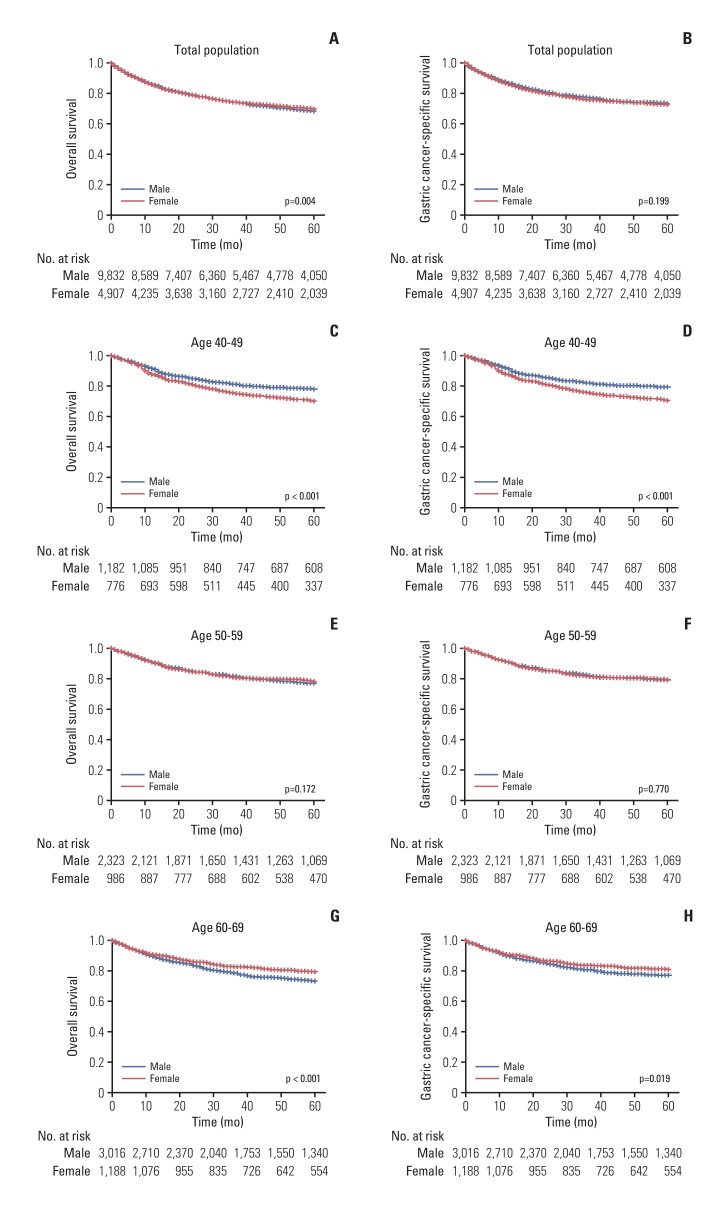

그림 출처: PubMed Central 공개 논문 (PMC12800952)
Conflict of interest statement
Conflicts of Interest . Conflict of interest relevant to this article was not reported.
그 밖의 정보
- 출판 형태
- Journal Article
- 저널
- Cancer research and treatment · eISSN 2005-9256
- 전자 출판
- 2025-04-16
- MeSH
- Humans · Stomach Neoplasms* / mortality / pathology / epidemiology · Male · Female · Middle Aged · Aged · Age Factors · Sex Factors · Prognosis · Adult · Survival Rate · Neoplasm Staging · Aged, 80 and over · Risk Factors · Republic of Korea / epidemiology
- 연구비
- National Research Foundation of Korea RS-2024-00337453 · Ministry of Science and ICT · Seoul National University Bundang Hospital 02-2023-0012
- 참고문헌
- 31편