Department of Pathology, Seoul National University Hospital, Seoul National University College of Medicine, Seoul, Korea.
Cancer Research Institute, Seoul National University, Seoul, Korea.
Department of Internal Medicine, Seoul National University Hospital, Seoul National University College of Medicine, Seoul, Korea.
Department of Laboratory Medicine, Seoul National University Hospital, Seoul National University College of Medicine, Seoul, Korea.
Department of Genomic Medicine, Seoul National University Hospital, Seoul, Korea.
Biomedical Research Institute, Seoul National University Hospital, Seoul, Korea.
Genomic Medicine Institute, Medical Research Center, Seoul National University, Seoul, Korea.
Abstract
PURPOSE Considering the high disease burden and unique features of Asian patients with breast cancer (BC), it is essential to have a comprehensive view of genetic characteristics in this population. An institutional targeted sequencing platform was developed through the Korea Research-Driven Hospitals project and was incorporated into clinical practice. This study explores the use of targeted next-generation sequencing (NGS) and its outcomes in patients with advanced/metastatic BC in the real world.
MATERIALS AND METHODS We reviewed the results of NGS tests administered to BC patients using a customized sequencing platform-FiRST Cancer Panel (FCP)-over 7 years. We systematically described clinical translation of FCP for precise diagnostics, personalized therapeutic strategies, and unraveling disease pathogenesis.
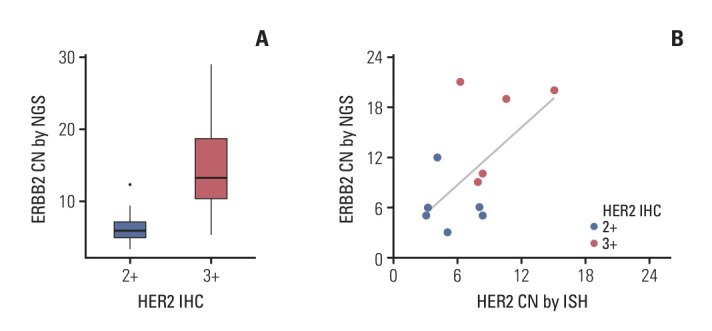
RESULTS NGS tests were conducted on 548 samples from 522 patients with BC. Ninety-seven point six percentage of tested samples harbored at least one pathogenic alteration. The common alterations included mutations in TP53 (56.2%), PIK3CA (31.2%), GATA3 (13.8%), BRCA2 (10.2%), and amplifications of CCND1 (10.8%), FGF19 (10.0%), and ERBB2 (9.5%). NGS analysis of ERBB2 amplification correlated well with human epidermal growth factor receptor 2 immunohistochemistry and in situ hybridization. RNA panel analyses found potentially actionable and prognostic fusion genes. FCP effectively screened for potentially germline pathogenic/likely pathogenic mutation. Ten point three percent of BC patients received matched therapy guided by NGS, resulting in a significant overall survival advantage (p=0.022), especially for metastatic BCs.
CONCLUSION Clinical NGS provided multifaceted benefits, deepening our understanding of the disease, improving diagnostic precision, and paving the way for targeted therapies. The concrete advantages of FCP highlight the importance of multi-gene testing for BC, especially for metastatic conditions.
Keywords
Breast neoplasmsCancer evolutionCopy number variationFusion geneHereditary cancerMutationNext-generation sequencing
Figures
Fig. 1.The genetic profile of breast cancer patients unveiled by FiRST Cancer Panel. The overall distribution of commonly detected mutations, copy number variations, fusions, as well as microsatellite instability scores and tumor mutational burden are presented alongside clinicopathological features. CTx, chemotherapy; ET, endocrine therapy; ER, estrogen receptor; IDC, invasive ductal carcinoma; HER2, human epidermal growth factor receptor 2; ILC, invasive lobular carcinoma; IO, immuno-oncology; MSI, microsatellite instability; TMB, tumor mutational burden; TNBC, triple-negative breast cancer; Tx, therapy.Fig. 2.ERBB2 copy number assessment by FiRST Cancer Panel compared to human epidermal growth factor receptor 2 (HER2) immunohistochemistry and in situ hybridization. (A) ERBB2 copy numbers were higher in tumors with HER2 immunohistochemistry (IHC) 3+ compared to HER2 IHC 2+. (B) ERBB2 copy number assessed by FiRST Cancer Panel showed a significant correlation with the results of HER2 in situ hybridization. CN, copy number; ISH, in situ hybridization; NGS, next-generation sequencing.Fig. 3.Fusion genes identified by FiRST Cancer Panel. (A) The novel ESR1::NBAT fusion gene is expected to cause the distruption of ligand binding domain of ESR1. (B) Fusion gene structures and clinical course of the patients harboring BCL2L14::ETV6 fusions are presented Case No. 205 was a 30-year-old female diagnosed with locally advanced triple-negative breast cancer. The lesions in the right breast, right axillary lymph nodes, and internal mammary lymph nodes (arrows in the first image) decreased after the neoadjuvant treatment with olaparib+durvalumab window of opportunity treatment followed by standard neoadjuvant therapy consisting of doxorubicin+ cyclophosphamide followed by docetaxel (arrow in the second image). However, the disease recurred with lung, pleura, and mediastinal lymph nodes (arrows in the third image) metastases after 1 year and 3 months. Case No. 296 was a 43-year-old premenopausal woman who initially presented with extensively metastatic breast cancer involving the axial skeleton. Despite palliative chemotherapy with docetaxel and cisplatin, the disease rapidly progressed after 3 months in bone and leptomeningeal seeding, however, extensive bone metastases showed metabolic response after 4 cycles of SG. CTx, chemotherapy; SG, Sacituzumab Govitecan.Fig. 4.Utilization of FiRST Cancer Panel for screening germline predisposition and cancer evolution. (A) Biallelic inactivation of PALB2 revealed by FiRST Cancer Panel (FCP) prompted germline confirmatory testing. The patient was confirmed to harbor germline PALB2 pathogenic mutation and enrolled in a clinical trial using a poly(ADP-ribose) polymerase inhibitor (PARPi), resulting in a remarkable clinical response (B). (C) Sequential FCP tests using samples from two different time points showed a BRCA1 reversion mutation. VAF, variant allele frequency.Fig. 5.Genetic evolution model of a rare breast cancer by multi-region sequencing. A rare mixed invasive ductal carcinoma and spindle cell carcinoma was subject to multi-region sequencing, where we found evidence of divergent evolution from a common ancestor. AC, adriamycin+cyclophosphamide; DFS, disease-free survival; IDC, invasive ductal carcinoma; LN, lymph node; PD, progressive disease; PFS, progression-free survival.Fig. 6.Matched therapy guided by FiRST Cancer Panel. (A, B) Progression-free survival and overall survival (OS) from the day 1 of the matched therapy are presented. (C) Better OS from metastasis diagnosis was observed in patients who received matched therapy compared to those who did not. (D) A remarkable response to poly(ADP-ribose) polymerase inhibitor (PARPi) was observed in a patient with somatic ATM mutation identified by FiRST Cancer Panel. C1D1, cycle 1 day 1; EOT, end of treatment; OS, overall survival; PFS, progression-free survival.
그림 출처: PubMed Central 공개 논문 (PMC12016828)
Conflict of interest statement
Conflicts of Interest . Jiwon Koh reports receiving consultation fees from DCGen. Co., Ltd. Seock-Ah Im reports advisory role for AstraZeneca, Novartis, Roche/Genentech, Eisai, Pfizer, Amgen, Hanmi, Lilly, MSD, Daiichi Sankyo, and received research grants through institution from AstraZeneca (Inst), Pfizer (Inst), Roche/Genentech (Inst), Daewoong Pharmaceutical (Inst), Eisai (Inst), Boryung Pharmaceuticals (Inst).
그 밖의 정보
출판 형태
Journal Article
저널
Cancer research and treatment · eISSN 2005-9256
전자 출판
2024-08-21
MeSH
Humans · Breast Neoplasms* / genetics / mortality / pathology / therapy · Female · High-Throughput Nucleotide Sequencing* / methods · Middle Aged · Biomarkers, Tumor* / genetics · Mutation · Adult · Aged · Precision Medicine · Prognosis · Republic of Korea · Aged, 80 and over