
Medicine (Baltimore). 2016;95(12):e3179.
Predictors of Relapse in Adult-Onset Nephrotic Minimal Change Disease.
제1저자 이하정 · 교신저자 임춘수
소속 (1)
- From the Department of Internal Medicine (HL, DKK, KHO, KWJ, YSK, CA, JSH, CSL), Seoul National University Hospital; Kidney Research Institute (YKO, DKK, KWJ, YSK, CA, JSH, CSL), Seoul National University; Department of Internal Medicine (YKO, CSL), Seoul National University Boramae Medical Center, Seoul; and Department of Internal Medicine (KDY), Dongguk University Medical Center, Gyeongju, Republic of Korea.
Abstract
Minimal change disease (MCD) is a well-known benign primary glomerulonephritis because of its distinct rare tendency to progress to end-stage renal disease. However, factors associated with relapse in adults are not well known. We aimed to identify predictors of relapse in adult-onset MCD patients.A retrospective cohort of 195 patients with adult-onset primary MCD with nephritic syndrome and disease onset between 1979 and 2013 was followed up for >12 months. The number of relapses was counted and predictors of relapse were analyzed.A total of 195 patients were included. Median age at diagnosis was 38 years (IQR, 23-53 years) and 113 (57.9%) were men. During 81 months (IQR, 44-153 months) of follow-up, 92% of patients achieved remission after initial treatment. However, only 60 (32.8%) did not experience a relapse and 11 patients failed to remit. Among the remaining 124 patients, 65 experienced a relapse once or twice and 59 experienced a relapse more than twice. Younger onset age, increased severity of nephrotic features such as lower serum albumin levels and higher cholesterol level were associated with relapse. Interestingly, the grade of mesangial proliferation was lower in patients who experienced a relapse. Initial combined treatment with corticosteroids (CS) and cyclophosphamide reduced the number of relapses. In addition, patients with shorter treatment duration tended to experience relapse more often. Multivariate analysis showed that younger onset age, combined mesangial proliferation, initial treatment regimen, and treatment duration were independent risk factors for relapse. Progression to end-stage renal disease was developed in only a patient.In conclusion, more than two-thirds of adult-onset nephrotic MCD patients experienced relapse, although their renal progression was rare. Younger onset age, CS without cyclophosphamide treatment, and shorter treatment duration were independent risk factors for relapse in adult-onset MCD patients.
Figures
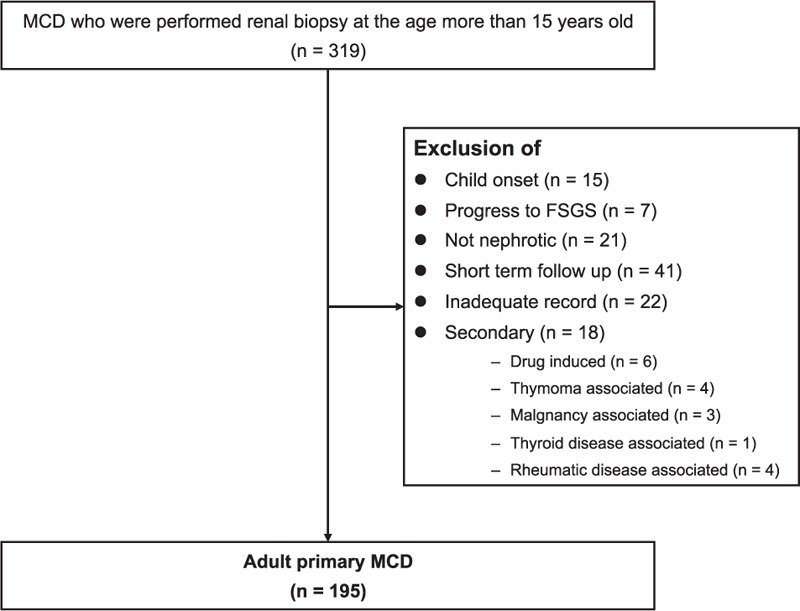
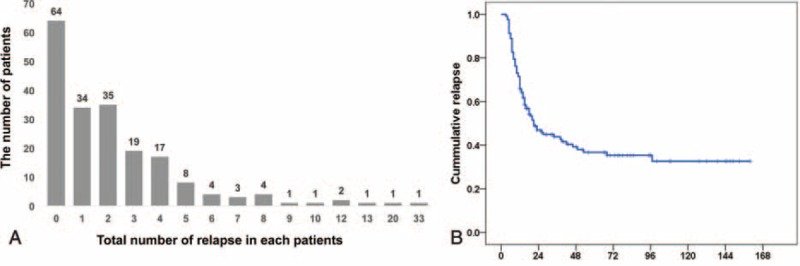
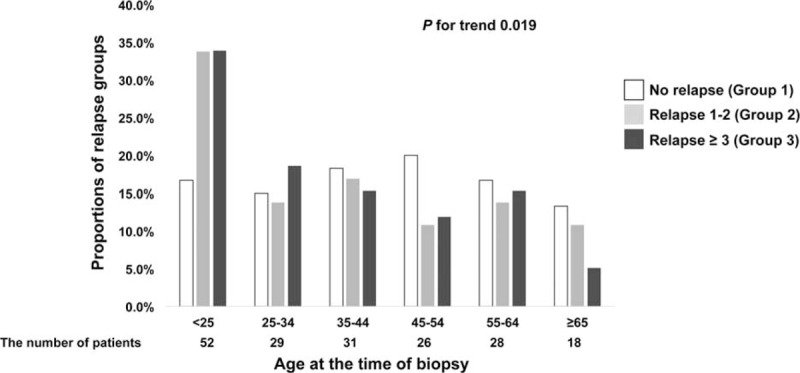
그림 출처: PubMed Central 공개 논문 (PMC4998403)
Conflict of interest statement
The authors have no funding and conflicts of interest to disclose.
그 밖의 정보
- 출판 형태
- Journal Article
- 저널
- Medicine · eISSN 1536-5964
- MeSH
- Adult · Age of Onset · Cohort Studies · Female · Humans · Male · Middle Aged · Nephrosis, Lipoid / diagnosis / drug therapy · Prognosis · Recurrence · Retrospective Studies · Young Adult
- 참고문헌
- 26편