SCI 발표논문

SCI 발표논문

← SCI 발표논문 목록

Korean Circ J. 2025;55(12):1106-1121.

Influence of Rhythm Control on Functional Mitral and Tricuspid Regurgitation Severity and Clinical Outcome in Patients With Atrial Fibrillation: A Propensity-Matched Cohort Study.

, , , , , , , ,

제1저자 박지석 · 교신저자 최홍미

소속 (4)
  1. Department of Cardiology, Cardiovascular Center, Seoul National University Bundang Hospital, Seongnam, Korea.
  2. Department of Internal Medicine, Seoul National University College of Medicine, Seoul, Korea.
  3. Department of Internal Medicine, Seoul National University College of Medicine, Seoul, Korea. hmchoi@snubh.org.
  4. Department of Internal Medicine, Seoul National University College of Medicine, Seoul, Korea. jihyunlee310@snubh.org.

Abstract

BACKGROUND AND OBJECTIVES This study evaluated the efficacy of atrial fibrillation (AF) rhythm control therapy in improving functional mitral regurgitation (MR) and tricuspid regurgitation (TR) and its association with clinical outcomes.

METHODS Among 2,574 patients with AF screened from 2003 to 2023, 817 pairs of patients were selected through propensity matching to compare rhythm control therapy (antiarrhythmic drugs, catheter ablation, or electrical cardioversion) with no rhythm control. MR and TR severity were assessed at baseline and follow-up echocardiography conducted at least 3-month intervals. Clinical outcomes included all-cause mortality and heart failure-related hospitalizations.

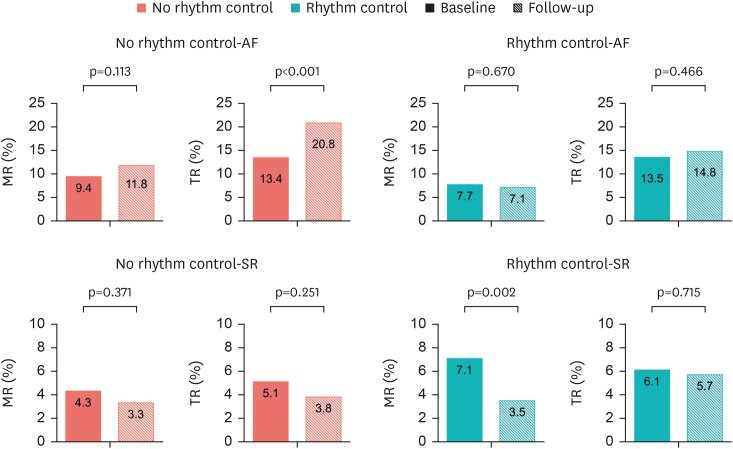
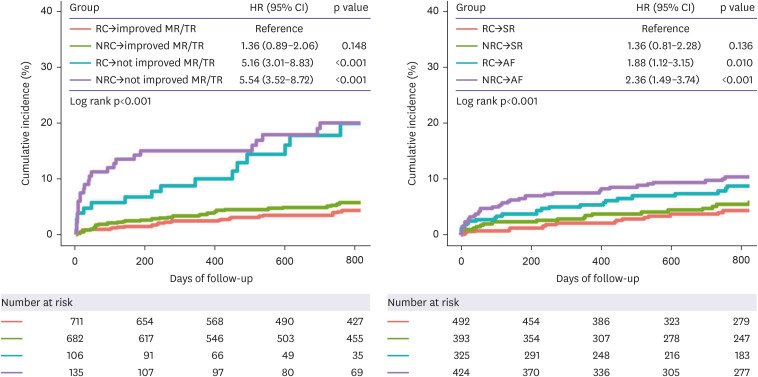
RESULTS Rhythm control was associated with a reduction in moderate or greater MR (7.3% to 4.9%, p=0.008) and attenuation of TR progression (9.1% to 9.3%, p=0.796), contrary to the worsening trends in the no rhythm control group. Sinus restoration was more frequent in the rhythm control group compared to the no rhythm control group (60.2% vs. 48.1%, p<0.001). Patients maintaining sinus rhythm after rhythm control showed the greatest MR improvement (7.3% to 3.5%, p=0.002). Rhythm control was also associated with reverse cardiac remodeling, including reductions in left atrial volume index and improved left ventricular ejection fraction (both p<0.001). Clinical outcomes were more favorable in the rhythm control group, particularly among patients with improved regurgitation or restored sinus rhythm.

CONCLUSIONS AF rhythm control therapy is associated with improved functional MR, attenuated TR progression, enhanced sinus rhythm maintenance, and favorable clinical outcomes. Echocardiography can provide valuable information for identifying the optimal timing of rhythm control intervention and assessing treatment response.

Copyright © 2025. The Korean Society of Cardiology.

Keywords

Anti-arrhythmia agentsAtrial fibrillationCatheter ablationMitral regurgitationTricuspid regurgitation

Figures

Figure 1
Figure 1 Trajectories in MR and TR severity stratified by AF rhythm control therapy. Trends in functional MR and TR, stratified by rhythm control therapy, were visualized using the Sankey diagram. Interval changes in moderate or greater MR and TR were further analysed according to the rhythm control therapy. AF = atrial fibrillation; MR = mitral regurgitation; TR = tricuspid regurgitation.
Figure 2
Figure 2 Interval changes in moderate or greater regurgitation according to AF rhythm control therapy and follow-up rhythm status. The impact of rhythm control therapy on subsequent changes in moderate or greater functional regurgitation was analysed according to the rhythm status at follow-up echocardiography. AF = atrial fibrillation; MR = mitral regurgitation; SR = sinus rhythm; TR = tricuspid regurgitation.
Figure 3
Figure 3 Interval changes in moderate or greater regurgitation and echocardiographic features according to AF rhythm control therapy in patients with progressed AF status. The impact of AF rhythm control therapy on functional regurgitation and cardiac remodelling was analysed in patients with progressed AF status, characterized by enlarged LV volume, and in those with persistent AF. AF = atrial fibrillation; EF = ejection fraction; LA = left atrial; LAVI = left atrial volume index; LVEF = left ventricular ejection fraction; MR = mitral regurgitation; TR = tricuspid regurgitation.
Figure 4
Figure 4 Path diagrams of relationship between AF rhythm control therapy, improved regurgitation status or sinus restoration, and clinical outcome. The path diagrams illustrated the associations between rhythm control therapy, improved regurgitation status or sinus restoration, and clinical outcomes. The direct and indirect effects of rhythm control therapy were represented by coefficients along each path, serving as effect estimates. AF = atrial fibrillation; HF = heart failure; MR = mitral regurgitation; SE = standard error; TR = tricuspid regurgitation.
Figure 5
Figure 5 Clinical outcome according to AF RC therapy and associated functional regurgitation and rhythm status. The event curves for clinical outcomes were displayed based on RC therapy, with additional stratification by improved regurgitation status and sinus restoration at follow-up echocardiography. AF = atrial fibrillation; HR = hazard ratio; MR = mitral regurgitation; NRC = no rhythm control; RC = rhythm control; SR = sinus rhythm; TR = tricuspid regurgitation.
Figure 6
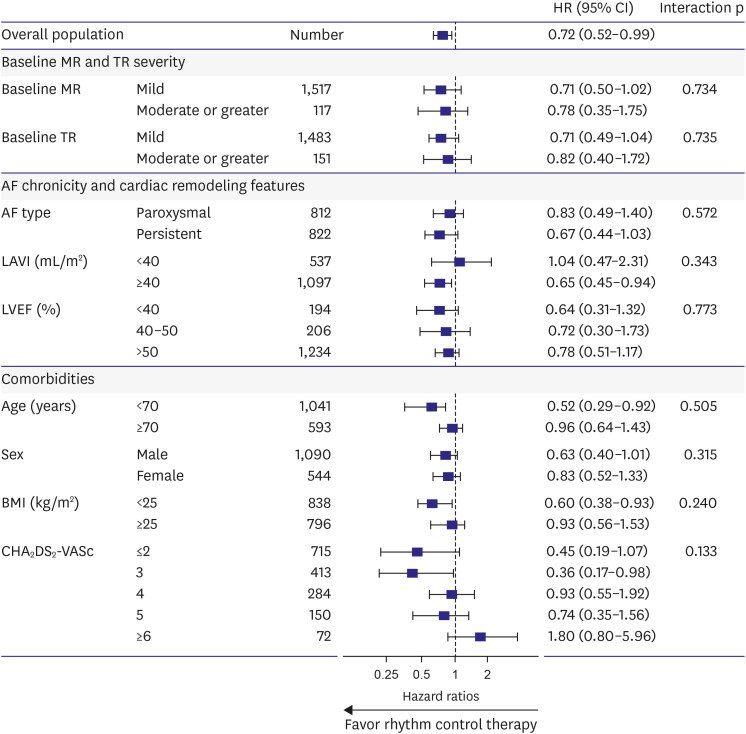
Figure 6 Subgroup analysis of outcome risk associated with AF rhythm control therapy. The outcome risk associated with the rhythm control therapy was examined across diverse clinical presentations, considering baseline MR and TR severity, AF chronicity, cardiac remodelling features, and associated comorbidities. AF = atrial fibrillation; BMI = body mass index; CI = confidence interval; HR = hazard ratio; LAVI = left atrial volume index; LVEF = left ventricular ejection fraction; MR = mitral regurgitation; TR = tricuspid regurgitation.

그림 출처: PubMed Central 공개 논문 (PMC12705248)

Conflict of interest statement

The authors have no financial conflicts of interest.

그 밖의 정보
출판 형태
Journal Article
저널
Korean circulation journal · ISSN 1738-5520
전자 출판
2025-07-01
연구비
Korean Society of Echocardiography KSER-202403
참고문헌
30편