Graduate School of Medical Science and Engineering, Korea Advanced Institute of Science and Technology, Daejeon, 34141, Korea.
Department of Internal Medicine, Seoul National University Bundang Hospital, Seoul National University College of Medicine, Seoul, Korea.
Division of Endocrinology and Metabolism, Department of Internal Medicine, Seoul St. Mary's Hospital, College of Medicine, The Catholic University of Korea, Seoul, Republic of Korea.
Biomedical Research Center, Korea Advanced Institute of Science and Technology, Daejeon, 34141, Korea.
Department of Biochemistry, College of Medicine, Chungnam National University, Daejeon, Korea.
Department of Physiology, College of Medicine, Yeongnam University, Daegu, Korea.
Department of Internal Medicine, Seoul National University Bundang Hospital, Seoul National University College of Medicine, Seoul, Korea. janghak@snu.ac.kr.
Graduate School of Medical Science and Engineering, Korea Advanced Institute of Science and Technology, Daejeon, 34141, Korea. hailkim@kaist.edu.
Biomedical Research Center, Korea Advanced Institute of Science and Technology, Daejeon, 34141, Korea. hailkim@kaist.edu.
Abstract
Pregnancy imposes a substantial metabolic burden on women, but little is known about whether or how multiple pregnancies increase the risk of maternal postpartum diabetes. In this study, we assessed the metabolic impact of multiple pregnancies in humans and in a rodent model. Mice that underwent multiple pregnancies had increased adiposity, but their glucose tolerance was initially improved compared to those of age-matched virgin mice. Later, however, insulin resistance developed over time, but insulin secretory function and compensatory pancreatic β cell proliferation were impaired in multiparous mice. The β cells of multiparous mice exhibited aging features, including telomere shortening and increased expression of Cdkn2a. Single-cell RNA-seq analysis revealed that the β cells of multiparous mice exhibited upregulation of stress-related pathways and downregulation of cellular respiration- and oxidative phosphorylation-related pathways. In humans, women who delivered more than three times were more obese, and their plasma glucose concentrations were elevated compared to women who had delivered three or fewer times, as assessed at 2 months postpartum. The disposition index, which is a measure of the insulin secretory function of β cells, decreased when women with higher parity gained body weight after delivery. Taken together, our findings indicate that multiple pregnancies induce cellular stress and aging features in β cells, which impair their proliferative capacity to compensate for insulin resistance.
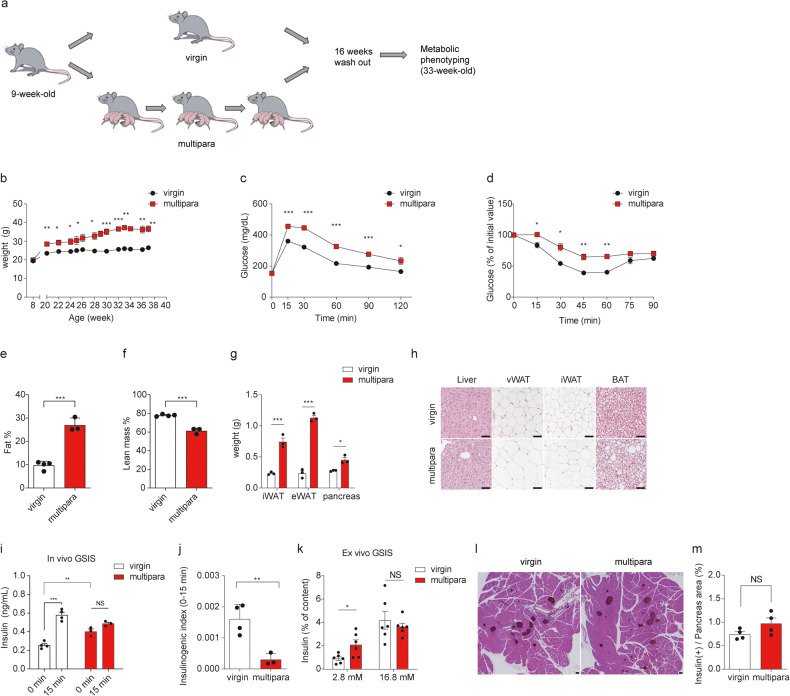
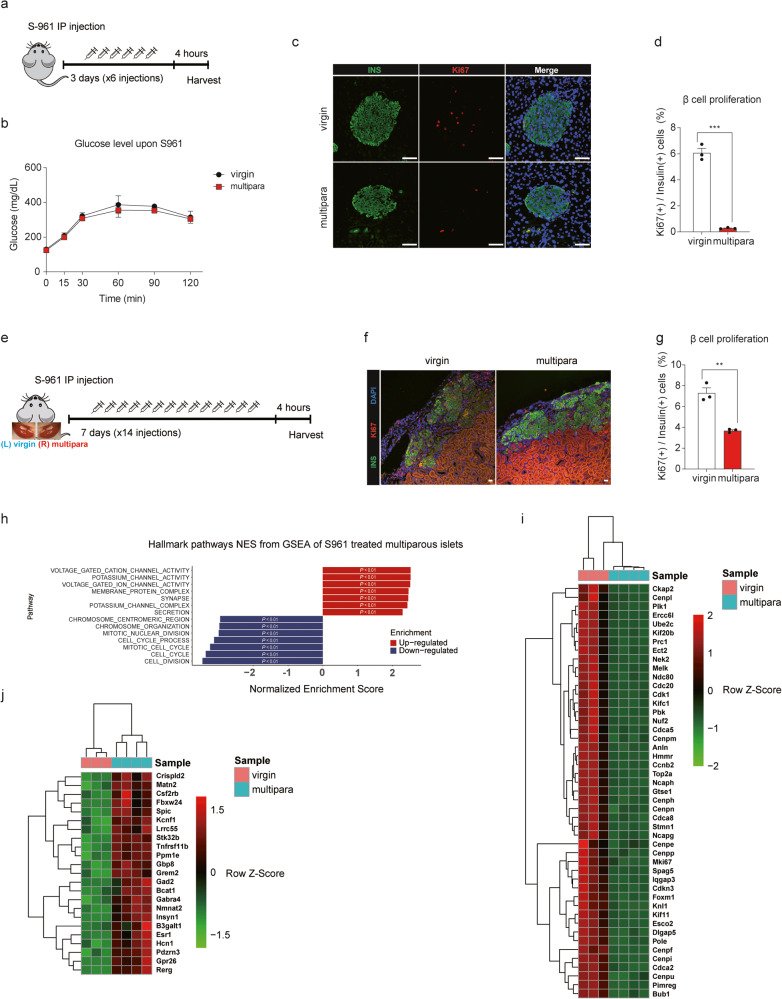
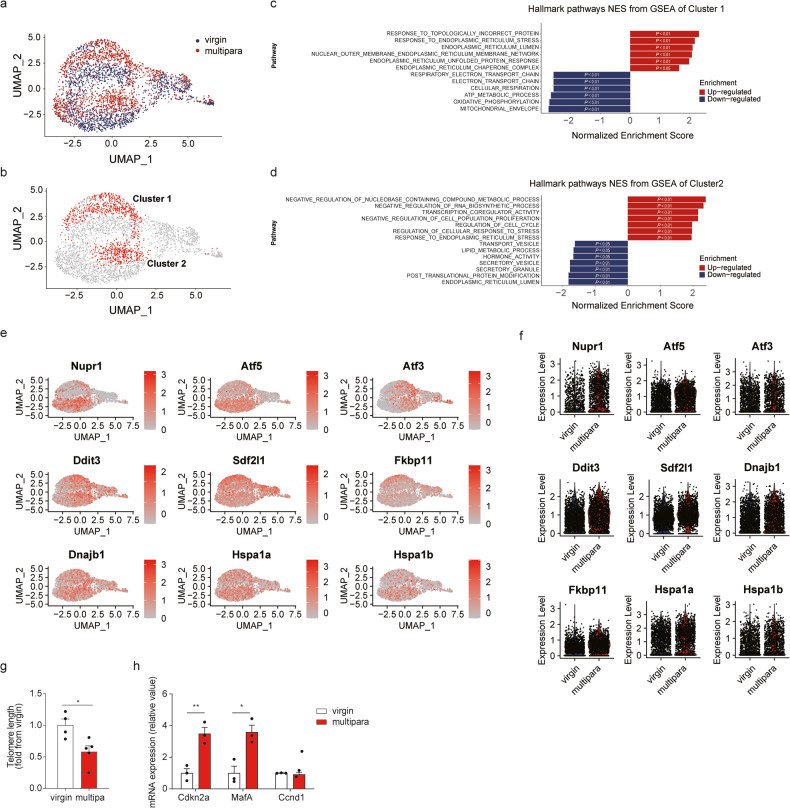
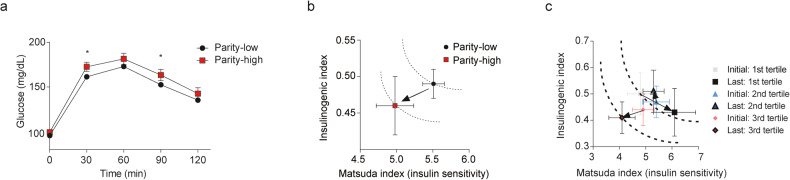
Fig. 1 Multiparity improves glucose tolerance by increasing β cell mass. a Schematic depicting the mouse model for multiple pregnancy. Age-matched female C57BL/6 J mice were randomly assigned to the virgin or multipara groups and mated to give birth three times consecutively. Metabolic phenotypes were evaluated at 3 weeks after the last delivery. b Gross images of virgin and multiparous mice and their inguinal white adipose tissue (iWAT), visceral WAT (vWAT), and brown adipose tissue (BAT) dissected at 3 weeks after the last delivery. c Body weight and d intraperitoneal glucose tolerance test data obtained after an overnight fast (2 g/kg); n = 7 for virgin, n = 10 for multipara. e Intraperitoneal insulin tolerance test after a 6 h fast (0.75 U/kg; n = 3 per group). f, g Glucose infusion rate, whole body glucose turnover, clamp hepatic glucose production, and g glucose uptake from soleus muscle and retroperitoneal adipose tissue were measured by the hyperinsulinemic-euglycemic clamp method in virgin and multiparous mice (n = 4 for virgin and n = 5 for multipara). h Indirect calorimetric analysis of virgin and multiparous mice. Oxygen consumption (VO2), carbon dioxide consumption (VCO2), total activity at the x-axis (XTOT), heat production, and the respiratory exchange ratio (RER) were recorded (n = 4 per group). i Islets were incubated for 15 min with 2.8 or 16.8 mM glucose, and the secreted insulin concentrations were measured with ELISA (n = 3 per group). j Plasma insulin concentrations were measured after intraperitoneal glucose injection (2 g/kg; n = 3 per group). k Representative images of pancreatic islets of virgin and multiparous mice; insulin was immunohistochemically (brown) stained with hematoxylin and eosin counterstaining. Scale bar: 50 μm. l The β cell area was quantified as the percentage of the insulin-positive area relative to the area of the entire pancreas. k, ln = 3 per group. (Data are expressed as the mean ± SEM. *P < 0.05, **P < 0.01 and ***P < 0.001, as determined by Student’s t test (c–g, l) or one-way ANOVA with Tukey’s post hoc test (i, j).Fig. 2 Multiparous β cells fail to compensate for insulin resistance. a Schematic depicting the mouse model for repeated pregnancy, evaluated at 16 weeks after the last delivery (34 weeks of age). b Body weight changes in virgin and multiparous mice. c Intraperitoneal glucose tolerance test after an overnight fast (2 g/kg). d Intraperitoneal insulin tolerance test after a 6 h fast (0.75 U/kg). b–dn = 4 per group). e Fat and f lean mass proportions in virgin and multiparous mice (n = 4 for virgin, n = 3 for multipara). g Weights of the indicated tissues (n = 3 per group). h Representative images of liver, vWAT, iWAT, and BAT (n = 3 per group, scale bar: 50 μm). i Plasma insulin concentrations and j the insulinogenic index were measured after intraperitoneal glucose injection (2 g/kg; n = 4 per group). k Islets were incubated for 15 min with 2.8 or 16.8 mM glucose, and the secreted insulin concentrations were measured with ELISA (n = 6 per group). m Representative images of pancreatic islets of virgin and multiparous mice; insulin was immunohistochemically detected (brown) with hematoxylin and eosin counterstaining. Scale bar: 50 μm. l The β cell area was quantified as the percentage of the insulin-positive area relative to the area of the entire pancreas. l, mn = 4 per group. Data are expressed as the mean ± SEM. NS not significant. *P < 0.05, as determined by Student’s t test (b–g, j, m) or one-way ANOVA with Tukey’s post hoc test (i, k).Fig. 3 Multiparity impairs the proliferative capacity of β cells. a Schematic depicting S-961 (insulin receptor antagonist) administration to test the replicative capacity of β cells in virgin and multiparous mice. b Glucose concentrations after S-961 administration in virgin and multiparous mice. c Representative images of Ki67 (red) and insulin (green) immunofluorescence in pancreas sections after S-961 administration (scale bar: 50 μm). d The β cell proliferation rate was calculated as the percentage of insulin and Ki-67 copositive cells relative to all insulin-positive cells. b–dn = 3 mice per group. (e-g) Size-matched islets from virgin and multiparous mice were transplanted into the left and right renal capsules, respectively, of C57BL/6 J mice, which were then injected intraperitoneally with S-961. e Schematic depicting the administration of S-961 to mice transplanted with islets from virgin and multiparous mice into the left and right renal capsules, respectively. f Representative images of Ki67 (red) and insulin (green) immunofluorescence in kidney sections after S-961 administration (scale bar: 100 μm). g The β cell proliferation rate as the percentage of insulin and Ki-67 copositive cells relative to all insulin-positive cells. f, gn = 3 per group. (h-j) RNA sequencing of islets obtained from virgin (n = 3) and multiparous (n = 4) mice subjected to intraperitoneal injection of S-961. h Gene set enrichment analysis of virgin and multiparous islets. i Downregulated and j upregulated genes of multiparous islets compared to virgin islets. i, j Z Scores of DESeq2 normalized counts are annotated by the color scale. (Data are expressed as the mean ± SEM. *P < 0.05, **P < 0.01 and ***P < 0.001, as determined by Student’s t test).Fig. 4 Multiparity increases cellular stress and accelerates the aging process of β cells. a–f Single-cell RNA sequencing of islets from virgin and multiparous mice (n ≥ 2 per group). a, b Multiparous mouse-specific β cell transcript clusters were annotated as Cluster 1 and Cluster 2 (Supplementary Fig. 2). c, d Pathways of genes enriched in c Cluster 1 and d Cluster 2 were analyzed using gene set enrichment analysis. e, f Stress-related genes visualized using UMAP (e) and a violin plot (f). g Telomere length was measured in islets from virgin (n = 4) and multiparous (n = 5) mice. h mRNA expression levels in islets from virgin and multiparous mice were assessed by qRT‒PCR (n = 3 per group). (Data are expressed as the mean ± SEM. *P < 0.05, **P < 0.01 and ***P < 0.001, as determined by Student’s t test).Fig. 5 Women who have experienced multiple pregnancies have a higher risk of diabetes. Women who had one to three pregnancies were categorized as the parity-low group (n = 376), and those with four or more were categorized as the parity-high group (n = 79). a Results of the 75 g oral glucose tolerance test at 2 months postpartum. b Hyperbolic curve of the insulinogenic index and Matsuda index (insulin sensitivity) at 2 months postpartum. c Hyperbolic curve of parity-high women who were followed up for a median of 4.0 years after delivery (n = 77), classified into tertiles based on their change in body mass index from the initial follow-up (postpartum 2 months) to the last follow-up. (Data are expressed as the mean ± SEM. *P < 0.05, as determined by Student’s t test).