Cancer Research Institute, Seoul National University College of Medicine, Seoul, Korea.
Integrated Major in Innovative Medical Science, Seoul National University College of Medicine, Seoul, Korea.
Department of Internal Medicine, Seoul National University Hospital, Seoul, Korea.
Abstract
PURPOSE Up to 20% of patients with biliary tract cancer (BTC) have alterations in DNA damage response (DDR) genes, including homologous recombination (HR) genes. Therefore, the DDR pathway could be a promising target for new drug development in BTC. We aim to investigate the anti-tumor effects using poly(ADP-ribose) polymerase (PARP) and WEE1 inhibitors in BTC.
MATERIALS AND METHODS We used 10 BTC cell lines to evaluate an anti-tumor effect of olaparib (a PARP inhibitor) and AZD1775 (a WEE1 inhibitor) in in vitro. Additionally, we established SNU869 xenograft model for in vivo experiments.
RESULTS In this study, we observed a modest anti-proliferative effect of olaparib. DNA double-strand break (DSB) and apoptosis were increased by olaparib in BTC cells. However, olaparib-induced DNA DSB was repaired through the HR pathway, and G2 arrest was induced to secure the time for repair. As AZD1775 typically regulates the G2/M checkpoint, we combined olaparib with AZD1775 to abrogate G2 arrest. We observed that AZD1775 downregulated p-CDK1, a G2/M cell cycle checkpoint protein, and induced early mitotic entry. AZD1775 also decreased CtIP and RAD51 expression and disrupted HR repair. In xenograft model, olaparib plus AZD1775 treatment reduced tumor growth more potently than did monotherapy with either drug.
CONCLUSION This is the first study to suggest that olaparib combined with AZD1775 can induce synergistic anti-tumor effects against BTC. Combination therapy that blocks dual PARP and WEE1 has the potential to be further clinically developed for BTC patients.
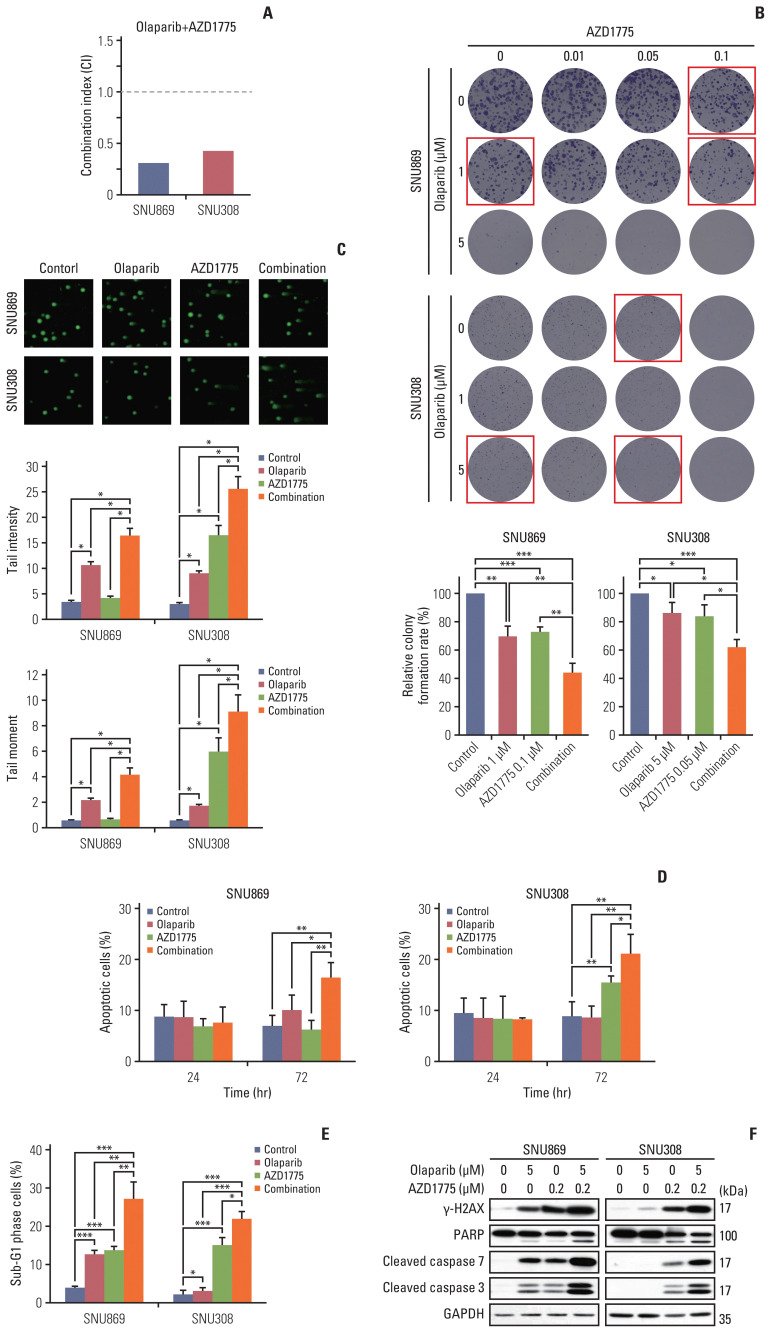
Fig. 1Olaparib-induced DNA damage and simultaneously activated G2/M checkpoint. (A) MTT assay was performed in 10 biliary tract cancer cell lines for 5 days after treatment with olaparib (0, 0.01, 0.1, 1, and 10 μM). The half-maximal inhibitory concentration (IC50) of olaparib was calculated using SigmaPlot. Error bars represent mean±standar deviation (SD). (B) The proteins that indicated the DNA damage and apoptosis were analyzed by western blotting after treatment with olaparib (0, 1, and 10 μM) for 72 hours. (C) Cell cycle stages were determined by flow cytometry after 72-hour treatment with olaparib (0, 1, and 10 μM). Error bars represent mean±SD. *p < 0.05, **p < 0.01, ***p < 0.001. (D) The levels of cell cycle proteins and homologous recombination proteins were assessed by western blotting of cells treated with 0, 1, and 10 μM olaparib for 24 hours.Fig. 2Combination therapy with olaparib and AZD1775 induced more potent DNA damage and apoptosis. (A) Combination effect was investigated by MTT for 5 days before treatment with olaparib (0, 0.01, 0.1, 1, and 10 μM) and AZD1775 (0, 0.001, 0.01, 0.1, and 1 μM), dose ratio was 10:1. CI value was analyzed by CalcuSyn software. If the value is lower than 1 is synergistic, and the cell lines that higher than 1 exhibit an antagonistic effect. (B) Colony-forming analysis was performed with olaparib (0, 1, 5 μM), AZD1775 (0, 0.01, 0.05, 0.1 μM) or both for 10 days. Error bars represent mean±standard deviation (SD) (n=3). (C) Comet analysis was conducted after treatment with olaparib (5 μM), AZD1775 (0.2 μM) or both for 72 hours. The tail intensity and tail moment were analyzed using the Comet assay IV program. The experiment was repeated three times. Data are expressed as mean±standrad error of mean (n=100). (D) Apoptosis analysis was performed using annexin V/propidium iodide (PI) double staining after 24-hour and 72-hour treatment with olaparib (5 μM), AZD1775 (0.1 μM) or both. Error bars represent mean±SD (n=4). (E) Cell cycle analysis were performed with PI-stained BTC cells using flow cytometry after 72-hour treatment with olaparib (5 μM), AZD1775 (0.2 μM) or both. Error bars represent mean±SD (n=3). (F) Western blotting of two cell lines was performed after 72-hour incubation with olaparib, AZD1775, or both. *p < 0.05, **p < 0.01, ***p < 0.001.Fig. 3AZD1775 abrogated G2 phase arrest and induced early mitotic entry. (A) The phospho-histone H3 (p-HH3)-positive population was analyzed by flow cytometry after 6-hour and 24-hour treatment with olaparib (5 μM), AZD1775 (0.1 μM), or both. The experiment was repeated four times. #p < 0.05, ##p < 0.01, in G2/M phase. *p < 0.05, in all cell cycle phases. (B) Cell cycle assay was performed after 6-hour and 24-hour treatment with olaparib (5 μM), AZD1775 (0.1 μM), or both (n=3). Error bars represent mean±standard deviation. *p < 0.05. (C) Western blotting of cell cycle arrest-related signaling proteins was performed in biliary tract cancer cells treated with olaparib (5 μM), AZD1775 (0.2 μM), or both for 24 hours.Fig. 4AZD1775 disrupted homologous recombination (HR) repair and enhanced the effects of olaparib. (A) Immunofluorescence staining of γ-H2AX (red) and RAD51 (green) in SNU869 cells treated with olaparib (5 μM), AZD1775 (0.2 μM), or a combination of olaparib and AZD1775 for 24 hours. Cells with more than five foci were counted; 100 cells were analyzed, with experiments repeated 3 times. A confocal microscope at ×400 magnification was used. Error bars represent mean±standard deviation. *p < 0.05, **p < 0.01, ***p < 0.001. (B) Western blotting was performed after 24-hour treatment to show decrease in HR-related proteins. (C) Cells were transfected with WEE1-specific siRNAs (50 nM) for 6 hours and cells were used for western blotting. (D) After transfected with siWEE1, cells were treated with olaparib 24 hours, and western blotting was conducted. (E) After transfected with siWEE1, we treated olaparib for 72 hours, and then performed western blotting.Fig. 5Combination treatment of olaparib with AZD1775 showed Anti-tumor growth effects in a xenograft mouse model. (A) Vehicle, olaparib (50 mg/kg), AZD1775 (25 mg/kg), or both drugs were administered orally once a day for 4 weeks (5 days on/2 days off) to all groups of SNU869 xenograft mice (n=5 per group). Tumor volumes were measured three times weekly. Data are expressed as mean±standard error of mean (SEM). *p < 0.05. (B) Mouse weights (n=5 per group) were measured three times weekly. Data are expressed as mean±SEM. (C) Western blotting was performed for tumor-specific proteins in each group after tumor isolation. (D) SNU869-xenografted tumors were stained with H&E (×200), Ki67 (×200), terminal deoxynucleotidyl transferase-mediated dUTP nick end labeling (TUNEL; ×200), and p-CDK1 (×400) for immunohistochemical analysis. Scale bars=200 μm (H&E, Ki67, and TUNEL), 60 μm (p-CDK1). Immunohistochemical staining was conducted with identical blocks per group.
그림 출처: PubMed Central 공개 논문 (PMC9016294)
Conflict of interest statement
Conflicts of Interest . Oh DY received a research grant from AstraZeneca and served as a consultant/advisor to AstraZeneca. No conflicts of interest are disclosed by the other authors.
그 밖의 정보
출판 형태
Journal Article
저널
Cancer research and treatment · eISSN 2005-9256
전자 출판
2021-08-06
MeSH
Antineoplastic Agents* / therapeutic use · Apoptosis · Biliary Tract Neoplasms* / drug therapy / genetics / metabolism · Cell Cycle Proteins · Cell Line, Tumor · Cell Proliferation · DNA · Humans · Poly(ADP-ribose) Polymerase Inhibitors / pharmacology / therapeutic use · Protein-Tyrosine Kinases · Xenograft Model Antitumor Assays
Substances
Antineoplastic Agents · Cell Cycle Proteins · Poly(ADP-ribose) Polymerase Inhibitors · DNA · Protein-Tyrosine Kinases · WEE1 protein, human
연구비
Seoul National University Hospital 03-2019-0220 · Seoul National University · National Research Foundation of Korea 2021R1A2C2007430 · Ministry of Science and ICT