
Cancer Res Treat. 2022;54(1):109-117.
Induction Chemotherapy as a Prognostication Index and Guidance for Treatment of Locally Advanced Head and Neck Squamous Cell Carcinoma: The Concept of Chemo-Selection (KCSG HN13-01).
제1저자 이윤규, 강은주 · 교신저자 김범석
소속 (15)
- Department of Internal Medicine, Kangbuk Samsung Hospital, Sungkyunkwan University School of Medicine, Seoul, Korea.
- Department of Internal Medicine, Korea University Guro Hospital, Seoul, Korea.
- Department of Internal Medicine, Seoul National University Hospital, Seoul, Korea.
- Department of Hematology-Oncology, Ajou University Hospital, Suwon, Korea.
- Department of Internal Medicine, SMG-SNU Boramae Medical Center, Seoul, Korea.
- Department of Hemato-Oncology, Keimyung University Dongsan Medical Center, Daegu, Korea.
- Department of Hematology and Oncology, Ewha Womans University Hospital, Seoul, Korea.
- Department of Internal Medicine, Hallym University Sacred Heart Hospital, Anyang, Korea.
- Department of Internal Medicine, Seoul National University Bundang Hospital, Seoul National University College of Medicine, Seongnam, Korea.
- Department of Hematology-Oncology, Yeungnam University Medical Center, Daegu, Korea.
- Department of Internal Medicine, Gachon University Gil Medical Center, Incheon, Korea.
- Department of Internal Medicine, Kosin University Gospel Hospital, Busan, Korea.
- Department of Internal Medicine, Yonsei Cancer Center, Yonsei University College of Medicine, Seoul, Korea.
- Department of Internal Medicine, Asan Medical Center, University of Ulsan College of Medicine, Seoul, Korea.
- Department of Internal Medicine, Chungnam National University Hospital, Daejeon, Korea.
Abstract
PURPOSE Certain patient subgroups who do not respond to induction chemotherapy (IC) show inherent chemoresistance in locally advanced head and neck squamous cell carcinoma (LA-HNSCC). This study aimed to assess the prognostic value of IC, and role of IC in guiding the selection of a definitive locoregional therapy.
MATERIALS AND METHODS Out of the 445 patients in multi-institutional LA-HNSCC cohort, 158 (36%) receiving IC were enrolled. The study outcome was to assess overall survival (OS) through IC responsiveness and its role to select subsequent treatments.
RESULTS Among 135 patients who completed subsequent treatment following IC, 74% responded to IC (complete response in 17% and partial response in 58%). IC-non-responders showed 4.5 times higher risk of mortality than IC-responders (hazard ratio, 4.52; 95% confidence interval, 2.32 to 8.81; p < 0.001). Among IC-responders, 84% subsequently received definitive concurrent chemoradiotherapy (CCRT) and OS was not differed by surgery or CCRT (p=0.960). Regarding IC-non-responders, 54% received CCRT and 46% underwent surgery, and OS was poor in CCRT (24-month survival rate of 38%) or surgery (24-month survival rate of 63%).
CONCLUSION Response to IC is a favorable prognostic factor. For IC-responders, either surgery or CCRT achieved similar survival probabilities. For IC-non-responder, multidisciplinary approach was warranted reflecting patients' preference, morbidity, and prognosis.
Keywords
Induction chemotherapyLocally advanced head and neck squamous cell carcinomaSubsequent treatment
Figures

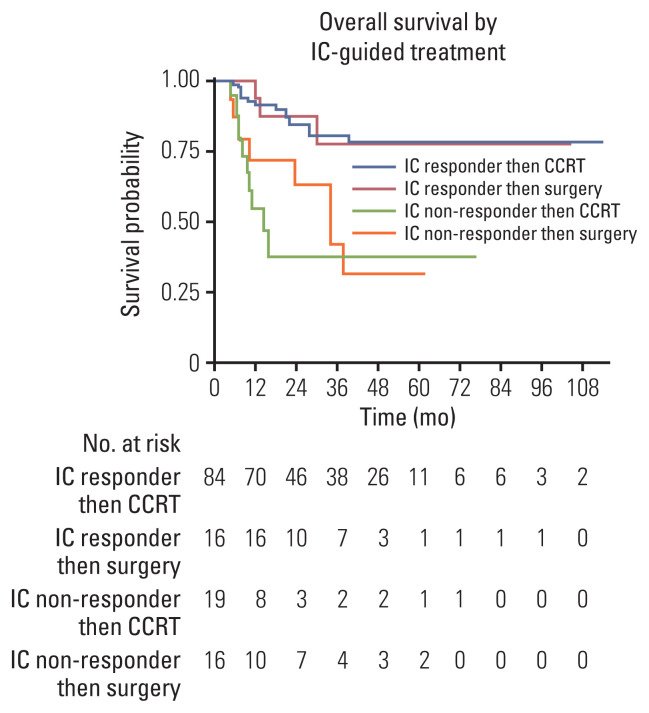
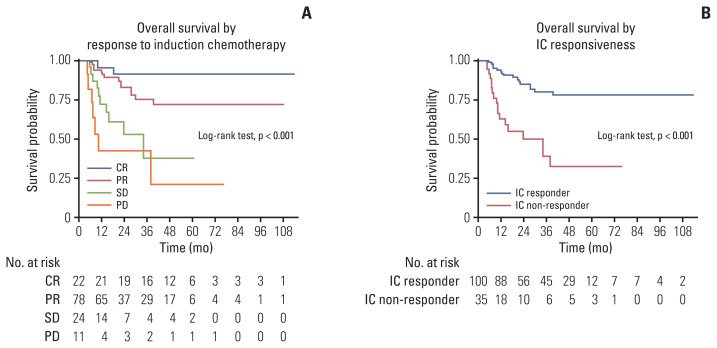
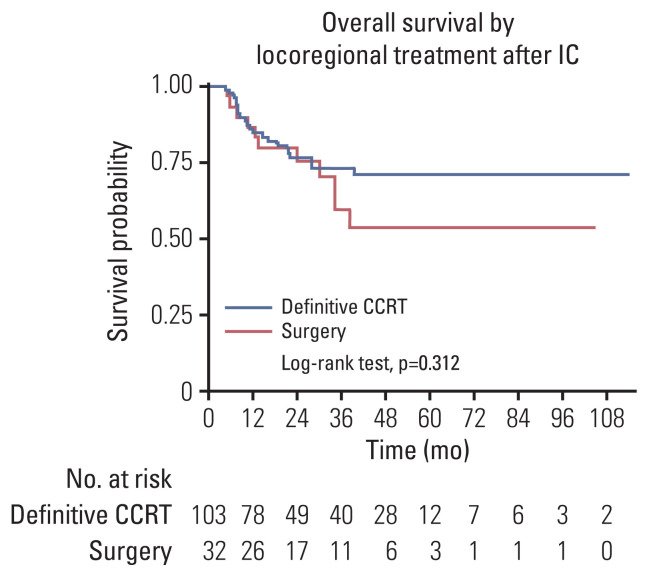
그림 출처: PubMed Central 공개 논문 (PMC8756113)
Conflict of interest statement
Conflicts of Interest . Conflict of interest relevant to this article was not reported.
그 밖의 정보
- 출판 형태
- Journal Article
- 저널
- Cancer research and treatment · eISSN 2005-9256
- 전자 출판
- 2021-04-27
- MeSH
- Adult · Aged · Antineoplastic Combined Chemotherapy Protocols / therapeutic use · Cisplatin / therapeutic use · Docetaxel / therapeutic use · Drug Resistance, Neoplasm · Female · Fluorouracil / therapeutic use · Follow-Up Studies · Head and Neck Neoplasms / drug therapy · Humans · Induction Chemotherapy / methods · Male · Middle Aged · Retrospective Studies · Squamous Cell Carcinoma of Head and Neck / drug therapy
- Substances
- Docetaxel · Cisplatin · Fluorouracil
- 연구비
- Ministry of Health and Welfare HA16C0015 · Korean Cancer Study Group · KCSG data center
- 참고문헌
- 23편