
Medicine (Baltimore). 2015;94(50):e2224.
High Expression of MicroRNA-196a Indicates Poor Prognosis in Resected Pancreatic Neuroendocrine Tumor.
제1저자 이윤석 · 교신저자 황진혁
소속 (1)
- From the Department of Internal Medicine (YSL, HWK, JCL, KHP, JK, JK, JHH); Department of Pathology (HK); Department of Surgery (YSY, HSH), Seoul National University College of Medicine, Seoul National University Bundang Hospital, Seongnam; Department of Internal Medicine, Keimyung University School of Medicine, Dongsan Medical Center, Daegu (YSL); Biostatistics and Clinical Epidemiology Center, Samsung Medical Center (IS); and Samsung Genome Institute, Samsung Medical Center, Seoul; Department of Nanobiomedical Science, Dankook University, Cheonan (JC).
Abstract
There is limited data on miRNA expression in pancreatic neuroendocrine tumors (PanNETs). In this study, we aimed to identify miRNAs that could be potential prognostic biomarkers of PanNETs in patients who underwent curative surgery. For miRNA target screening, 2 primary PanNETs and corresponding liver metastases were screened for miRNA expression by the NanoString nCounter analysis. Candidate miRNAs were selected by ≥2-fold difference of expression between metastatic versus primary tumor. For miRNA target validation, quantitative real-time PCR was performed for candidate miRNAs on 37 PanNETs and matched nonneoplastic pancreata, and the miRNA levels were correlated with the clinicopathological features and patient survival data. Eight miRNAs (miRNA-27b, -122, -142-5p, -196a, -223, -590-5p, -630, and -944) were selected as candidate miRNAs. Only miR-196a level was significantly associated with stage, and mitotic count. When PanNETs were stratified into high (n = 10) and low (n = 27) miRNA-196a expression groups, miRNA-196a-high PanNETs were significantly associated with advanced pathologic T stage (50.0% vs 7.4%), N stage (50.0% vs 3.7%), higher mitotic counts (60.0% vs 3.7%), and higher Ki-67-labeling indices (60.0% vs 22.2%). In addition, high miRNA-196a expression was significantly associated with decreased overall survival (P = 0.046) and disease-free survival (P < 0.001) during a median follow-up of 37.9 months with the hazard ratio for recurrence of 16.267 (95% confidence interval = 1.732-153.789; P = 0.015). MiRNA-196a level may be a promising prognostic marker of recurrence in resected PanNETs, although further experimental investigation would be required.
Figures
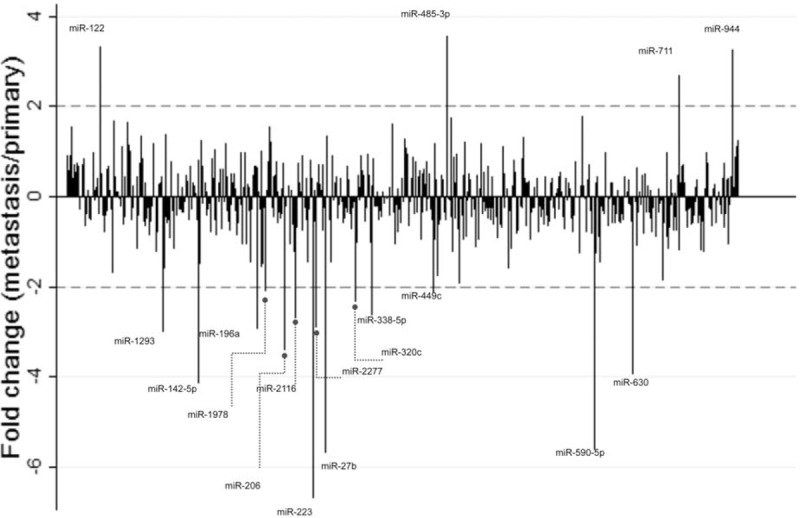
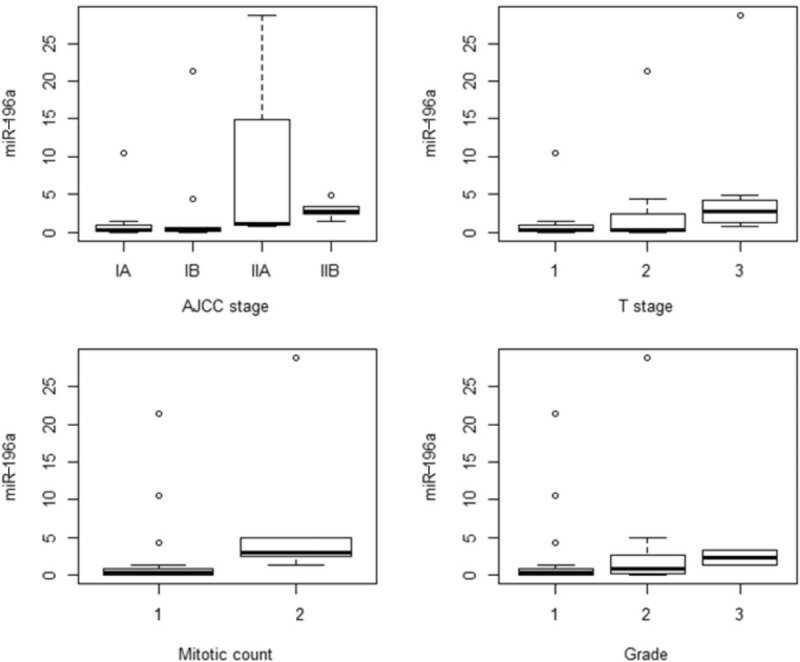
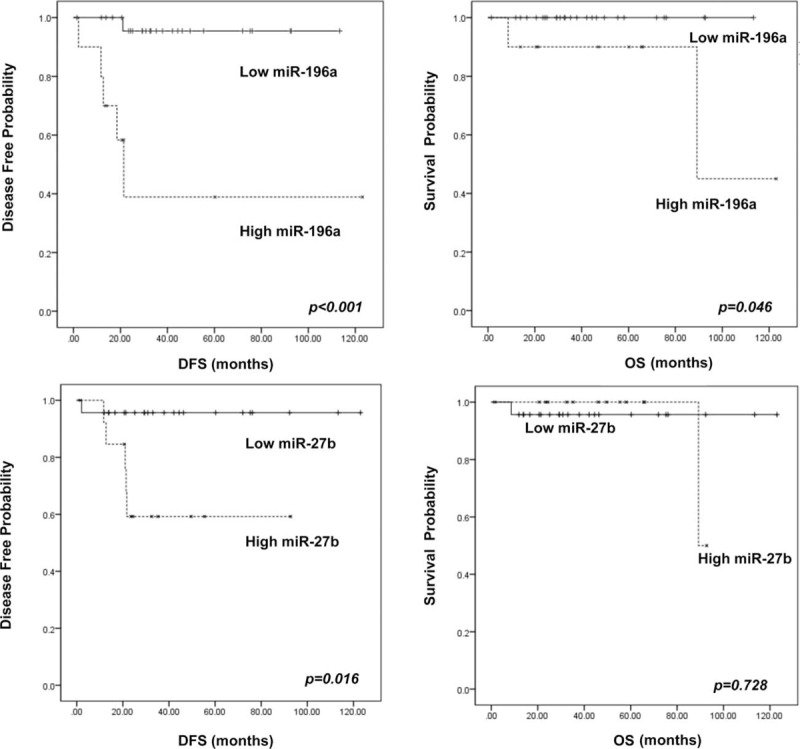
그림 출처: PubMed Central 공개 논문 (PMC5058906)
Conflict of interest statement
The authors have no conflicts of interest to disclose.
그 밖의 정보
- 출판 형태
- Journal Article, Research Support, Non-U.S. Gov't
- 저널
- Medicine · eISSN 1536-5964
- MeSH
- Adult · Aged · Biomarkers / metabolism · Disease-Free Survival · Female · Humans · Male · MicroRNAs / genetics / metabolism · Middle Aged · Neuroendocrine Tumors / metabolism / mortality / pathology / surgery · Pancreatectomy · Pancreatic Neoplasms / metabolism / mortality / pathology / surgery · ROC Curve · Treatment Outcome
- Substances
- Biomarkers · MIRN196 microRNA, human · MicroRNAs
- 참고문헌
- 31편