
Cancer Res Treat. 2019;51(3):1167-1179.
Therapeutic Targeting of the DNA Damage Response Using an ATR Inhibitor in Biliary Tract Cancer.
제1저자 남아롱, 김미화 · 교신저자 오도연
소속 (2)
- Cancer Research Institute, Seoul National University College of Medicine, Seoul, Korea.
- Department of Internal Medicine, Seoul National University Hospital, Seoul, Korea.
Abstract
PURPOSE The DNA damage response (DDR) is a multi-complex network of signaling pathways involved in DNA damage repair, cell cycle checkpoints, and apoptosis. In the case of biliary tract cancer (BTC), the strategy of DDR targeting has not been evaluated, even though many patients have DNA repair pathway alterations. The purpose of this study was to test the DDR-targeting strategy in BTC using an ataxia-telangiectasia and Rad3-related (ATR) inhibitor.
MATERIALS AND METHODS A total of nine human BTC cell lines were used for evaluating anti-tumor effect of AZD6738 (ATR inhibitor) alone or combination with cytotoxic chemotherapeutic agents through MTT assay, colony-forming assays, cell cycle analyses, and comet assays. We established SNU478-mouse model for in vivo experiments to confirm our findings.
RESULTS Among nine human BTC cell lines, SNU478 and SNU869 were the most sensitive to AZD6738, and showed low expression of both ataxia-telangiectasia mutated (ATM) and p53. AZD6738 blocked p-Chk1 and p-glycoprotein and increased γH2AX, a marker of DNA damage, in sensitive cells. AZD6738 significantly increased apoptosis, G2/M arrest and p21, and decreased CDC2. Combinations of AZD6738 and cytotoxic chemotherapeutic agents exerted synergistic effects in colony-forming assays, cell cycle analyses, and comet assays. In our mouse models, AZD6738 monotherapy decreased tumor growth and the combination with cisplatin showed more potent effects on growth inhibition, decreased Ki-67, and increased terminal deoxynucleotidyl transferase-mediated dUTP nick end labeling than monotherapy with each drug.
CONCLUSION In BTC, DDR targeting strategy using ATR inhibitor demonstrated promising antitumor activity alone or in combination with cytotoxic chemotherapeutic agents. This supports further clinical development of DDR targeting strategy in BTC.
Keywords
ATMATR inhibitorBiliary tract neoplasmsDNA damage responsep53
Figures

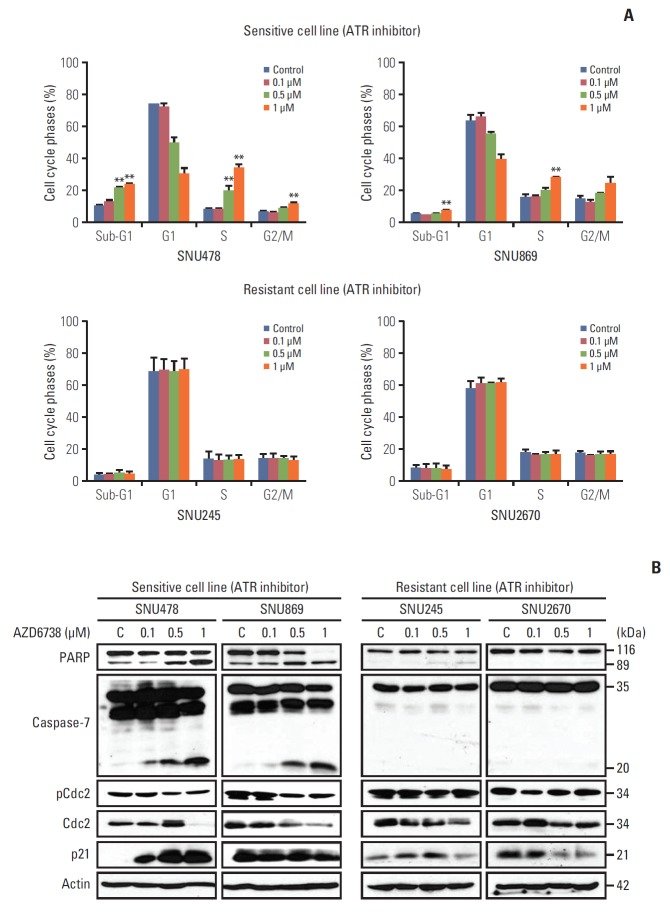
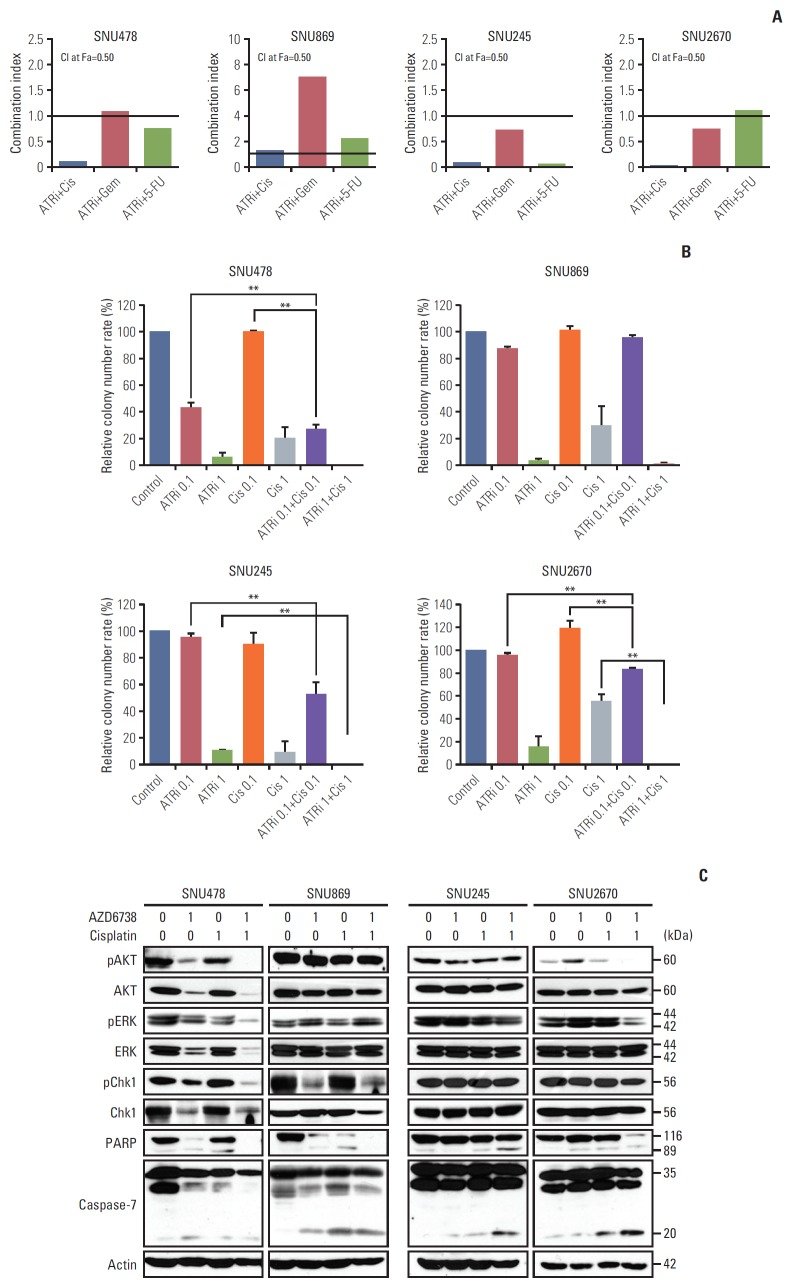
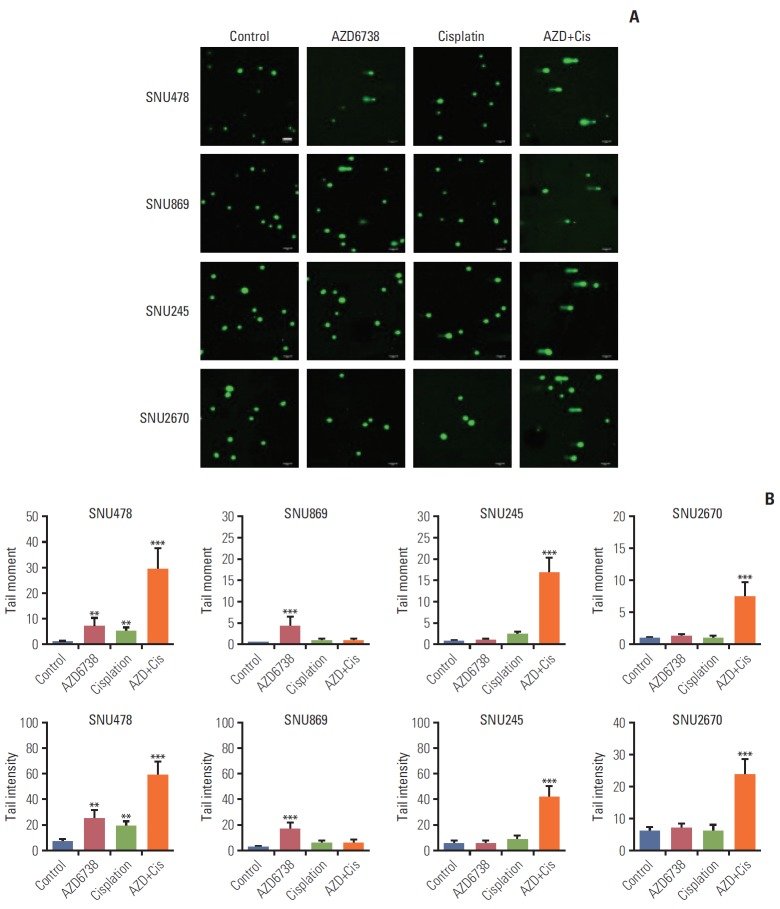
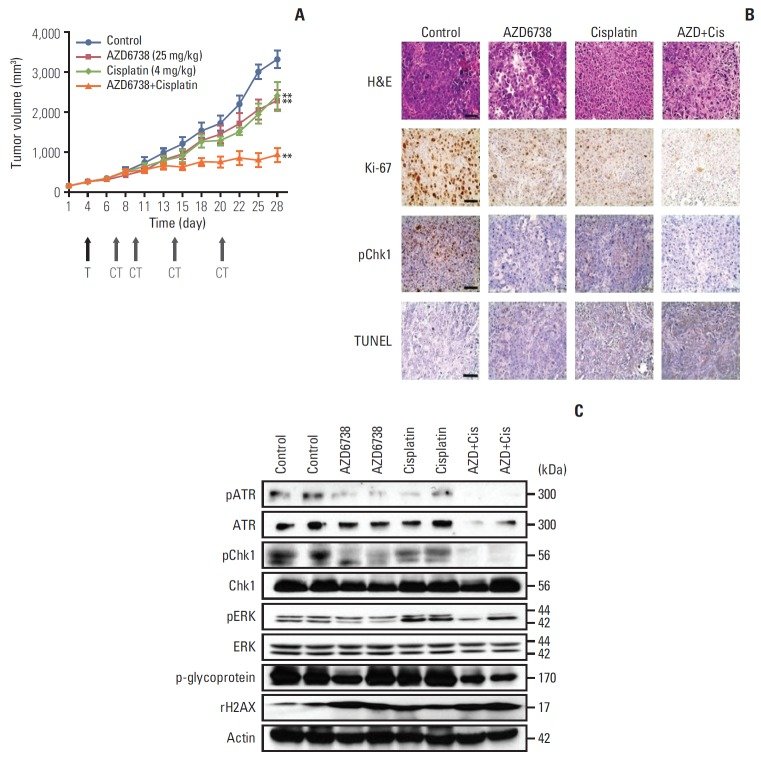
그림 출처: PubMed Central 공개 논문 (PMC6639230)
Conflict of interest statement
D-Y Oh received AstraZeneca-KHIDI (Korea Health Industry Development Institute) Oncology Research Program Grant and Y-J Bang is a consultant/advisory board member of AstraZeneca. No conflicts of interest were disclosed by the other authors.
그 밖의 정보
- 출판 형태
- Journal Article
- 저널
- Cancer research and treatment · eISSN 2005-9256
- 전자 출판
- 2018-12-03
- MeSH
- Animals · Ataxia Telangiectasia Mutated Proteins / antagonists & inhibitors / genetics · Biliary Tract Neoplasms / drug therapy / genetics · Cell Line, Tumor · Cell Proliferation / drug effects · Cell Survival / drug effects · Cisplatin / administration & dosage / pharmacology · DNA Repair · Down-Regulation · Drug Synergism · Female · Gene Expression Regulation, Neoplastic / drug effects · Humans · Indoles · Mice · Morpholines · Pyrimidines / administration & dosage / pharmacology · Sulfonamides · Sulfoxides / administration & dosage / pharmacology · Tumor Suppressor Protein p53 / genetics · Xenograft Model Antitumor Assays
- Substances
- Indoles · Morpholines · Pyrimidines · Sulfonamides · Sulfoxides · Trp53 protein, mouse · Tumor Suppressor Protein p53 · ceralasertib · ATR protein, human · Ataxia Telangiectasia Mutated Proteins · Cisplatin
- 연구비
- Korea Health Industry Development Institute 0620141970 · Seoul National University 800-2016-0312
- 참고문헌
- 30편