
Cancer Res Treat. 2021;53(2):471-479.
Targeting Hypoxia Using Evofosfamide and Companion Hypoxia Imaging of FMISO-PET in Advanced Biliary Tract Cancer.
제1저자 윤지선 · 교신저자 오도연
소속 (3)
- Department of Internal Medicine, Seoul National University Hospital, Seoul National University College of Medicine, Seoul, Korea.
- Department of Nuclear Medicine, Seoul National University Hospital, Seoul National University College of Medicine, Seoul, Korea.
- Cancer Research Institute, Seoul National University College of Medicine, Seoul, Korea.
Abstract
PURPOSE Hypoxia is widely known as one of the mechanisms of chemoresistance and as an environmental condition which triggers invasion and metastasis of cancer. Evofosfamide is a hypoxia-activated prodrug of the cytotoxin bromo-isophosphoramide mustard conjugated with 2-nitroimidazole. Biliary tract cancer (BTC) is known to contain large hypoxic area. This study evaluated the efficacy and safety of evofosfamide as a second-line treatment of advanced BTC.
MATERIALS AND METHODS Patients received evofosfamide at a dose of 340 mg/m2 on days 1, 8, and 15 of every 28-day cycle. Primary end-point was progression-free survival (PFS) rate at 4-months (4m-PFSR). Secondary end-points included overall survival (OS), PFS, disease control rate (DCR), metabolic response by 18F-fluorodeoxyglucose positron emission tomography (PET), hypoxic parameters evaluated by 18F-fluoromisonidazole (FMISO) PET and toxicity.
RESULTS Twenty patients were treated with evofosfamide, with 16 response-evaluable patients. There was no objective response; stable disease was observed in nine patients, with a DCR of 56.25%. 4m-PFSR was 40.6%. Median PFS was 3.60 months (95% confidence interval [CI], 1.68 to 5.52). Median OS was 6.37 months (95% CI, 3.94 to 8.79). Reduction of tumor metabolic activity was observed in eight of 15 patients (53.3%). High baseline hypoxic parameters were associated with poor PFS. Change of hypoxic parameters between pretreatment and post-treatment reflected hypoxic-activated drug response. There was no treatment-related death.
CONCLUSION Evofosfamide as second-line treatment of advanced BTC showed acceptable safety and comparable efficacy to other agents. Changes in volumetric parameters measured with FMISO PET, showing the degree of tumor hypoxia, reflected the response to evofosfamide based on the mode of action.
Keywords
Biliary tract neoplasmsChemotherapyEvofosfamideHypoxiaPhase IITH302
Figures
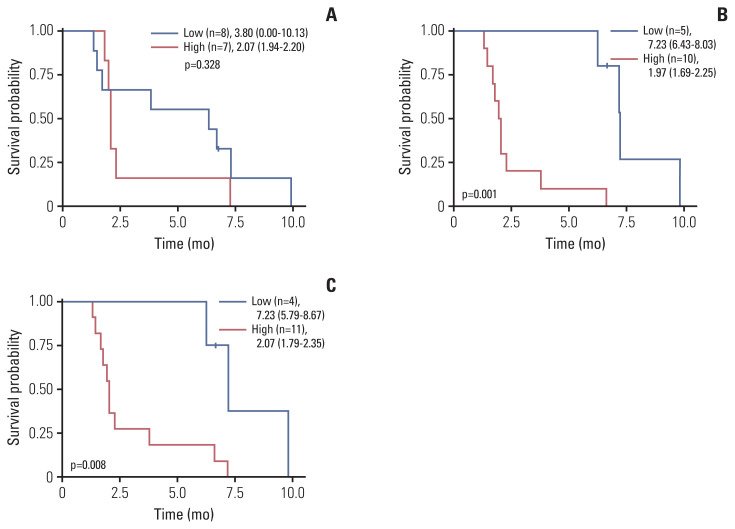
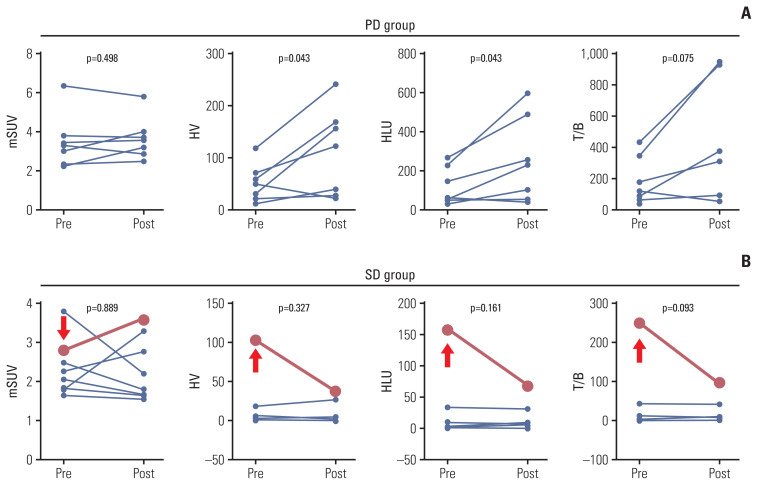
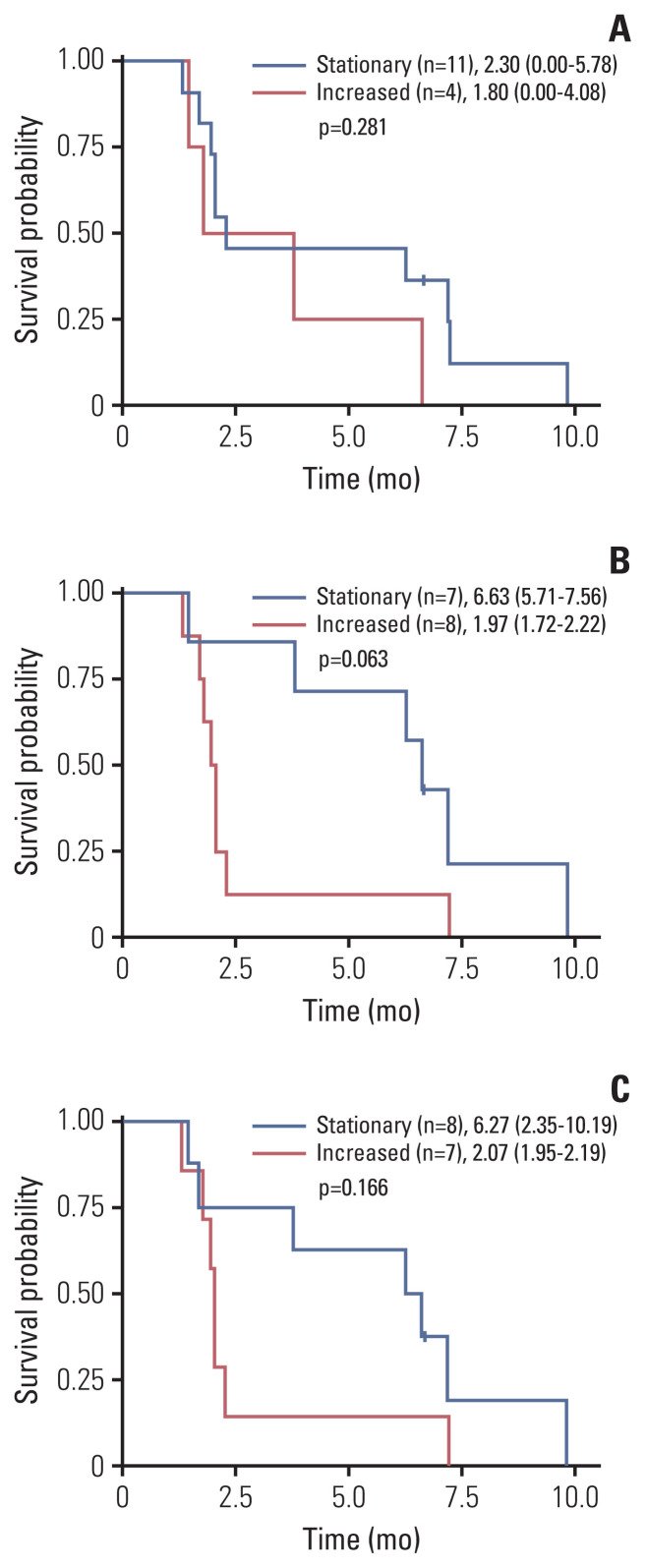
그림 출처: PubMed Central 공개 논문 (PMC8053876)
Conflict of interest statement
Conflicts of Interest. Author DYO: Research grant from AstraZeneca, Novartis, Array, Eli Lilly, Green Cross. Consultant/Advisory board for AstraZeneca, Novartis, Genentech/Roche, Merck Serano, Bayer, Taiho, ASLAN. Author JSY, SYK, KHL and GJC declare that they do not have any conflicts of interest.
그 밖의 정보
- 출판 형태
- Journal Article
- 저널
- Cancer research and treatment · eISSN 2005-9256
- 전자 출판
- 2020-10-22
- MeSH
- Biliary Tract Neoplasms / drug therapy / pathology · Cell Hypoxia / drug effects · Female · Humans · Male · Middle Aged · Misonidazole / analogs & derivatives / pharmacology / therapeutic use · Nitroimidazoles / pharmacology / therapeutic use · Phosphoramide Mustards / pharmacology / therapeutic use · Positron-Emission Tomography / methods · Prospective Studies
- Substances
- Nitroimidazoles · Phosphoramide Mustards · TH 302 · fluoromisonidazole · Misonidazole
- 연구비
- Korea Health Industry Development Institute · Ministry of Health and Welfare HI14C1072 · Ministry of Health and Welfare HI18C1916
- 참고문헌
- 24편